The Strategic Failure of "Analog" Operational Excellence
What is the difference between Analog OpEx and a System of Action?
Analog Operational Excellence relies on manual observation, paper Gemba walks, and subjective shift reports to identify waste
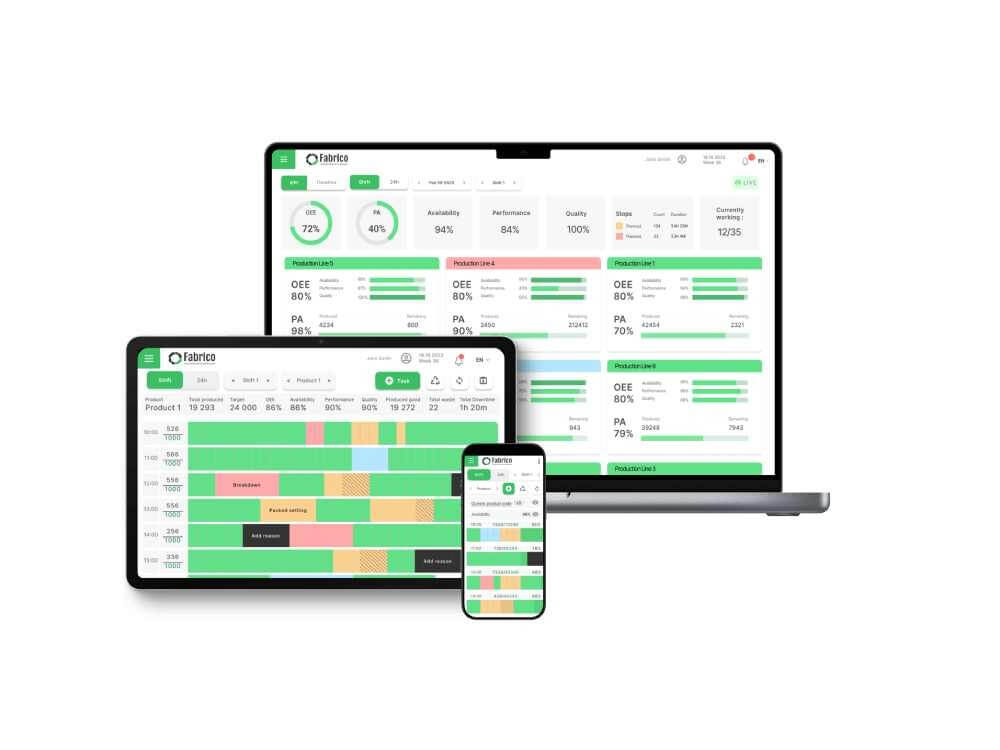
A System of Action (like Fabrico) uses machine-validated OEE and synchronized maintenance execution to identify the "Hidden Factory" in real-time and trigger immediate corrective tasks.
For the CEO and COO, the primary challenge of 2026 is that OpEx initiatives have plateaued.
Most manufacturing groups have spent years on Lean training and Kaizen events, yet margins continue to be eroded by unrecorded downtime.
Robert C. Hansen identifies this as the "Hidden Factory", the 20% of revenue capacity that your current "analog" reporting systems simply cannot see.
Without a unified operational layer, your Continuous Improvement team is fighting symptoms rather than root causes.
Fabrico acts as the System of Action required to bridge the gap between "Strategy" and "Execution," ensuring that OpEx is a machine-validated reality rather than a boardroom wish.
Strategic Performance Matrix: Static OpEx vs. Unified Action
| OpEx Pillar |
Static / Analog Strategy (The Risk) |
Fabrico Unified Action (The Moat) |
| Waste Detection |
Manual Observation (Subjective) |
Real-Time: Native OEE + Computer Vision |
| Root Cause Discovery |
"Five Whys" based on memory |
Visual Evidence: "Zoom-In" video context |
| Maintenance Link |
Siloed (CI doesn't talk to Maintenance) |
Native: Insights trigger prioritized work orders |
| Governance |
Site-by-site "Tribal Knowledge" |
Global: Master PM Standardization |
| Data Integrity |
High risk of "Pencil Whipped" logs |
Machine-Validated: Direct PLC/IoT feeds |
| Labor Priority |
Administrative Reporting |
Maximized "Wrench Time" |
The Fabrico Framework: Turning Improvement into Action
Pillar 1: Reclaiming the "Hidden Factory" through High-Resolution Visibility
The most profitable unit you produce is the one recovered from lost revenue capacity.
In an analog environment, micro-stops and unrecorded speed losses are accepted as "part of the process."
Fabrico’s Native OEE module captures these silent margin killers by connecting directly to the PLC.
By identifying every second of performance loss, the system removes the "Information Asymmetry" between the shop floor and leadership.
Furthermore, our Computer Vision "Zoom-In" module provides visual evidence for inefficiencies that sensors miss.
Leadership can see the exact cause of a process deviation—whether it is a manual jam, a setup delay, or a material issue.
This turns the "Hidden Factory" into a visible, solvable set of improvement tasks.
Pillar 2: Balancing the "Value Fulcrum" with Condition-Directed Maintenance
World-class Operational Excellence requires a perfect balance between maintenance intensity and effective runtime.
Hansen calls this the Value Fulcrum.
Fragmented systems treat maintenance as a "Cost Center" to be minimized, leading to reactive firefighting.
Fabrico transforms maintenance into a "Revenue Engine" by linking OEE performance directly to the CMMS.
Maintenance moves from being calendar-based to being Condition-Directed (CD).
This ensures that your skilled labor and MRO capital are only deployed where they directly protect revenue capacity.
It prevents the "Maintenance Debt" that eventually results in catastrophic downtime and brand risk.
Pillar 3: Liquidating "Tribal Knowledge" via Global Governance
The manufacturing skills gap is a systemic threat to OpEx; when an expert leaves, the "best practice" often leaves with them.
If your OpEx program isn't digitized, your governance is fragile and site-dependent.
Fabrico allows you to deploy Master PM Templates across your entire global portfolio.
This ensures that a plant in Mexico and a plant in Germany are performing the same "Golden Batch" maintenance recipes.
By turning "Tribal Knowledge" into a digital enterprise asset, you protect your Value Fulcrum against labor turnover.
Standardization is the only way to ensure that Operational Excellence is scalable and predictable across every timezone.
The Business Case for Unified Data Integrity
For the CFO and Quality Director, OpEx is a tool for risk management.
Fragmented systems rely on manual logs that are frequently "pencil whipped"—data entered after the fact to satisfy a checklist.
Fabrico provide Machine-Validated Traceability for every changeover, safety round, and repair.
Every task is time-stamped and linked to a secure User ID and asset QR Code.
This ensures you are "Audit-Ready 365," moving from a reactive compliance crisis to a proactive governance model.
It provides the C-Suite with the factual foundation required for "Repair vs. Replace" decisions and long-term capital allocation.
The Future Roadmap: AI-Driven Self-Optimizing Excellence
Strategic leaders are building for a future where Operational Excellence is an automated, self-stabilizing process.
However, AI agents cannot optimize a factory that is currently running on unstructured or fragmented data.
On our future roadmap, we are developing the "Fabrico Agent" for automated schedule refinement based on live asset health.
We are also working on the "Fabrico Assistant," a GenAI advisor that provides technicians and operators with instant, expert guidance derived from your proprietary data history.
Consolidating on Fabrico now ensures that your organization owns the high-resolution dataset required to activate these modules.
You are moving from "reporting on excellence" to "automating it."


 Login
Login
 Blog
Blog