Many operations directors celebrate when their factory achieves an eighty percent OEE score.
They present these metrics to the boardroom as proof of operational excellence.
However, at the end of the quarter, the financial ledgers show that the factory is still missing its revenue targets.
This mathematical paradox occurs because leadership teams confuse scheduled efficiency with total operational capacity.
A machine running perfectly for only four hours a day is a massive waste of capital expenditure.
Here is the strategic 2026 guide to understanding Overall Operations Effectiveness.
We will explore why you must unite your production planners and maintenance technicians to unlock the hidden capacity of your factory.
What is Overall Operations Effectiveness?
Overall Operations Effectiveness (OOE) is a manufacturing metric that measures machine availability against the total potential operating time. Unlike OEE, which only measures scheduled production time, OOE includes unscheduled time, planned maintenance, and offline shifts. It provides a holistic view of how well a factory utilizes its total available equipment capacity.
The Difference Between OEE, OOE, and TEEP
Understanding the hierarchy of manufacturing metrics is critical for accurate capacity planning.
Overall Equipment Effectiveness (OEE) measures how efficiently a machine runs during its scheduled production shift.
Overall Operations Effectiveness (OOE) measures that same efficiency against total operating time, including scheduled maintenance and breaks.
Total Effective Equipment Performance (TEEP) measures efficiency against a true 24/7 calendar, assuming the factory never closes.
If your OEE is ninety percent but your OOE is forty percent, your equipment is highly efficient but heavily underutilized.
This massive gap indicates a severe flaw in your production scheduling and maintenance planning.
The Latency Tax of Disconnected Scheduling
A low OOE score is almost always caused by departmental silos.
Production managers want to run the equipment constantly to hit their output quotas.
Maintenance planners want to take the equipment offline frequently to perform preventive servicing.
When these two departments use disconnected software systems, they engage in constant reactive firefighting.
A planner might schedule a critical motor rebuild during a high priority production run.
This forces the production team to halt the line unexpectedly, destroying the operational effectiveness of the shift.
This friction creates a latency tax that artificially inflates your downtime and damages your yield integrity.
Uniting the Factory with an Interactive Planning Board
To maximize your Overall Operations Effectiveness, your schedules must exist in a single, unified ecosystem.
You cannot maximize capacity if your logistics team is guessing at machine availability.
Our unified manufacturing platform solves this disconnect by deploying an Interactive Planning Board.
This advanced drag and drop scheduling tool merges your production queue with your maintenance backlog.
If a technician generates an urgent work order, the Interactive Planning Board flags the conflict instantly.
It automatically adjusts the upcoming production runs around the required maintenance window.
Your leadership team never has to overpromise on supply chain deliverables because the schedule reflects absolute reality.
Establishing Truth with Native OEE
You cannot improve your OOE if your baseline data relies on manual spreadsheets.
Operators who are pressured to hit quotas will inevitably forget to log minor delays and shift changes.
Native OEE tracking completely eliminates this human subjectivity.
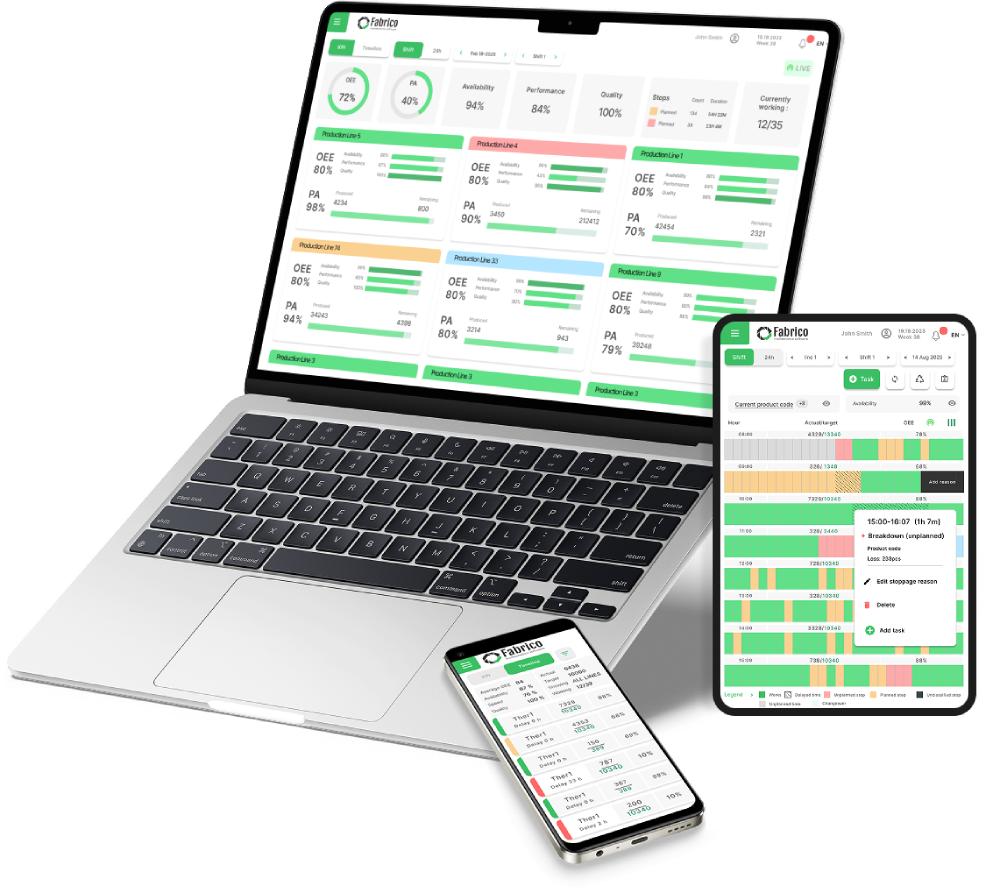
By connecting directly to your machine logic controllers, the system monitors Availability, Performance, and Quality automatically.
It stops the clock the exact second a machine goes offline, whether for an unplanned failure or a scheduled break.
This machine validated truth provides your engineering team with flawless data for capacity planning.
Visual Diagnostics via Computer Vision
Sensors are highly effective at registering when an asset transitions from running to idle.
Unfortunately, standard sensors cannot explain the human variables that delay a machine from restarting.
A prolonged stoppage during a shift change might be a mechanical issue, or it might result from operators returning late from a break.
Leading factories solve this diagnostic mystery by demanding Computer Vision capabilities.
Industrial cameras mounted above the production lines act as an objective digital witness.
When an idle event extends past its scheduled duration, engineers use the Inefficiencies Zoom In feature to watch a video replay.
You gain absolute visual proof of the operational delay, allowing you to refine your management processes instantly.
Executing Maintenance with a Field Ready CMMS
Protecting your operational capacity requires executing maintenance flawlessly the first time.
If a preventive task takes three hours instead of one, your OOE score plummets.
A Field Ready CMMS allows technicians to receive prioritized work orders directly on their smartphones.
They simply scan an asset QR code to instantly access digital standard operating procedures and spare parts lists.
By forcing mandatory photo uploads on Digital CILs, you guarantee the work was completed to your exact standards.
This strict compliance prevents recurring breakdowns from continually disrupting your master production schedule.

The Autonomous Planning Roadmap
The next generation of factory scheduling will be driven entirely by automated artificial intelligence.
We are actively developing advanced capabilities to support your production planners and technicians.
The Fabrico Agent is an artificial intelligence engine currently in beta on our product roadmap.
It will autonomously analyze your historical OEE and OOE data to suggest optimized schedule refinements.
Concurrently, the upcoming Fabrico Assistant will serve as a generative AI troubleshooting guide.
Technicians will be able to query complex equipment manuals using natural language directly from the shop floor.
Securing Your Enterprise Valuation
You cannot achieve world class manufacturing efficiency using disconnected calendars and passive scoreboards.
Your planners require immediate access to the exact performance metrics and maintenance constraints of your factory.
By choosing a unified platform that combines machine validated data with an Interactive Planning Board, you eliminate decision latency.
This integrated strategy maximizes your total operational capacity and transforms your factory into a highly profitable asset.


 Login
Login
 Blog
Blog