In the world of Packaging Manufacturing, speed is everything.
You operate on thin margins and massive volumes. A conveyor running at 300 bottles per minute is profitable. The same conveyor running at 270 bottles per minute is losing money.
Unlike heavy industry where machines break slowly, packaging lines break quickly and frequently.
You face thousands of "Micro-Stops" (jams, sensor errors, glue failures) that fragment your production shift.
To win in this environment, you cannot use a generic "Building Maintenance" strategy.
You need a High-Speed Maintenance Strategy focused on OEE (Overall Equipment Effectiveness).
Here is the 2026 playbook for optimizing packaging lines using digital tools.
Phase 1: The War on Micro-Stops
A packaging line rarely has a catastrophic engine failure. Instead, it dies a death by a thousand cuts.
Operators usually don't log these. They just clear the jam and hit reset. But if this happens 50 times a shift, you have lost an hour of production.
The Strategy: Automated Event Capture.
You cannot rely on manual logs. You must connect your maintenance software to the PLC.
-
The Rule: Log every stop longer than 10 seconds.
-
The Analysis: Use Pareto charts to find the "Top 5 Stop Reasons."
-
The Fix: If "In-feed Jam" is the top reason, dedicate a technician to align the rails. You fix the chronic issue, not just the symptom.
Phase 2: Visualizing High-Speed Failures
When a machine runs at 500 units per minute, the human eye cannot see why a jam happened. Was the cardboard bent? Was the pusher arm late?
By the time you open the door, the evidence is gone.
The Strategy: Video-Assisted Root Cause.
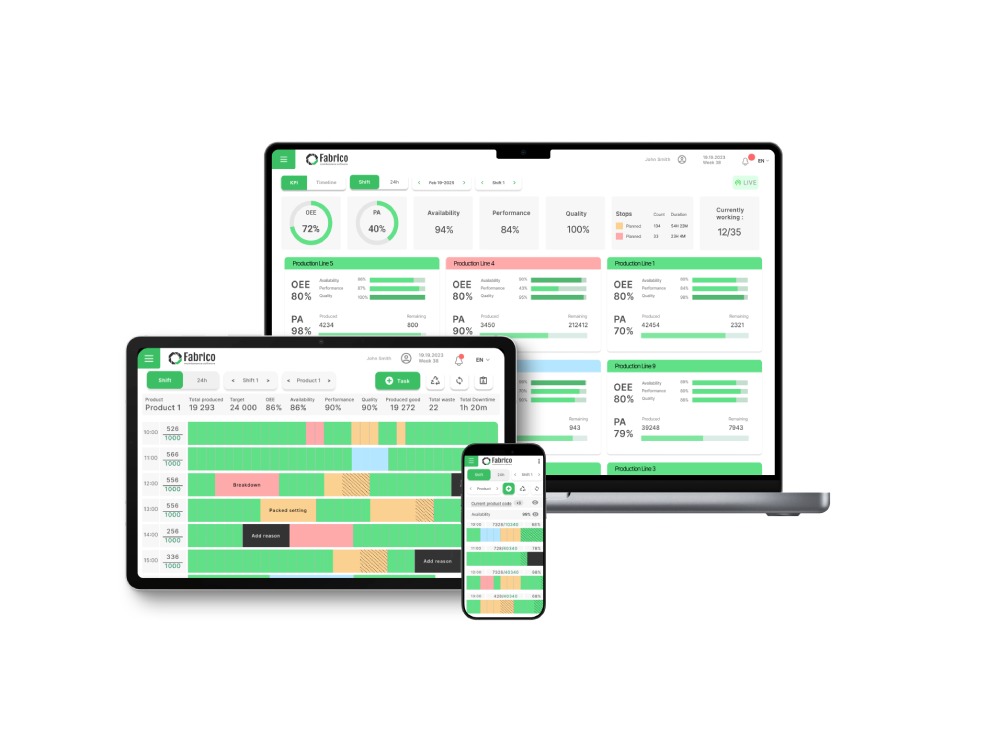
Modern platforms like Fabrico utilize Inefficiencies Zoom-In.
-
The Setup: Cameras overlook critical transfer points (e.g., the filler to the capper).
-
The Value: When the PLC detects a stop, the system saves the video clip. You watch the "Instant Replay" in slow motion.
-
The Result: You see that the gripper is arriving 50 milliseconds late. You adjust the timing. The jam disappears.
Phase 3: The "Vertical Startup" (SMED)
Packaging is no longer about long runs of a single product. It is about frequent changeovers between SKUs.
The danger zone is the "Startup" after a changeover. This is where you produce scrap and lose time tweaking the machine.
The Strategy: Digital Changeover Checklists.
Standardize the setup using a mobile app.
-
Visual Settings: Don't just say "Set rails to width A." Show a photo of the ruler setting.
-
Mandatory Checks: Force the operator to input the "First Piece" quality dimensions into the app before starting the run.
-
The Result: You achieve a "Vertical Startup" (running at full speed immediately), minimizing the ramp-up loss.
Phase 4: Synchronizing Production and Maintenance
In packaging, the machine is the bottleneck. You cannot take it down for maintenance whenever you want.
However, waiting for a breakdown is worse.
The Strategy: Opportunistic Maintenance.
Your software must bridge the gap between the Production Schedule and the Maintenance Backlog.
-
The Opportunity: Production has a planned 45-minute material reload at 2:00 PM.
-
The Action: The system highlights this gap to the Maintenance Planner.
-
The Execution: You slot in a "Lubrication and Inspection" task during that window. You gain reliability without stopping the line for a dedicated PM.
Phase 5: Managing Wear Parts
Packaging machines consume parts. Belts, suction cups, and teflon tapes wear out predictable.
Running out of a specific vacuum cup can stop the whole line.
The Strategy: Consumption-Based Inventory.
Stop guessing. Link your spare parts inventory to the Cycle Count of the machine.
-
Rule: "Vacuum cups last 1 million cycles."
-
Action: When the machine hits 900,000 cycles, the system alerts you to stage the new cups at the machine.
-
Benefit: You replace the part before it fails, but you don't waste money replacing it too early.
Conclusion: Flow is the Goal
In packaging, maintenance is not about fixing broken things. It is about maintaining Flow.
By using software to eliminate micro-stops, visualize jams, and perfect your changeovers, you turn your maintenance team into production partners.
Keep the line moving.
[Request a Demo] and see how Fabrico visualizes packaging line performance.


 Login
Login
 Blog
Blog