Every industrial boardroom wants to talk about artificial intelligence and predictive maintenance.
Operations directors are pressured to purchase expensive IoT sensors and complex software suites.
However, attempting to fast forward to machine learning without mastering your basic data is a catastrophic mistake.
If your technicians are still using paper checklists, your predictive initiatives will fail.
Here is the strategic guide to implementing predictive maintenance in manufacturing for 2026.
We will explore how to build the necessary data foundation to protect your yield integrity and scale your operations.
What is Predictive Maintenance in Manufacturing?
Predictive maintenance in manufacturing is a proactive reliability strategy that uses data analytics to forecast equipment failures. It relies on continuous asset condition monitoring to schedule interventions exactly when needed.
The goal is to maximize effective runtime and completely eliminate unplanned downtime before it occurs.
The Data Prerequisite for Artificial Intelligence
Many software vendors sell the illusion of instant predictive insights.
The reality of the factory floor is much more complicated.
Effective machine learning models require at least twelve months of clean and contextualized data.
If your current software setup is fragmented, your historical data is likely filled with errors and pencil whipping.
An algorithm cannot predict a motor failure if previous downtime events were vaguely logged as general faults.
To achieve true predictive capabilities, you must first consolidate your production and maintenance data into a single source of truth.
Building the Foundation with Condition Directed Tasks
Before you can predict the future, you must understand the present.
Reliability Centered Maintenance principles established by Smith and Hinchcliffe emphasize preserving equipment function.
Their research proves that eighty percent of equipment failures are entirely random and not age related.
Therefore, relying on a calendar to schedule preventive maintenance is strategically flawed.
Modern factories must transition to Condition Directed tasks.
This means triggering maintenance work orders based on actual machine usage, cycle counts, or performance degradation.
By executing maintenance based on real conditions, you create the exact data environment required for future predictive models.
Capturing the Baseline with Native OEE
Your production data is your most valuable diagnostic asset.
A degrading machine will almost always show behavioral symptoms before it suffers a functional failure.
Native OEE tracking captures these symptoms perfectly.
By connecting directly to your logic controllers, the system monitors cycle times and micro stops in real time.
A sudden ten percent drop in packaging speed is a highly accurate leading indicator of mechanical wear.
Standalone reporting dashboards will flag this speed loss but offer no mechanism to fix it.
Unified platforms capture this anomaly and automatically trigger a diagnostic inspection.
Visual Diagnostics via Computer Vision
Sensors report numerical anomalies but they do not provide visual context.
To train accurate predictive models, you must understand exactly why a process deviated from the standard.
Computer Vision provides this critical layer of intelligence.
Cameras positioned above your production lines capture video evidence of every single stoppage.
Engineers use this Inefficiencies Zoom In feature to watch a replay of the exact moment a bottleneck occurs.
This absolute visual proof eliminates guesswork and ensures your master dataset of inefficiencies is perfectly accurate.
Automating the Cure with a Field Ready CMMS
Predicting a failure adds zero value to your profit margin if you cannot execute the repair in time.
When your analytical tools are disconnected from your workforce, you suffer from severe operational latency.
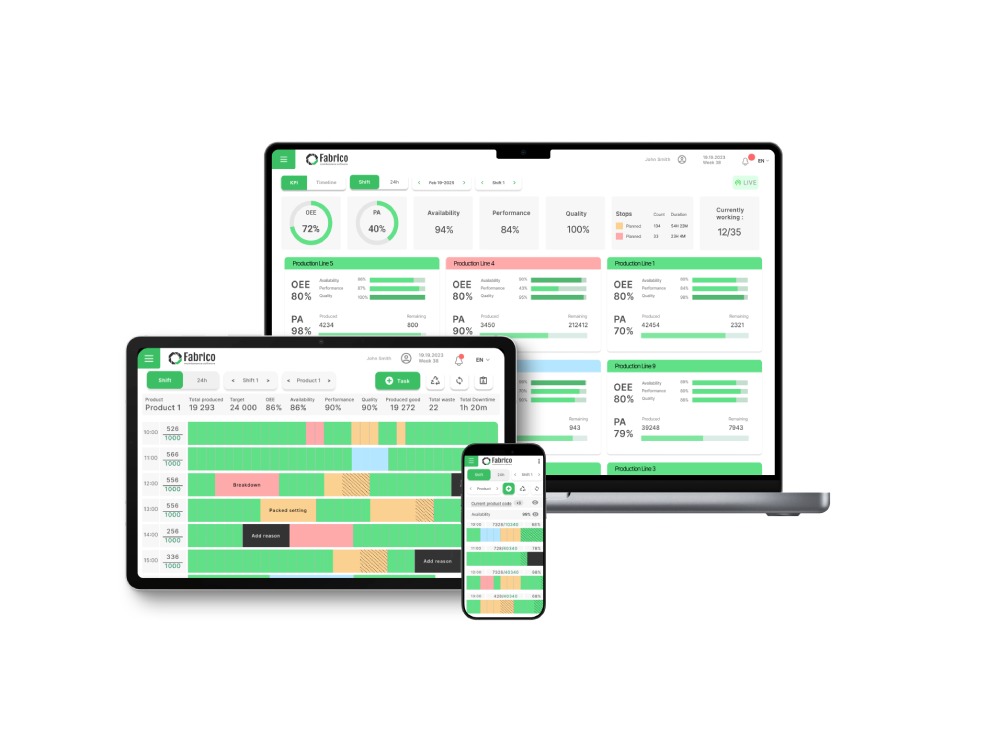
Fabrico eliminates this gap by unifying OEE intelligence with a Field Ready CMMS.
When our system detects a severe performance drop, it instantly generates a prioritized work order.
A mobile alert is dispatched to a technician who can scan a QR code to access digital standard operating procedures.
Simultaneously, the Interactive Planning Board adjusts the production schedule to accommodate the repair window.

Predictive Maintenance Software Comparison Matrix
Choosing the right technology stack dictates the success or failure of your reliability journey.
Investing in disconnected systems will only further isolate your departments.
| Feature Category |
Legacy EAM Systems |
Fabrico Unified Platform |
| Data Architecture |
Fragmented financial focus |
Unified operational master data |
| Early Warning Signs |
Relies on manual operator requests |
Automated via Native OEE tracking |
| Diagnostic Accuracy |
Vague text descriptions |
Computer Vision with video replay |
| Work Execution |
Desktop heavy interfaces |
Field Ready Mobile CMMS |
| Production Alignment |
Blind to shop floor reality |
Interactive Planning Board |
The Fabrico Autonomous Roadmap
We are actively building the next generation of industrial intelligence.
Our predictive models and the Fabrico Agent are currently in beta on our product roadmap.
Once fully deployed, this AI engine will autonomously analyze your clean historical data to forecast optimal maintenance windows.
It will automatically refine your production schedules to maximize available capacity.
Additionally, the upcoming Fabrico Assistant will allow technicians to query equipment manuals using natural language.
By laying the groundwork with unified data today, you guarantee your factory is ready for the autonomous tools of tomorrow.
Protecting Your Operational Liquidity
You cannot buy your way into predictive maintenance with a single software license.
You must build an ecosystem that enforces standard work and captures machine validated truth.
By uniting your OEE diagnostics with mobile work execution, you eliminate decision latency and protect your enterprise valuation.
This disciplined approach ensures your factory remains agile and highly profitable in any economic environment.


 Login
Login
 Blog
Blog