It is a standard Monday morning meeting.
Paula (the Plant Manager) looks at the payroll report and asks: "Why was maintenance overtime at 20% last week?"
Mike (the Maintenance Manager) sighs. "The palletizer went down on Saturday night. Bob had to come in. Then the compressor tripped on Sunday morning. It’s the nature of the beast."
This is the Overtime Trap.
Many organizations accept high overtime as the "cost of doing business" in manufacturing. They view it as a necessary evil to keep the plant running.
But it isn't necessary. And it is arguably the most controllable variable in your operating budget.
High overtime is not a sign of a hardworking team. It is a symptom of a Reactive Maintenance Strategy.
The True Cost of the "Emergency Call-Out"
When a machine breaks after hours, the financial impact goes far beyond the "Time and a Half" hourly rate.
-
The Premium: You are paying 1.5x or 2x the hourly wage.
-
The Minimum: Most union contracts require a "4-Hour Minimum" for call-outs, even if the fix takes 10 minutes.
-
The Efficiency Loss: A technician working alone at 2 AM is slower. The store room is locked. Support is asleep. A 1-hour job becomes a 3-hour ordeal.
-
The "Sleepy" Risk: Fatigue causes mistakes. A tired technician is more likely to install a bearing incorrectly, leading to another breakdown next week.
The Math: A planned bearing replacement might cost
100∗∗inlabor(2hoursstandard).Anemergencyreplacementofthatsamebearingcaneasilycost∗∗100∗∗inlabor(2hoursstandard).Anemergencyreplacementofthatsamebearingcaneasilycost∗∗
600+ in labor (Call-out min + OT + inefficiency).
Breaking the "Hero Complex"
Culturally, factories often praise the "Hero"—the guy who sacrifices his weekend to save the production line.
But every time you need a hero, it means your System Failed.
You rely on heroes when you don't have data. You rely on late-night calls when you don't have early warnings.
To escape the trap, you need to move from Reacting (Firefighting) to Predicting (Fire Prevention).
The Solution: Data-Driven Planning
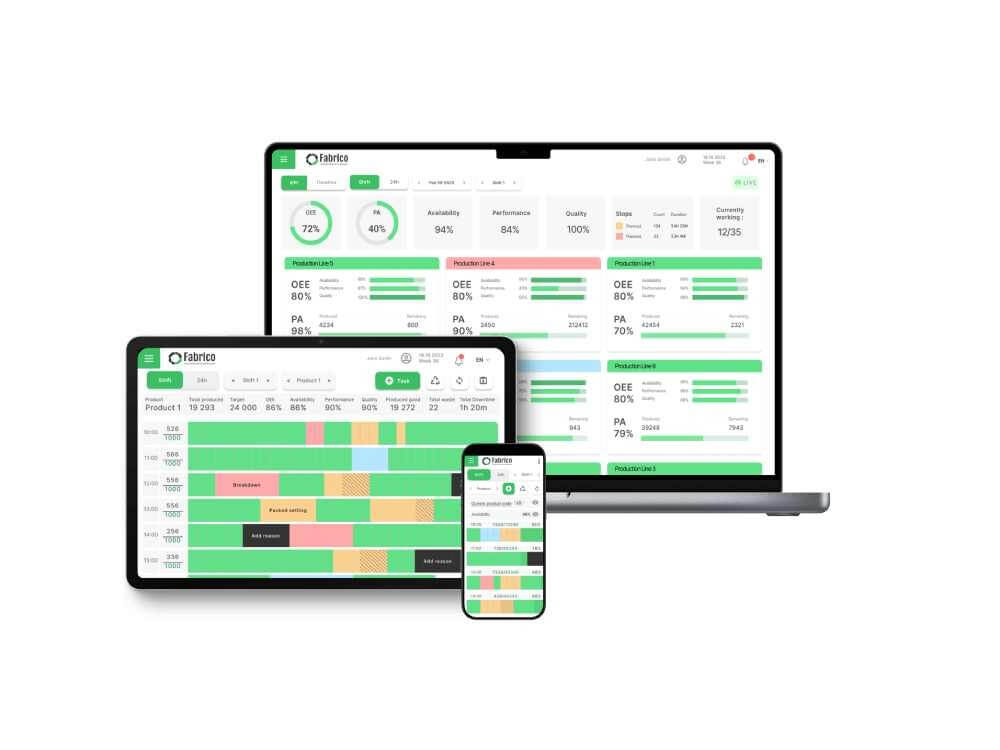
Fabrico helps you kill the overtime bill by moving maintenance activities into standard shift hours.
1. Condition-Based Alerts (Stop the Weekend Surprise)
Instead of waiting for the compressor to trip on Sunday, Fabrico connects to the Temperature Sensor.
-
Thursday: Fabrico alerts you that the compressor temp is trending up.
-
Friday: You schedule the repair during normal hours at straight time.
-
Sunday: The compressor runs smoothly. No call-out.
2. The Interactive Planning Board
Fabrico’s scheduler allows you to visualize your labor capacity.
If you see that Bob is scheduled for 100% capacity on Friday, you know he won't be able to handle an emergency without OT. You can proactively move non-critical PMs to Monday, leveling the load.
3. Remote Triage (The "No-Drive" Diagnosis)
Sometimes, an alarm goes off, but it isn't critical.
With Fabrico Mobile, the on-call technician can check the asset health and error logs from home.
-
Diagnosis: "It's just a warning, it can wait until morning."
-
Result: You saved a 4-hour call-out fee by having data visibility.
Summary: Reliability is Cheaper than Reaction
You cannot budget your way out of the Overtime Trap. You have to plan your way out.
Every dollar you spend on Predictive Software usually saves three dollars in Reactive Labor.
Give your technicians their weekends back. Give your CFO a predictable budget.
Ready to cut the overtime bill?
See how Fabrico uses condition monitoring to move repairs to straight-time hours.
Book a Demo with Fabrico Today


 Login
Login
 Blog
Blog