Every Plant Manager faces the same pressure: "Get more product out the door, but don't spend money on new equipment."
The answer lies in your Manufacturing Cycle Time.
Cycle time is the total time it takes to convert raw materials into a finished product at a specific process step. It is the heartbeat of your factory. When you reduce cycle time, you don't just make things faster; you reduce inventory costs, improve delivery times, and radically increase your margins.
But you cannot simply "turn up the speed dial." Running a machine faster than it can handle only leads to breakdowns and scrap.
To sustainably reduce cycle time, you need a strategy that combines Data (OEE), Action (Maintenance), and Process (Lean).
Here are 7 proven strategies to reduce manufacturing cycle time in 2026.
1. Eliminate "Micro-Stops" with Video Analysis
The biggest killer of cycle time isn't the 2-hour breakdown; it's the 10-second stop.
A sensor trips. A box jams. An operator waits for a label. These "Micro-Stops" often go unrecorded in manual logs because they are too short to write down. But if you have 100 micro-stops a shift, you lose massive amounts of capacity.
The Strategy: Use a system that combines OEE Data with Computer Vision.
-
Capture the Event: When the machine stops for 5 seconds, the camera records it.
-
Zoom In: Replay the video to see why it stopped. Was it a jam? A blocked sensor?
-
Fix the Root Cause: Often, a simple guide rail adjustment can eliminate the stop forever, instantly improving your average cycle time.
Fabrico Insight: Our "Inefficiencies Zoom-In" feature was built for this exact purpose—turning invisible time losses into visible problems you can fix.
2. Attack the Bottleneck (The Theory of Constraints)
You cannot reduce cycle time everywhere at once. You must focus on the Bottleneck.
The bottleneck is the process step with the longest cycle time. It dictates the speed of the entire plant. Improving the speed of a non-bottleneck machine is a waste of resources—it just creates inventory piles.
The Strategy:
-
Identify: Use your OEE dashboard to find the asset with the lowest throughput.
-
Protect: Ensure the bottleneck never stops. Prioritize maintenance on this machine above all others.
-
Elevate: Focus your engineering efforts here. Can you speed up the motor? Can you automate the loading?

3. Implement Condition-Based Maintenance (CBM)
A machine with worn bearings, loose belts, or dirty filters runs slower. Operators often dial back the speed to prevent it from crashing, silently killing your cycle time.
Reactive maintenance (fixing it when it breaks) guarantees instability. Calendar-based maintenance (fixing it every month) is inefficient.
The Strategy: Move to Condition-Based Maintenance.
-
Monitor: Track vibration, temperature, and amps.
-
Trigger: If the main drive amps spike, trigger a work order automatically.
-
Action: Replace the worn part before it forces the operator to slow the machine down.
4. Digitize Standard Operating Procedures (SOPs)
Why does "Shift A" always hit 1000 units, but "Shift B" only hits 850?
The difference is usually Human Variability. One operator knows the "trick" to loading the hopper quickly; the other doesn't. Tribal knowledge creates inconsistent cycle times.
The Strategy: Standardize the best way.
-
Document: Record the best operator performing the task.
-
Digitize: Put that video or step-by-step checklist into a mobile app (like Fabrico).
-
Enforce: Ensure every operator follows the exact same sequence for setup and loading. Precision creates speed.
5. Slash Changeover Time (SMED)
If you produce multiple products, Changeover Time is eating your capacity. Every minute the machine is stopped for a setup is a minute it isn't producing.
The Strategy: Apply SMED (Single-Minute Exchange of Die) principles, supported by digital tools.
-
Internal vs. External: Do as much prep work as possible while the machine is still running (External).
-
Digital Checklists: Give the setup crew a mobile checklist. They shouldn't have to look for tools or settings; it should all be on the screen.
-
Pit Stop Mentality: Treat changeovers like F1 pit stops. Track the time. Analyze where you were slow. Improve.
6. Optimize Material Flow to the Line
A machine cannot cycle if it is waiting for material. "Starving" the line is a logistics failure, not a manufacturing failure.
The Strategy: Integrate your maintenance and logistics.
-
MRO Availability: Ensure spare parts are kitted and ready so maintenance doesn't spend 20 minutes looking for a fuse while the machine sits idle.
-
Andon Calls: Empower operators to signal for material before they run out. A digital "Andon" button on a tablet is faster than walking to the warehouse.
7. Reduce Scrap and Rework
Scrap is the ultimate cycle time killer. If you make a bad part, you have wasted the cycle time to make it, plus the cycle time to make its replacement.
The Strategy: Link Maintenance to Quality.
-
Correlation: Often, a quality drift (e.g., bad seal) is caused by a maintenance drift (e.g., low heater temperature).
-
Proactive Fixes: Use your CMMS to track process parameters. If a heater is fluctuating, fix it before it starts producing scrap.
The Fabrico Framework: Visibility is Velocity
You cannot improve what you cannot see.
Traditional manufacturing runs on "gut feel" and paper logs. This hides the micro-stops, the slow cycles, and the maintenance delays that inflate your cycle time.
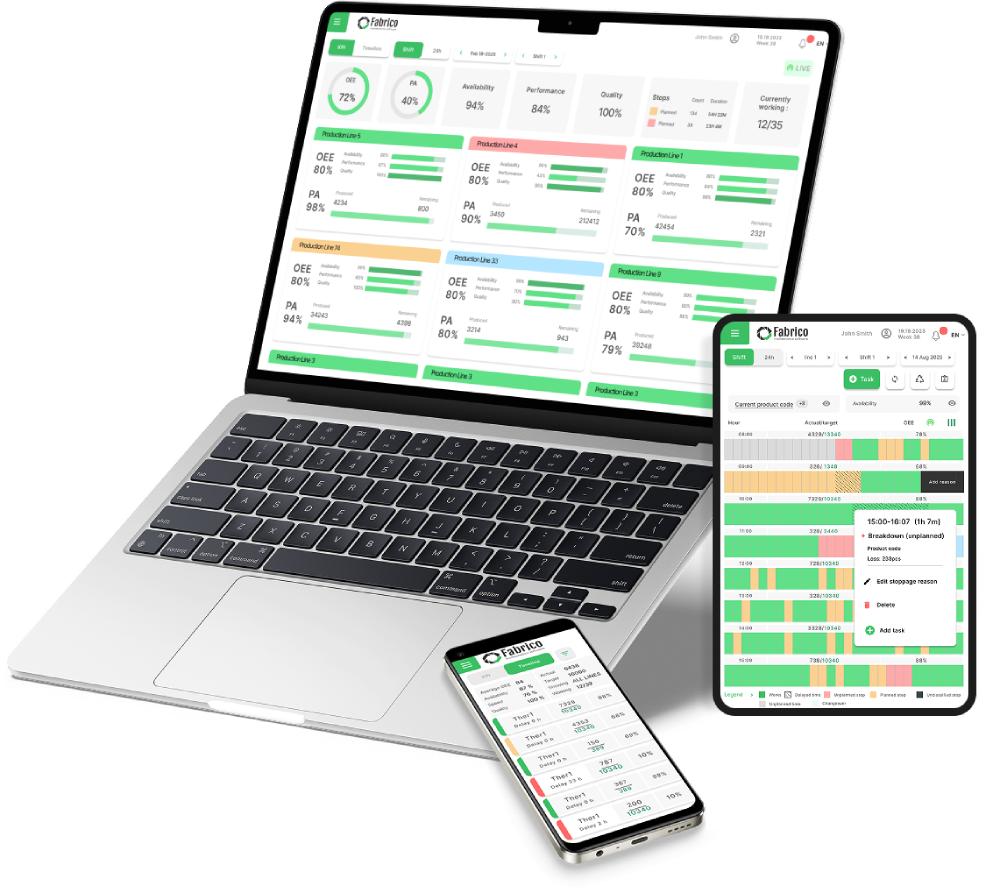
Fabrico bridges the gap between Production (Data) and Maintenance (Action).
-
We visualize your OEE so you see the bottleneck.
-
We zoom in on Inefficiencies so you solve the root cause.
-
We streamline Maintenance so your machines run at full rated speed.
Ready to unlock your factory's hidden capacity?
Stop running slow. [Request a Demo] to see how Fabrico can reduce your cycle time today.


 Login
Login
 Blog
Blog