What is Unrecorded Downtime in Manufacturing?
Unrecorded downtime, often referred to as "ghost losses," represents the brief equipment stoppages and minor speed reductions that occur on the shop floor but are never documented in official production logs.
Because these interruptions typically last less than two minutes, operators routinely resolve them without notifying the maintenance department or logging a formal fault code.
When aggregated across a massive manufacturing facility over an entire year, these undocumented micro-stops severely inflate your perceived machine availability and destroy your true Operational Equipment Effectiveness (OEE).
The Fiduciary Danger of "Ghost Losses"
Most manufacturing executives operate under the dangerous assumption that their OEE scores accurately reflect the physical reality of their production lines.
When plant leadership relies on paper-based shift logs or legacy ERP data, they are exclusively looking at catastrophic breakdowns that lasted long enough for an operator to document them.
This analog reporting creates a massive fiduciary blind spot for the boardroom.
If a high-speed bottling line experiences forty distinct 30-second jams during a single shift, the operator will simply clear the jams and keep the line moving.
It is physically impossible to expect an operator to pick up a clipboard forty times to document these chaotic, split-second interruptions.
Because these chronic defect cycles go completely unrecorded, management continues to authorize overtime pay instead of engineering a permanent mechanical solution for the specific machine causing the bottleneck.
Automating Fault Logging with Native OEE
To completely eradicate ghost losses, strategic leaders must remove human data entry from the downtime tracking process entirely.
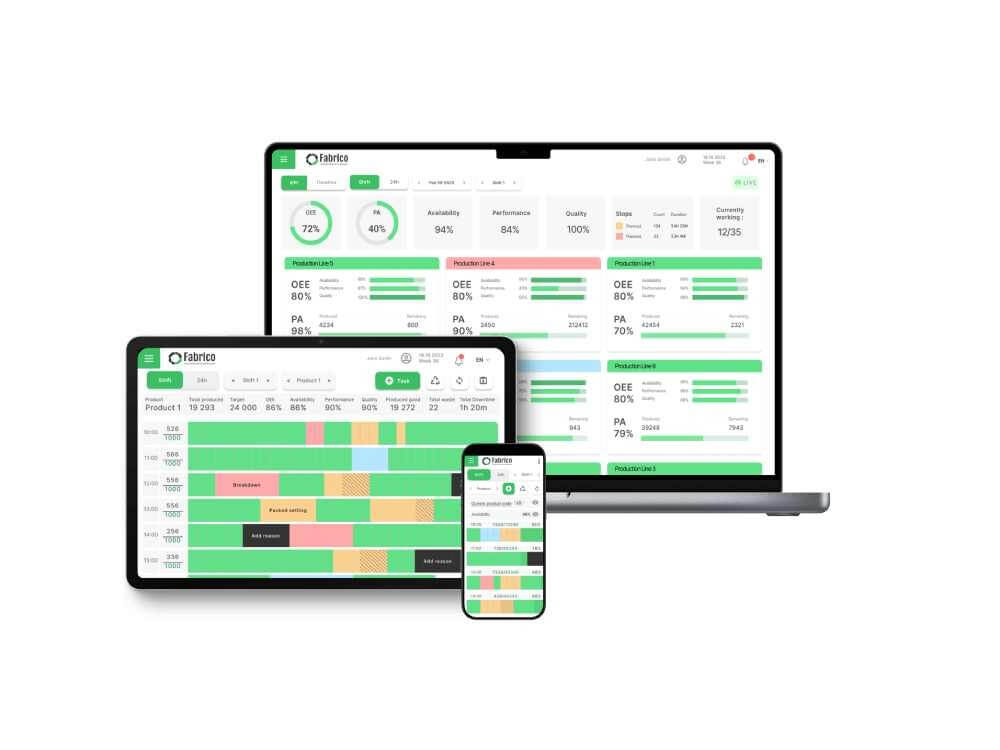
Fabrico achieves this operational clarity by unifying native OEE tracking directly within its core Computerized Maintenance Management System (CMMS) architecture.
The system continuously captures real-time signals from your PLCs, monitoring exact cycle counts, throughput variance, and immediate machine stoppages with absolute mathematical precision.
When an asset experiences even a ten-second interruption, the system automatically logs the exact timestamp and duration of the event.
This automated data acquisition ensures that your reliability engineering team has 100% visibility into the true performance baseline of your entire factory.
By exposing the hidden factory, organizations can instantly redirect their highly skilled maintenance bandwidth toward the assets that are bleeding the most cash.
Exposing Silent Failures with Computer Vision
Capturing the exact duration of an unrecorded stoppage is critical, but raw PLC data cannot always explain the physical cause of the disruption.
A machine might register a twenty-second pause because of a mechanical slip, but it could equally be caused by a distracted operator or a misaligned raw material feed.
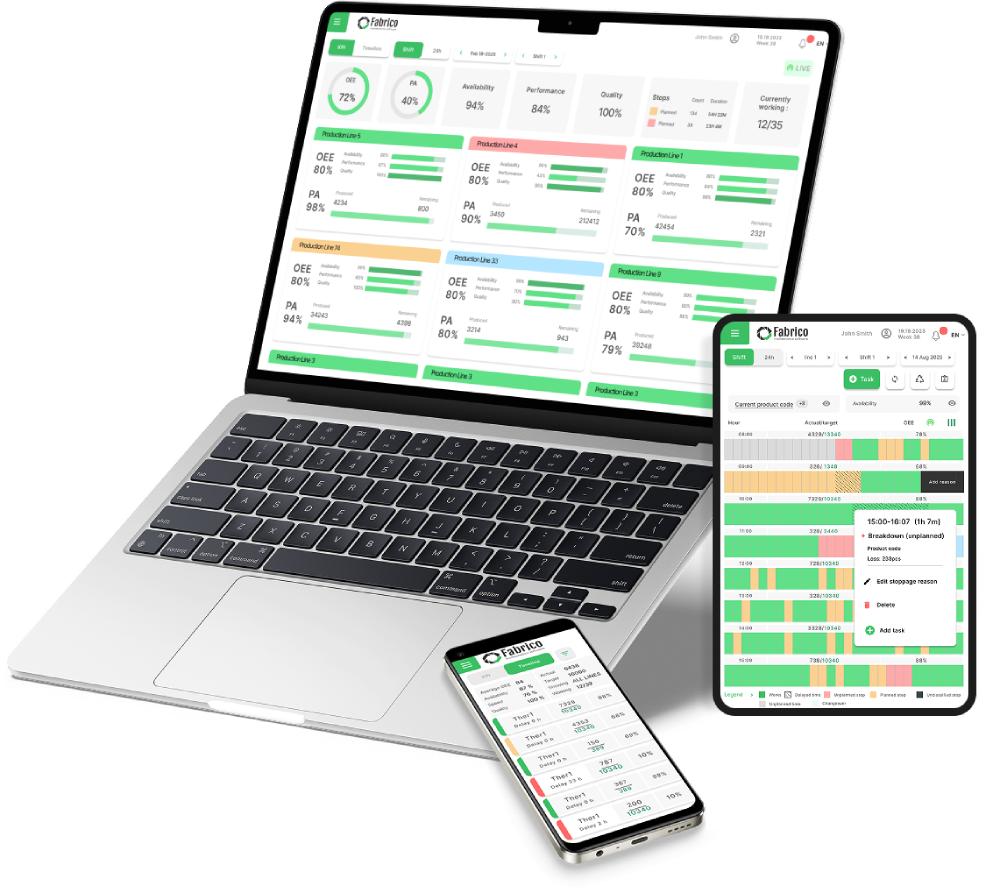
Fabrico eliminates this diagnostic blind spot with its "Inefficiencies Zoom-In" module, deploying overhead computer vision cameras to continuously monitor the production environment.
When native OEE detects a micro-stop or a sudden drop in running speed, the system automatically flags the timestamp and links it to the corresponding high-definition video footage.
Reliability engineers can instantly watch a replay of the exact mechanical jam or procedural deviation from their web dashboard.
This indisputable visual evidence proves whether the asset requires a mechanical adjustment, a change in packaging film, or targeted operator retraining.
Executing Permanent Fixes with a Field-Ready CMMS
Visualizing an unrecorded micro-stop provides zero financial ROI unless it instantly triggers a permanent corrective action on the shop floor.
Once the recurring ghost loss is identified via computer vision, Fabrico translates that intelligence into immediate execution via its Field-Ready CMMS.
A prioritized work order is dispatched directly to a maintenance technician's mobile device, complete with the video footage of the failure.
When the technician arrives at the asset, they scan the physical QR code to unlock the exact, version-controlled Standard Operating Procedure (SOP) required to engineer the permanent fix.
They execute the repair, write off any consumed MRO spare parts, and digitally log their exact labor hours at the point of action.
This closed-loop system ensures that minor process variations are permanently eliminated by the maintenance department rather than continuously band-aided by the production operator.

The 2026 Strategic Roadmap: Building Master Data for AI
Industrial boardrooms are aggressively pushing to deploy Artificial Intelligence to automate complex continuous improvement initiatives and predict machine failures.
However, AI algorithms are fundamentally useless if they are trained on manual spreadsheets that completely ignore the thousands of unrecorded micro-stops occurring daily.
Before a factory can trust an AI to autonomously diagnose and optimize a production line, it must establish at least 12 months of clean, verified, and visually backed master data.
By implementing Fabrico’s computer vision and mobile CMMS architecture today, you are actively building the comprehensive dataset that future automation requires.
Advanced capabilities, such as the Fabrico Agent for autonomous process optimization and the Fabrico Assistant for AI-driven troubleshooting guidance, are currently on our strategic roadmap.
Forcing digital execution and capturing visual downtime evidence right now is the mandatory first step toward an AI-ready, highly profitable manufacturing facility.


 Login
Login
 Blog
Blog