For many manufacturers, "Industry 4.0" is still a PowerPoint presentation, not a reality.
The machines are advanced (Robotics, CNCs). The ERP is advanced (SAP, cloud).
But the layer in the middle—Maintenance—is often stuck in Industry 2.0 (Paper, Whiteboards, Walkie-Talkies).
This "Analog Gap" breaks the flow of data. It means your expensive Smart Machines are being maintained by dumb processes.
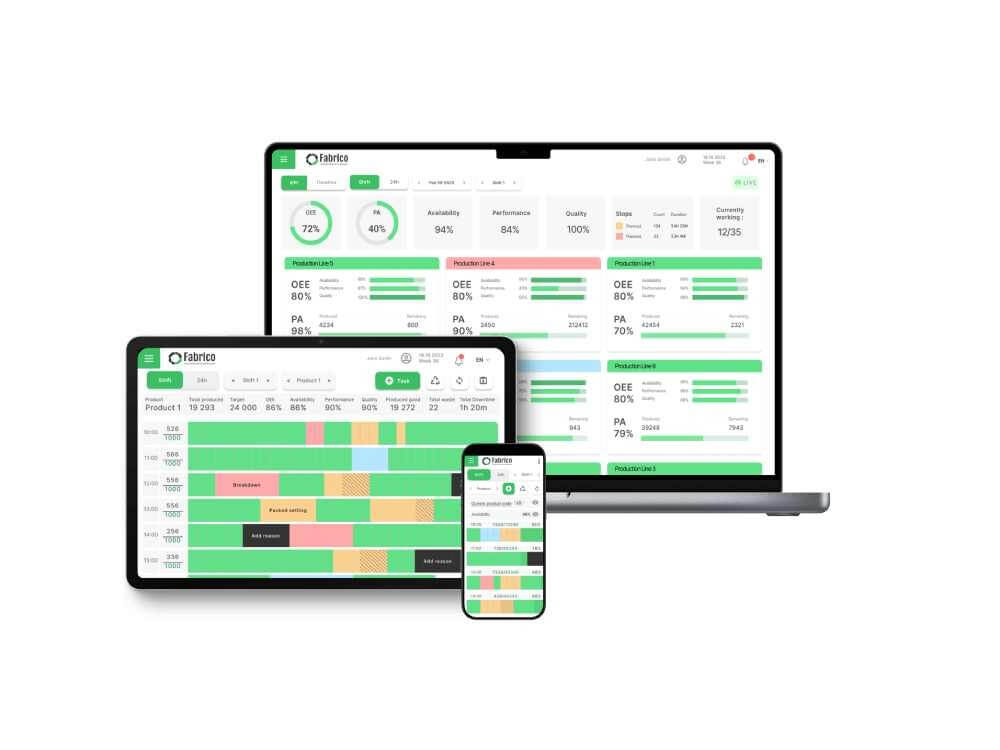
Smart Factory Maintenance Software is the missing link.
It sits at the intersection of Operational Technology (OT) and Information Technology (IT). It translates the raw signals of the factory floor into the strategic actions of the business.
Here is how to upgrade your maintenance execution to match the intelligence of your machinery.
The OT/IT Convergence: Why It Matters
In a traditional factory, the machine knows it is sick (the PLC throws a code), but the maintenance team doesn't know until an operator walks 50 meters to tell them.
Smart Software automates this conversation.
1. Automated Data Capture (The Pulse)
Stop relying on human data entry. Humans are slow and make typos.
-
The Smart Way: Fabrico connects directly to the machine control layer (via API or IoT Gateway).
-
The Data: It pulls Cycle Counts, Run Hours, and Alarm Codes automatically.
-
The Value: Your "Asset History" is now a forensic record of machine reality, not just a diary of what technicians remembered to write down.
2. Context-Aware Maintenance
A breakdown doesn't happen in a vacuum.
-
The Old Way: A Work Order says "Conveyor Stopped."
-
The Smart Way (Fabrico): The Work Order says "Conveyor Stopped | Speed: 150m/min | Product: SKU-X | Shift: Night."
-
The Insight: This rich context allows Reliability Engineers to spot patterns (e.g., "We only break when running SKU-X at high speed").
The Role of OEE in a Smart Factory
In a Smart Factory, Maintenance isn't a silo; it is a servant of Production.
Therefore, Smart Maintenance Software must be natively integrated with OEE (Overall Equipment Effectiveness).
-
Availability: The software tracks why the machine stopped (Downtime Reason).
-
Performance: The software tracks if the machine is running slow (Speed Loss).
-
Quality: The software tracks waste (Scrap Counts).
By unifying these metrics, Fabrico ensures that maintenance resources are always prioritized toward the asset that is hurting OEE the most.
Preparing for the AI Future
Innovation Directors ask: "When can we use AI?"
The answer is: "When you have Smart Data."
AI models need structure. They need to know that "Asset A" relates to "sensor B" and "Repair C."
Fabrico builds this Knowledge Graph.
-
Today: We structure your assets, digitize your manuals, and connect your sensors.
-
Tomorrow: This structured data becomes the fuel for advanced AI agents (like the Fabrico Assistant) that can diagnose complex issues and optimize schedules automatically.
Comparison: Digital vs. Smart
| Feature |
Digital Maintenance (Level 3) |
Smart Maintenance (Level 4 - Fabrico) |
| Data Entry |
Manual Typing on Tablet |
Automated via PLC/IoT |
| Trigger |
Human Request |
Data Condition |
| Context |
"Machine Broken" |
"Broken + Speed + Temp + Product" |
| OEE Link |
Separate Spreadsheet |
Unified Database |
| Goal |
Efficiency (Paperless) |
Intelligence (Data-Driven) |
The Fabrico Framework: The 3-Step Upgrade
-
Connect: Link the software to the critical assets (Bottlenecks) to read their status.
-
Visualize: Use the "Inefficiencies Zoom-In" (Video) to see what the data is telling you.
-
Act: Configure the system to auto-dispatch technicians when data thresholds are crossed.

Conclusion: Close the Analog Gap
Your machines are smart. Your maintenance software should be too.
Don't let paper processes hold back your digital transformation.
Get connected.
[Request a Demo] and see how Fabrico bridges OT and IT.


 Login
Login
 Blog
Blog