Why is OEE a Fiduciary Requirement for Modern Leaders?
What is the strategic purpose of OEE?
OEE (Overall Equipment Effectiveness) is a strategic financial metric that quantifies how well a manufacturing operation is utilized relative to its full potential.
For leadership, OEE serves as a fiduciary guardrail, proving that fixed assets are meeting their intended ROI by exposing the "Six Big Losses" of availability, performance, and quality.
For the CEO and Board, OEE resolution represents the difference between managing a "Black Box" and governing a transparent revenue engine.
In many global groups, OEE is treated as a post-mortem reporting tool rather than a real-time operational compass.
Robert C. Hansen identifies this as the foundation of the "Hidden Factory."
This represents the unproduced output that your overhead already pays for, but stays invisible because your "Systems of Record" lack the resolution to capture millisecond-level inefficiencies.
The Hansen Framework: OEE vs. TEEP and the "Hidden Factory"
To drive world-class performance, leadership must distinguish between what is scheduled and what is possible.
Robert C. Hansen’s framework introduces the concept of TEEP (Total Effective Equipment Performance).
While OEE measures performance during scheduled shifts, TEEP measures performance against total calendar time (24/7/365).
This distinction is critical for the "Value Fulcrum"—the point where maintenance intensity perfectly supports maximum effective runtime.
If your OEE is high but your TEEP is low, your assets are under-utilized, and your capital is trapped.
Reclaiming this "Hidden Factory" requires moving beyond passive dashboards to a System of Action that identifies unrecorded micro-stops and speed losses.
Strategic Comparison: Standalone OEE vs. Unified Systems of Action
| Strategic Metric |
Standalone OEE (Fragmented) |
Fabrico Unified Action (Standard) |
| Data Integrity |
Subjective: Filtered manual shift logs |
Validated: Direct Machine Connectivity |
| Integrity Proof |
Low: High risk of "Pencil-Whipping" |
High: Machine-validated audit trails |
| Diagnostic Mode |
None: Vague anecdotal RCA |
Visual Intelligence: "Zoom-In" context |
| Maintenance Link |
Siloed: No connection to technical flow |
Native: OEE triggers automated technical response |
| Governance Mode |
Site-specific "Tribal" art |
Global: Master Standardized Templates |
| ROI Logic |
Lagging: Reporting on historical cost |
Offensive: Recovering revenue capacity |
Bridging the Gap: OEE Diagnoses, CMMS Cures
Strategic leaders know that the highest return on capital is achieved when technical intensity perfectly supports functional integrity.
This is the transition from "reporting on failure" to "guaranteeing functional output."
In a disconnected factory, OEE data is often "filtered" by human bias.
This masks the true frequency of minor jams and setup delays that precede a total asset failure.
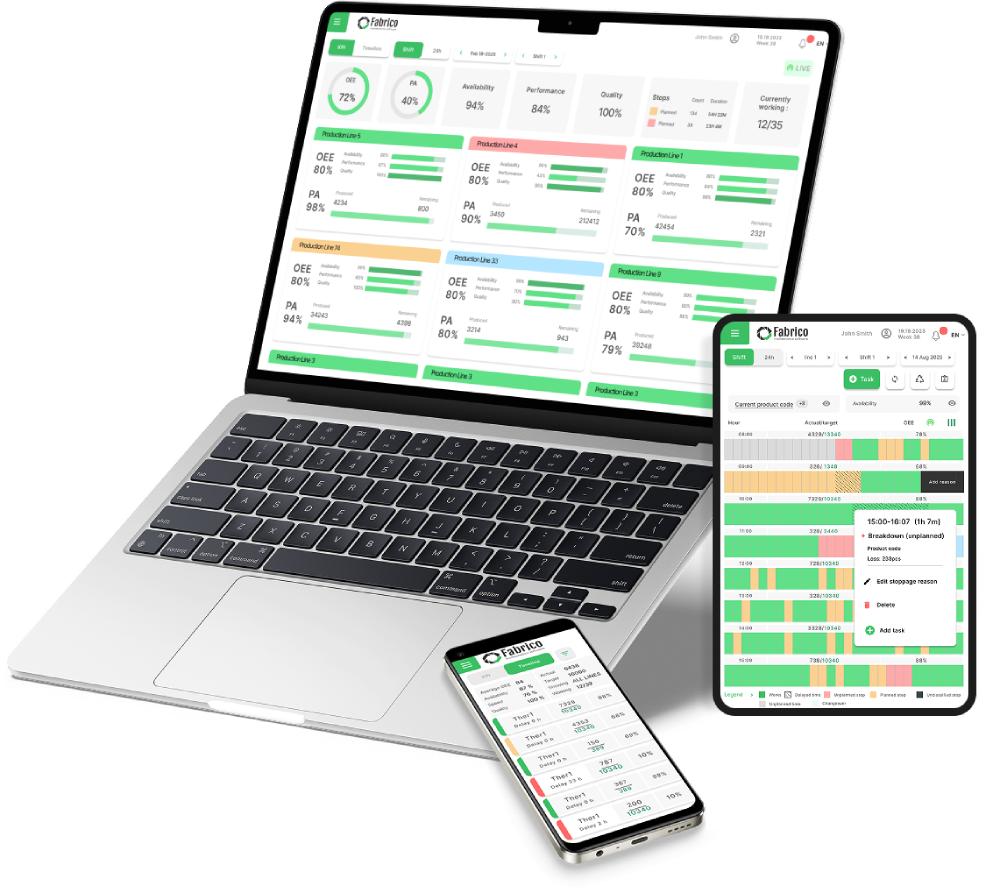
Fabrico bridges this gap by functioning as a unified Operational Layer.
By linking real-time performance tracking with maintenance execution, the platform ensures that every "Diagnosis" leads to a prioritized technical response.
This ensures your margins are protected by a predictable, machine-validated reliability model.
It aligns with Smith & Hinchcliffe’s RCM principles: you are preserving the function of the asset, not just the physical machine.
3 Strategic Steps to Move Beyond Percentages to Revenue Capacity
1. Liquidate the "Subjectivity Tax" of Manual Logs
If your OEE reports are manually entered by operators, you are managing by "hope."
Manual entry inevitably masks the micro-stops that signal functional decay.
Establishing machine-to-cloud connectivity allows you to see the millisecond losses that erode up to 20% of your EBITDA.
2. Implement Integrated Visual Root-Cause Intelligence
Text-based logs like "Fixed jam" offer zero diagnostic value for a CFO looking to allocate capital.
Using visual monitoring modules that link to OEE events provides the objective "Proof of Performance" required for fiduciary oversight.
Leadership can see the exact circumstances of a performance drop, enabling rapid improvement tasks backed by evidence.
3. Standardize the "Global Reliability Recipe"
Standardization is the only way to prove to shareholders that your results are a repeatable "System," not local technical "art."
Deploying Master PM and Operational Templates across your entire global group ensures that every site adheres to the same Smith & Hinchcliffe RCM standards.
This protects your enterprise equity against local labor turnover and unmanaged technical debt.
Moving Toward Autonomous Yield Protection
Strategic leaders are building today for a future where production flow is self-stabilizing and automated.
However, industrial intelligence cannot protect your valuation if the underlying data is currently unstructured or "dirty."
On our future roadmap, we are developing advanced optimization modules for automated schedule refinement based on live asset health.
We are also working on intelligent assistant tools designed to provide technicians with expert troubleshooting guidance derived from your proprietary history.
Consolidating on Fabrico now ensures that your organization owns the high-resolution, validated dataset required for these future modules.
You move from "reporting on the gap" to "automating the alignment" across your global portfolio.


 Login
Login
 Blog
Blog