Why Manufacturers Look for Tulip Alternatives
Tulip solves a specific problem with genuine technical sophistication.
In manufacturing environments where operators need structured digital guidance — step-by-step assembly instructions, quality inspection guidance, operator training workflows, and process parameter capture — Tulip's no-code app building platform delivers more flexibility than any competing connected worker tool.
Production managers can build custom operator apps without writing code.
Engineers can create digital work instructions with embedded quality checks.
Quality teams can design inspection workflows that adapt dynamically to what the operator finds at each step.
The ceiling appears when the improvement program moves beyond operator guidance into machine performance and maintenance execution.
A pharmaceutical manufacturer where operators follow validated assembly procedures perfectly through Tulip-built apps but where the filling equipment's peristaltic pump tubing is degrading and creating fill weight variation has a maintenance execution problem that operator guidance cannot solve.
A discrete manufacturer where Tulip captures production counts from machine signals but where those counts feed a production tracking dashboard rather than an OEE analysis connected to maintenance decisions has visibility without the closed-loop response that moves performance.
The manufacturer evaluating Tulip alternatives has typically identified one of these conclusions.
They need native OEE monitoring across the Six Big Losses framework rather than production count tracking.
They need a CMMS that goes beyond operator request routing into condition-based maintenance execution.
Or they need the digital guidance capability within a broader unified architecture that connects operator actions to machine performance data and maintenance responses.
The 4 Structural Limitations That Drive the Tulip Evaluation
Limitation 1: Production tracking rather than OEE monitoring
Tulip captures production data from machines through its connectivity modules.
The data captured is primarily production counts and process parameters rather than the Availability, Performance, and Quality breakdown across the Six Big Losses framework that OEE analysis requires.
A facility that needs to understand whether its OEE losses are dominated by micro-stops, speed reductions, or quality defects cannot answer that question from Tulip's production tracking data alone.
Limitation 2: No native CMMS execution
Tulip routes maintenance requests from operators.
Work order management, PM scheduling, condition-based maintenance triggers, spare parts management, and compliance audit trail generation require a separate CMMS.
Limitation 3: No condition-based maintenance capability
Tulip has no machine connectivity architecture for condition signal monitoring that generates PM work orders automatically from detected performance degradation.
Limitation 4: Custom app building creates maintenance overhead
Tulip's no-code flexibility is its primary strength.
It is also its primary operational complexity.
Every custom app requires building, testing, and maintaining — and as the app library grows, the maintenance burden of keeping apps current with process changes, equipment modifications, and procedure updates grows with it.
A platform with native manufacturing workflows requires less ongoing custom development than a no-code platform that builds every workflow from scratch.
The 7 Best Tulip Alternatives for Manufacturing
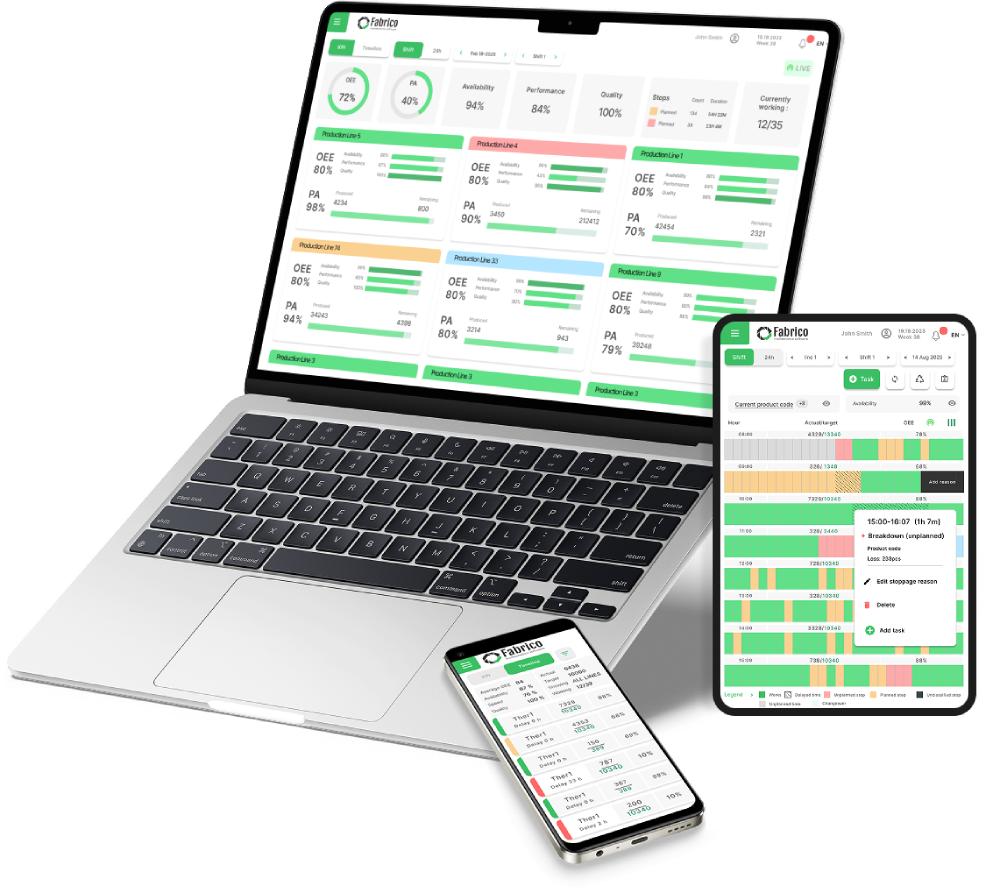
1. Fabrico
Best for: Discrete, assembly, pharmaceutical, and medical device manufacturers ready to unify OEE monitoring, maintenance execution, and digital SOP access in a single platform — replacing the fragmented architecture that Tulip creates alongside a separate CMMS and OEE monitoring tool.
Fabrico addresses the structural limitations that drive most Tulip evaluations directly.
Where Tulip provides production tracking, Fabrico provides native OEE monitoring across the Six Big Losses framework from machine-connected signals.
Where Tulip routes maintenance requests, Fabrico generates condition-based work orders automatically from OEE performance data.
Where Tulip requires a separate CMMS, Fabrico provides full CMMS capability within the same environment that monitors OEE.
Native OEE monitoring that goes beyond production count tracking
Fabrico connects directly to production machine PLCs — capturing Availability, Performance, and Quality losses in real time from machine signals.
Micro-stops, speed deviations, and quality rejection rates are captured automatically and categorized within the Six Big Losses framework without custom app development.
The OEE analysis that Tulip's production tracking data requires external processing to produce is native in Fabrico.
Closed-loop maintenance execution
When Fabrico detects an OEE performance deviation, a condition-based work order is automatically generated and dispatched to the responsible technician's mobile device.
The work order includes the machine's complete history, the correct SOP version, and parts availability confirmation.
The detection and the response are the same event — with no custom app development, no separate CMMS, and no manual coordination between systems.
Digital SOP access within the maintenance execution workflow
Fabrico's digital SOPs are version-controlled, accessed via QR code at the asset, and linked to specific work orders.
For pharmaceutical and medical device manufacturers under 21 CFR Part 11 and ISO 13485, Fabrico's automatic maintenance audit trail generates the electronic records compliance documentation that Tulip-built apps do not produce for maintenance activities.
Honest assessment
Fabrico's no-code custom app building capability is less developed than Tulip's.
For manufacturers whose primary requirement is maximum flexibility in building custom operator guidance workflows — step-by-step assembly apps with embedded quality decision trees, dynamic inspection workflows that adapt based on operator findings, or complex operator training applications — Tulip's no-code platform provides more customization depth.
For manufacturers who need native OEE monitoring connected to maintenance execution in a unified environment, Fabrico delivers more operational value than Tulip's production tracking plus a separate CMMS.
Note: AI predictive maintenance modules and the Fabrico Agent are currently in development and on the product roadmap.
Implementation: 30-day pilot, 3 to 4 month full deployment.
Adoption: 96% within first month of go-live.
Best fit: Discrete, assembly, pharmaceutical, and medical device manufacturers where unified OEE and maintenance execution are the strategic priority.
2. Parsable
Best for: Manufacturers who evaluated Tulip for its digital work instruction capability and want a connected worker alternative with stronger procedure compliance focus and less custom development overhead.
Parsable's connected worker platform provides digital work instructions, paperless operations, and frontline worker connectivity — with a more structured out-of-the-box approach than Tulip's custom app building model.
Where it performs well
Digital work instructions and paperless procedure compliance are well-developed for food, pharmaceutical, and industrial manufacturing.
Lower custom development overhead than Tulip — standard connected worker workflows rather than custom no-code apps.
Compliance documentation for procedure completion is well-implemented.
Where it falls short
No native OEE monitoring.
No CMMS execution capability.
No condition-based maintenance triggers.
Best fit: Manufacturers who prioritized Tulip for digital work instructions and want a more standardized procedure compliance alternative with less custom development requirement.
3. Poka
Best for: Manufacturers who evaluated Tulip for its operator knowledge management and training content capability and want a connected worker alternative with richer multimedia training content.
Poka's connected worker platform provides multimedia work instructions, operator training content management, and skills certification tracking as a more structured alternative to Tulip's custom-built training apps.
Where it performs well
Multimedia work instructions and video-based training content are more developed than Tulip's standard content capability.
Operator training content management and skills certification tracking are genuine strengths.
Frontline operator adoption is genuinely high.
Where it falls short
No machine-connected OEE monitoring.
No CMMS execution capability.
Skills certification management requires a separate training content investment rather than Tulip's flexible app-building approach.
Best fit: Manufacturers who evaluated Tulip primarily for training content and operator engagement — and want a platform built specifically for connected worker training rather than a general-purpose app building environment.
4. MaintainX
Best for: Manufacturers who evaluated Tulip and concluded that maintenance execution — not digital work instructions — is the primary operational gap.
MaintainX's mobile-first CMMS addresses the maintenance coordination and work order management problem that Tulip does not serve.
Where it performs well
Fastest CMMS implementation available — one to three weeks.
Very high frontline adoption.
Work request portal gives operators a direct channel to the maintenance team.
Strong team communication model for maintenance coordination.
Where it falls short
No native OEE monitoring.
No custom app building capability.
Asset management depth insufficient for complex manufacturing equipment portfolios.
Best fit: Manufacturers who evaluated Tulip alongside a CMMS search, concluded maintenance execution is the primary gap, and want the fastest CMMS deployment available.
5. Limble CMMS
Best for: Manufacturers who evaluated Tulip alongside a CMMS search and want the best traditional mid-market CMMS without yet committing to a unified OEE and CMMS platform.
Limble provides excellent asset management, PM scheduling, and technician adoption for manufacturers whose primary need is structured maintenance execution.
Where it performs well
Excellent user satisfaction ratings.
Fast implementation — two to four weeks.
Strong PM scheduling flexibility and asset hierarchy management.
Customer support quality consistently cited as a differentiating strength.
Where it falls short
No native OEE monitoring.
No custom app building capability.
No condition-based PM triggers from live machine data.
Best fit: Manufacturers who concluded maintenance management is the primary gap and want the best traditional CMMS at mid-market pricing.
6. Leading2Lean (L2L)
Best for: Manufacturers who evaluated Tulip for its production tracking and shop floor visibility capability and want an alternative with stronger organizational escalation and daily management system discipline.
L2L's shop floor management platform provides production target tracking, structured escalation workflows, and daily management system discipline — with more developed organizational accountability structures than Tulip's production tracking capability.
Where it performs well
Organizational escalation hierarchy is L2L's most distinctive capability.
Production target tracking and shift accountability structures are well-developed.
Kaizen submission workflows connect frontline observations to improvement programs.
Where it falls short
No native OEE monitoring from machine signals.
No CMMS execution capability beyond basic request routing.
No custom app building capability at Tulip's depth.
Best fit: Manufacturers who evaluated Tulip for production discipline and shop floor visibility and want stronger organizational accountability structures.
7. Fiix (by Rockwell Automation)
Best for: Larger manufacturers in the Rockwell Automation ecosystem who evaluated Tulip alongside a CMMS search and need enterprise maintenance compliance depth for pharmaceutical, medical device, or automotive applications.
Fiix provides enterprise CMMS depth for larger manufacturers who concluded the CMMS gap was the primary architectural problem identified during the Tulip evaluation.
Where it performs well
21 CFR Part 11, ISO 13485, and IATF 16949 compliance documentation is mature.
Rockwell PLC connectivity for Allen-Bradley equipped production lines.
Enterprise asset management for complex manufacturing portfolios.
Where it falls short
No native OEE monitoring.
No custom app building capability.
Technician adoption in production floor environments is lower than mobile-first platforms.
Best fit: Larger manufacturers in the Rockwell ecosystem where enterprise compliance depth justifies the implementation investment.
Full Comparison Matrix
| Criteria |
Fabrico |
Parsable |
Poka |
MaintainX |
Limble |
L2L |
Fiix |
| Native OEE Monitoring |
Yes |
No |
No |
No |
No |
No |
No |
| Six Big Losses Framework |
Yes |
No |
No |
No |
No |
No |
No |
| Machine Connectivity |
PLC, IoT, Vision |
No |
No |
No |
No |
No |
Partial |
| No-Code App Building |
No |
No |
No |
No |
No |
No |
No |
| Work Order Management |
Auto-generated |
No |
No |
Yes |
Yes |
Partial |
Yes |
| Condition-Based PM Triggers |
Yes |
No |
No |
No |
Manual meter |
No |
Limited |
| Digital Work Instructions |
Maintenance SOPs |
Yes |
Yes, rich |
Partial |
Partial |
Partial |
Partial |
| 21 CFR Part 11 Compliance |
Yes |
No |
No |
No |
No |
No |
Yes |
| Closed-Loop Fault-to-Fix |
Automatic |
No |
No |
Partial |
No |
No |
Partial |
| Organizational Escalation |
Partial |
No |
No |
Partial |
No |
Yes |
No |
| Replaces Tulip Fully |
Partially |
Partially |
Partially |
No |
No |
Partially |
No |
| Replaces Separate CMMS |
Yes |
No |
No |
Yes |
Yes |
No |
Yes |
| Implementation Timeline |
30-day pilot, 3 to 4 months |
Fast |
Fast |
1 to 3 weeks |
2 to 4 weeks |
Fast |
3 to 6 months |
How to Choose the Right Tulip Alternative
If the primary gap is native OEE monitoring and maintenance execution:
Fabrico closes both gaps — native OEE from machine signals, full CMMS execution, condition-based maintenance, and compliance documentation in a single unified environment.
If the primary gap is standardized digital work instructions with less custom development overhead:
Parsable provides a more standardized procedure compliance alternative without Tulip's custom development requirement.
If the primary gap is richer multimedia operator training content:
Poka provides more developed training content management than any other platform in this comparison.
If the conclusion from the Tulip evaluation is that maintenance execution was always the real gap:
MaintainX for the fastest deployment. Limble for the best traditional CMMS depth. Fiix for Rockwell ecosystem environments with regulated compliance requirements.
If the primary gap is organizational escalation and production accountability:
L2L provides stronger daily management system discipline and escalation architecture than Tulip's production tracking.
Frequently Asked Questions
Can Tulip and Fabrico be used together?
Yes. Tulip for custom no-code operator guidance apps alongside Fabrico for native OEE monitoring, CMMS execution, and compliance documentation is a valid architecture for manufacturers who genuinely need both custom app flexibility and unified production performance management.
The combination creates two data environments that require acceptance of the separation rather than elimination of it.
Does Fabrico replace Tulip's no-code app building capability?
No. Fabrico provides digital SOPs linked to work orders and digital CIL checklists for operator-facing inspection rounds.
For manufacturers who need maximum flexibility in building custom operator guidance workflows — dynamic decision trees, multi-step assembly apps with embedded quality checks, or complex training applications — Tulip's no-code platform provides a depth of customization that Fabrico's maintenance-oriented SOP library does not replicate.
What is the most common reason manufacturers replace Tulip rather than supplement it?
The most common reason is the architectural complexity and cost of running Tulip alongside a separate CMMS and OEE monitoring tool.
Three platforms create three data environments, three vendor relationships, and three integration projects — and the total cost frequently exceeds the cost of a unified platform that consolidates production performance monitoring and maintenance execution while retaining the digital SOP capability that Tulip was providing.
Tulip built your operators great apps. The next step is connecting those apps to the machine performance data and maintenance execution that acts on what operators observe. Request a demo and see what changes when operator guidance, OEE detection, and maintenance response are the same event.


 Login
Login
 Blog
Blog