What is Predictive Maintenance (PdM)?
What is predictive maintenance? Predictive maintenance is a proactive reliability strategy that uses real time data and condition monitoring to forecast when a machine will fail. The primary goal is to perform maintenance interventions at the exact moment they are needed to prevent catastrophic breakdowns.
This approach is fundamentally different from preventive maintenance. Preventive maintenance relies on rigid calendar schedules. Predictive maintenance relies on the actual real time health of your physical assets.
The Problem with Legacy Predictive Maintenance
Traditional predictive maintenance relies heavily on standalone vibration sensors and oil analysis tools. While these tools gather valuable data, they create massive operational silos.
A vibration sensor might trigger a red light on a passive dashboard in the manager's office. However, it does not tell the technician on the floor exactly how to fix the problem.
This disconnect creates severe decision latency. By the time the data is analyzed and a manual work order is finally written, the machine has already broken down. You are paying for predictive analytics but still suffering from reactive downtime.
The Fabrico Framework: OEE as the Ultimate Predictive Sensor
To build a world class maintenance program, you must redefine how you predict failures. The Fabrico Framework states that production decay always precedes mechanical decay.
Long before a motor overheats or a bearing violently shakes, the machine will struggle to maintain its designed Takt Time. A packaging line that drops from one hundred units a minute to ninety units a minute is giving you a clear warning sign.
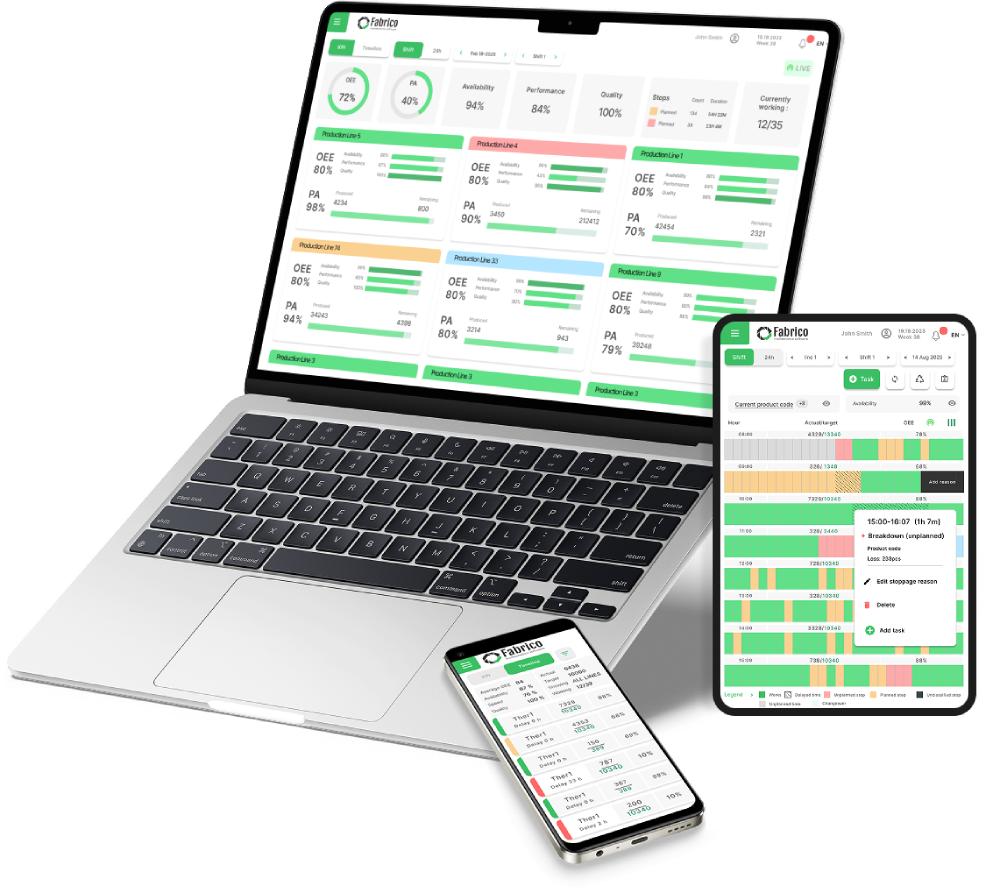
Standalone CMMS platforms are entirely blind to this revenue leak. Fabrico solves this by using Native OEE as your primary predictive sensor.
We connect directly to your PLCs to track Availability, Performance, and Quality in real time so you can catch minor speed losses weeks before a physical failure occurs.
Validating Predictions with Computer Vision
Sensor data alone cannot capture every variable on the factory floor. PLCs cannot see human workflow errors or subtle material jams. You must add a visual layer of intelligence to your predictive strategy.
Fabrico utilizes an Inefficiencies Zoom-In feature powered by Computer Vision. We install overhead cameras that continuously monitor your critical production lines. When the OEE system detects a micro stop, the cameras capture a short video clip of the exact event.
Managers can watch this footage to visually verify the root cause of the anomaly. This eliminates the need for subjective operator interviews and provides objective proof of the impending failure.
Note: To completely automate this process, our AI driven Computer Vision models and the Fabrico Agent are currently in Beta and on our product roadmap. Soon, the Fabrico Agent will autonomously analyze historical video data and suggest predictive maintenance tasks without any human intervention.
Closing the Loop with Automated CMMS Execution
Predicting a failure is completely useless if your team cannot execute the repair efficiently. A predictive alert must instantly translate into a guided maintenance action.
Fabrico bridges the gap between data discovery and physical repair. When our Native OEE system or connected IoT sensors detect a performance drop, the platform automatically generates a Condition-Based Maintenance work order.
This work order is instantly dispatched to a technician via the Fabrico Field-Ready CMMS mobile app. The technician scans a QR code on the machine to access digital Standard Operating Procedures and the required spare parts list. This seamless workflow guarantees that your predictive insights actually reduce your Mean Time To Repair.
Comparison Matrix: Legacy PdM vs. Unified Predictive Action
| Capability |
Legacy PdM (Standalone Sensors) |
Basic CMMS |
Fabrico (System of Action) |
| Primary Trigger |
Vibration and heat anomalies. |
Calendar dates. |
Real time OEE speed and quality drops. |
| Data Silos |
Disconnected from maintenance tasks. |
Disconnected from production data. |
Unified production and maintenance data. |
| Root Cause Validation |
Requires manual inspection. |
Relies on subjective text logs. |
Objective video via Computer Vision. |
| Execution Loop |
Requires manual work order creation. |
Manual task assignment. |
Automated dispatch to a mobile app. |
Conclusion: Stop Guessing and Start Predicting
Investing in expensive vibration sensors will not protect your profit margins if your software stack remains fragmented. Predicting a failure means nothing if you still rely on paper work orders to execute the fix.
Manufacturing leaders must adopt a unified System of Action. By combining Native OEE, Computer Vision, and a mobile CMMS, you transform your maintenance department into a proactive revenue shield.
Upgrade your factory intelligence today and stop letting unexpected breakdowns dictate your production schedule.


 Login
Login
 Blog
Blog