What is SCADA (Supervisory Control and Data Acquisition)?
What is a SCADA system? SCADA stands for Supervisory Control and Data Acquisition, which is an industrial software and hardware system used to monitor and control equipment in real time.
It continuously gathers raw data from sensors and Programmable Logic Controllers (PLCs) to display a graphical overview of the entire factory floor.
Operators rely on this software interface to interact with valves, pumps, and motors without having to walk across a massive facility. If a boiler exceeds its safe temperature limit, the software sounds an alarm and allows the operator to shut the system down remotely.
These systems have been the backbone of industrial manufacturing, oil refineries, and water treatment plants for decades. However, simply monitoring your equipment is not enough to achieve world class reliability.
The Maintenance Blind Spot in Industrial Automation
Many factory leaders mistakenly believe that installing a massive control room dashboard solves their efficiency problems. This is a very expensive strategic error.
A control system is incredibly smart at operating a machine, but it is completely blind to maintenance execution. When a pressure valve fails, the system flashes a red warning light on a computer screen. It does not tell the mechanic how to fix the valve or whether the required spare parts are in stock.
This forces your maintenance department to operate in a disconnected silo. An operator must pick up a radio and verbally request a repair, creating massive decision latency. You are paying millions for industrial automation but still relying on a reactive, manual repair process.
Translating Machine Signals into Native OEE
To protect your EBITDA, you must translate raw machine data into actionable business intelligence. The Fabrico Framework dictates that factory data is only valuable if it drives a proactive operational response.
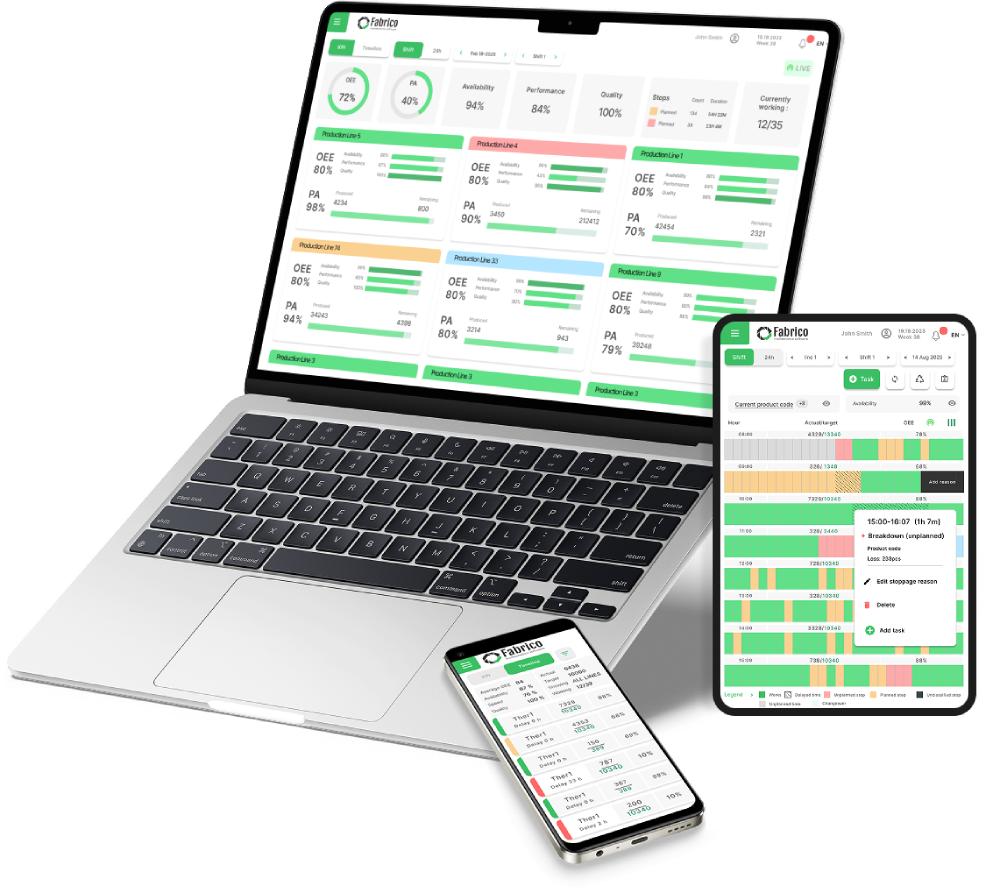
Fabrico bridges this gap by connecting directly to your PLCs and feeding that data into our Native OEE module. Instead of just showing a flashing red light, we calculate your exact Availability, Performance, and Quality metrics automatically.
If a packaging line begins running 5 percent slower than its target Takt Time, our system detects the speed loss instantly. We transform basic machine monitoring into a proactive financial shield that protects your daily production yield.
Uncovering Root Causes with Computer Vision
Raw electrical signals can tell you that a machine stopped running. They rarely provide the physical context needed to understand exactly why the failure occurred.
Fabrico eliminates this massive troubleshooting gap by utilizing an Inefficiencies Zoom In feature powered by Computer Vision. We install overhead cameras that continuously record your critical production lines. When your PLC detects a sudden stoppage, our system captures a short video clip of the exact physical event.
Reliability engineers can watch this objective video replay on their smartphones instantly. They can see with their own eyes if the stoppage was caused by a mechanical jam, a material shortage, or an operator workflow error.
Note: We are advancing this visual technology even further. Our AI driven Computer Vision models and the Fabrico Agent are currently in Beta and on our product roadmap. Soon, the system will autonomously analyze historical video footage to categorize downtime reasons without human intervention.
Executing the Repair with a Field-Ready CMMS
Gathering flawless data from your control systems and cameras is completely useless if you cannot execute a repair efficiently. Information must flow directly to the frontline workforce holding the wrenches.
When the Fabrico OEE module detects a performance drop, it automatically generates a Condition Based Maintenance work order. This task is dispatched instantly to a technician via our Field-Ready CMMS mobile application.
The technician walks up to the broken asset and scans its unique QR code to load the correct digital Standard Operating Procedure. They review the video footage of the fault, follow the mandatory safety checklist, and execute the repair perfectly on the very first attempt.
Automation Software Comparison Matrix
| Factory Capability |
Traditional SCADA |
Standalone CMMS |
Fabrico (System of Action) |
| Primary Focus |
Machine control and monitoring. |
Work orders and task execution. |
Unified Production & Maintenance Action. |
| Data Context |
Raw electrical signals. |
Subjective operator text logs. |
Actionable Native OEE business metrics. |
| Root Cause Visibility |
Error codes only. |
Blind to cycle times. |
Video evidence via Computer Vision. |
| Maintenance Triggers |
Passive screen alerts. |
Manual requests and dates. |
Automated via PLC speed loss. |
| Execution Tool |
None. |
Mobile application. |
Mobile app with offline QR scanning. |
Conclusion: Stop Monitoring and Start Executing
Staring at a wall of monitors in a control room will not improve your First Pass Yield. If your automation software cannot automatically dispatch a technician when a machine degrades, you are trapped in a reactive maintenance cycle.
Manufacturing leaders must demand a unified System of Action. By combining direct PLC connectivity, Native OEE, Computer Vision, and a mobile CMMS, you transform raw data into proactive reliability.
Upgrade your technology stack today to stop guessing what your machines are doing and start maximizing your actual factory capacity.


 Login
Login
 Blog
Blog