Why Buying More Machines Won't Fix Your Throughput Problem
What is the difference between Capex expansion and Capacity Reclamation?
Capex expansion is the purchase of new physical assets to increase output, whereas Capacity Reclamation is the process of using OEE software and an integrated CMMS to identify and eliminate the inefficiencies in your current machines, effectively increasing output without additional hardware.
If your current OEE is 65%, buying a new machine will simply result in two machines running at 65%.
You aren't solving the root cause; you are scaling your inefficiency.
Fabrico targets the Value Fulcrum, ensuring you maximize the Effective Runtime of your current fleet before you invest in more complexity.
Phase 1: Exposing the "Invisible" Loss with Computer Vision
You cannot reclaim capacity that you cannot see.
In high-speed lines, traditional sensors often miss the 45-second jams and 3% speed drops that accumulate into 15% lost capacity.
Fabrico’s Inefficiencies Zoom-In (Computer Vision) module acts as the "Eyes" of the factory.
When a performance drop occurs, the system flags a video clip so Mike (the Tactical Manager) can see the visual truth.
This visual evidence allows your team to fix the "Ghost Losses" that manual logs never record, providing an immediate boost to your total OEE.
Phase 2: Bridging the "Decision Latency" Gap
The fastest way to increase availability is to reduce the time wasted between a machine signal and a technician's response.
In a disconnected factory, "Decision Latency" can consume 30-45 minutes per downtime event.
Fabrico’s integrated OEE and CMMS automates this workflow.
The moment the OEE module detects a threshold breach, it triggers a prioritized Work Order for Tom (the Technician).
Reducing this delay to near zero allows you to reclaim hours of production time every week without adding a single worker.
Phase 3: Moving from Emergency Response to Predictive Availability
Sustainable capacity growth requires a move away from the "Firefighting" culture.
Fabrico’s Interactive Planning Board uses real-time OEE and maintenance data to create Predictive Availability.
Instead of forcing a worn machine to run until it breaks, you schedule a 15-minute "just-in-time" adjustment based on its performance trend.
This stabilizes the production flow and ensures that your highest-priority orders are always running at the rated speed.
It protects your Residual Asset Value and ensures your current machines reach their full design life.
Comparison Matrix: Hardware Capex vs. Digital System of Action
| Investment Factor |
Buying New Machinery (Capex) |
Fabrico (System of Action) |
| Initial Cost |
Very High ($1M+) |
Low (Optimized SaaS) |
| Implementation Time |
6-12 Months |
3-4 Months |
| Floor Space Needed |
High |
Zero |
| ROI Speed |
2-5 Years |
3-6 Months |
| Efficiency Focus |
Capacity Addition |
Capacity Reclamation |
| Labor Requirement |
High (New Operators) |
Low (Optimized Wrench Time) |
The Financial Verdict: ROI through Capacity Reclamation
For Paula, the business case for Fabrico is a "No-Brainer" compared to a hardware expansion.
By reclaiming 15% of her lost capacity, she avoids the costs of new floor space, additional operators, and massive depreciation.
This data-driven approach turns her existing maintenance department into a strategic partner for Operational Excellence.
As the system builds 12 months of clean data, it prepares the plant for the Fabrico Agent (AI Roadmap).
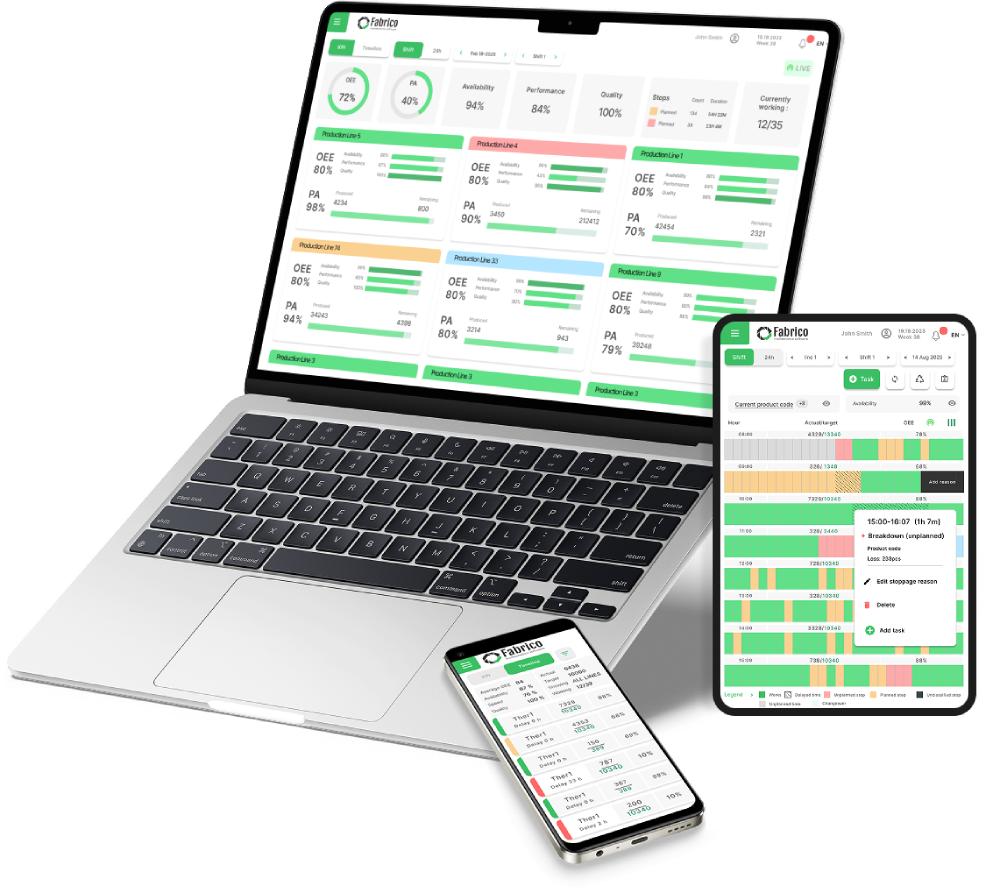
Stop buying more machines. Start reclaiming your revenue with a System of Action.


 Login
Login
 Blog
Blog