For years, manufacturers have been forced to buy two separate brains for their factory.
-
The Production Brain (OEE): "We are running at 65% efficiency. We lost 2 hours to downtime."
-
The Maintenance Brain (CMMS): "We did 4 work orders today. The machine is fixed."
The problem? These two brains don't talk. Production reports downtime that Maintenance says didn't happen. Maintenance fixes machines that Production says weren't broken. This "Silo Tax" costs you money in lost data, duplicate license fees, and friction between teams.
In 2026, the best strategy is Unification. Here are the 5 best software solutions that combine OEE and CMMS into a single source of truth.
Why You Should Stop Buying Separate Tools
Buying a standalone OEE tool (like Vorne) and a standalone CMMS (like UpKeep) creates a Data Gap.
-
Latency: The machine stops at 9:00 AM. The operator calls maintenance at 9:15 AM. The tech logs the work order at 9:30 AM. You lost 30 minutes of accurate data.
-
Disconnection: The OEE chart shows "Uncategorized Downtime." The CMMS shows "Sensor Replacement." You have to manually match them up in Excel to calculate the True Cost of Ownership.
-
The Integrated Advantage: In a unified system, the machine stop IS the Work Order trigger. Data is instant, accurate, and shared.
Top 5 Integrated OEE and CMMS Software Solutions (Ranked)
1. Fabrico
Best For: Native Unification (Built as One Platform).
The "Unified Data" Advantage:
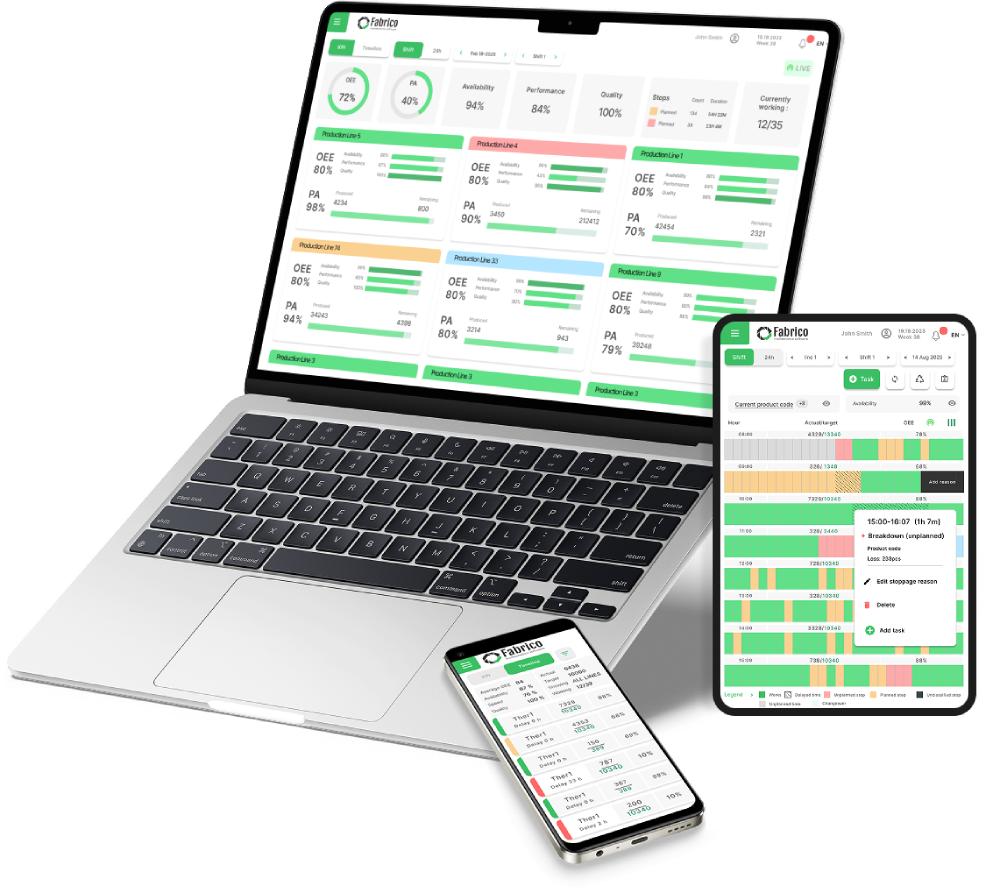
Fabrico is not an OEE tool that "talks" to a CMMS. It is a single platform built to handle both datasets natively. This eliminates the need for expensive API integrations or middleware.
How the Integration Works:
-
Closed Loop Action: Fabrico connects to the PLC. When the machine stops (OEE Loss), it automatically generates a Work Order (Maintenance Action).
-
Unified Dashboard: The Plant Manager sees the "Production View" (Efficiency), while the Maintenance Manager sees the "Execution View" (Wrench Time)—but they are looking at the exact same data source.
-
Root Cause Clarity: Fabrico uses Computer Vision to bridge the gap. When OEE drops, the Inefficiencies Zoom-In captures video. Both teams watch the same clip to agree on the root cause.
Pros:
-
Single License: Stop paying for two separate software subscriptions.
-
Zero Integration Cost: It works out of the box; no custom API coding required.
-
Shared Inventory: Spare parts usage is linked directly to machine performance costs.
Cons:
2. L2L (Leading2Lean)
Best For: Lean Dispatching.
Overview:
L2L is a powerful "Smart Factory" platform rooted in Lean Manufacturing principles. It treats the factory floor like an air traffic control system. Its "Dispatch" module is the core: when a line goes down, it "dispatches" the right resource (Maintenance, Quality, or Material Handler).
Key Integrated Features:
-
Dispatch Engine: Real-time routing of issues to the right team.
-
Production Pitch: Visualizes hourly production targets vs. actuals.
-
Maintenance Module: Full CMMS capabilities integrated into the dispatch flow.
Pros:
Cons:
3. Redzone
Best For: Workforce Engagement.
Overview:
Redzone combines Productivity (OEE) with Collaboration. It is famous for its "Huddles" and chat features. While it is primarily a Productivity tool, it has a "Maintenance" module that allows operators to tag maintenance issues directly in the flow of work.
Key Integrated Features:
-
One Team: Operators and Techs use the same iPad interface.
-
OEE Scoreboard: Real-time gamification of production goals.
-
Asset Care: Basic maintenance checklists for operators (Autonomous Maintenance).
Pros:
Cons:
4. Evocon + Integration
Best For: Lightweight OEE.
Overview:
Evocon is a fantastic, simple OEE tracker. It is not a CMMS. However, it is included here because many companies successfully pair it with a simple CMMS via API. It represents the "Best of Breed" approach: buy a simple OEE tool and a simple CMMS, and glue them together.
Key Features:
Pros:
Cons:
5. Plex (Rockwell Automation)
Best For: ERP-Level All-in-One.
Overview:
Plex is the "Nuclear Option." It is a cloud ERP that includes MES, OEE, and CMMS in one massive database. If you want total integration—from the customer order to the shipping label to the grease gun—Plex does it all.
Key Integrated Features:
-
Smart Manufacturing Platform: Everything flows into one General Ledger.
-
Finite Scheduling: Production planning is linked to machine uptime.
-
Supply Chain: Integration with raw material ordering.
Pros:
Cons:
Comparison Matrix: Integration Depth
| Feature |
Fabrico |
L2L |
Redzone |
Evocon + CMMS |
Plex |
| Integration Type |
Native Unified |
Native Unified |
Native Unified |
API / Manual |
ERP Native |
| Primary Focus |
OEE + Maintenance |
Lean Dispatch |
Culture/Prod. |
Simple OEE |
ERP/Finance |
| Setup Time |
Fast (Days/Weeks) |
Medium (Months) |
Fast (Weeks) |
Fast (Days) |
Slow (Years) |
| CMMS Depth |
High |
High |
Medium |
Low (Separate) |
High |
| Best For |
Manufacturing |
Lean Plants |
Team Culture |
Small Shops |
Global Corp |
The "Closed Loop" Workflow
The power of Fabrico is the Closed Loop:
-
Alert: Machine stops (OEE Trigger).
-
Action: Work Order creates automatically (CMMS).
-
Diagnosis: Tech watches the video clip (Computer Vision).
-
Fix: Tech repairs and closes the ticket.
-
Result: Machine restarts, and OEE updates automatically.
No phone calls. No lost data. Just a unified factory.
Stop paying the Silo Tax. Get unified OEE & CMMS with Fabrico.


 Login
Login
 Blog
Blog