

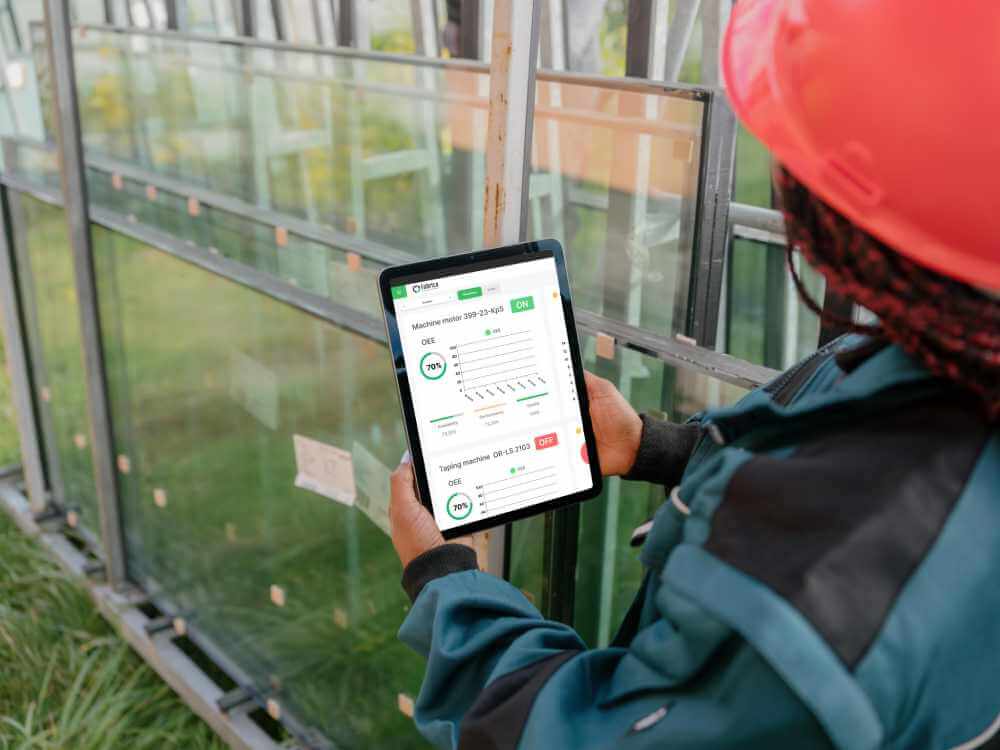

Choosing the best OEE software with unified machine and operator data is the only way to eliminate the "Context Gap" that renders standard dashboards useless.
In high-speed manufacturing, machine signals (PLC) tell you when a machine stopped, but they are notoriously blind to the why. To achieve world-class results in 2026, you must implement a unified System of Action that merges machine pulses with operator insights to capture 100% of the operational truth.
See how Fabrico unifies OEE and maintenance in one platform.
Book a demoMachine data alone is a liability. Relying only on sensors masks the human-centric inefficiencies that drain 15% of your capacity.
The "Visibility Trifecta" ensures 100% truth. True OEE requires the integration of PLC signals, human context, and AI-powered visual proof.
Unified data slashes Decision Latency. The best tools natively link performance drifts to maintenance work orders to close the loop on downtime.
OEE data unification is the digital process of synchronizing real-time signals from machine PLCs with manual inputs from operators to provide a single source of truth for downtime categorization, root cause analysis, and maintenance prioritization.
For Mike (the Tactical Manager), this unification is the end of "Conflicting Reports."
Instead of arguing about whether a stop was a mechanical failure or a material delay, he uses Fabrico to see the PLC timestamp combined with the operator’s mobile note and a video replay of the event.
Fabrico is the only platform built to natively unify Native OEE machine pulses, Operator Context, and Computer Vision into a cohesive technical medical record.
Why it wins for data unification:
Fabrico utilizes the "Visibility Trifecta." It pulls cycle times directly from PLCs and uses a native mobile interface to allow operators to log context in seconds.
Because it is a System of Action, any deviation identified by the machine or the operator natively triggers a prioritized Work Order in the Field-Ready CMMS. This ensures maintenance effort is applied to the Value Fulcrum, the specific mechanical adjustments that reclaim the Hidden Factory revenue.
MachineMetrics is a robust IoT platform that excels at deep machine connectivity, particularly in the CNC and discrete manufacturing sectors.
The Trade-off:
They are the leaders in "Machine Intelligence," pulling deep data from control systems. However, they often lack the native "Human Intelligence" and mobile-first operator workflow found in a unified system.
For Paula (the Strategic Leader), the lack of a native, maintenance execution loop means she still faces a data silo between machine truth and technician action.
Tulip provides a "no-code" platform that allows manufacturers to build their own custom apps for data collection and operator guidance.
The Trade-off:
Tulip is the leader in "Human Intelligence." The challenge is the "DIY Tax."
Connecting high-frequency machine signals and unifying them with a technical maintenance engine requires significant custom development. It acts as a platform to build a tool, rather than being an out-of-the-box System of Action.
Matics is an agile, cloud-native production monitoring platform that focuses on real-time OEE visibility and simple task management for operators.
The Trade-off:
Matics excels at floor-level communication. However, it lacks the deep engineering asset data and Advanced Visual RCA (Computer Vision) needed for a full Reliability-Centered Maintenance (RCM) strategy.
It tracks the "What" but often misses the "Why" buried in visual or technical failure patterns.
Sepasoft provides a highly customizable MES module that runs on the Inductive Automation Ignition platform, offering deep control over OEE and SCADA data.
The Trade-off:
It is a "Developer-First" tool. While it can unify machine and human data with extreme precision, it carries a high "Complexity Tax."
Implementation requires significant IT resources and long timelines (6-12 months). Many plants find themselves stuck in a "Development Loop," resulting in higher Maintenance Cost per Unit.
| Feature | Fabrico (System of Action) | MachineMetrics | Tulip | Matics | Sepasoft |
| Visibility Trifecta | Machine+Human+Vision | Machine Focus | Human Focus | Machine+Human | Machine Focus |
| Maintenance Link | Native CMMS | Siled / API | None | Basic Tasks | Module-Based |
| Response Trigger | Auto-Work Order | Alert Only | Custom App | Manual Chat | Manual |
| Visual Evidence | Advanced (Zoom-In) | Data-Only | Photo-Only | Photo-Only | None |
| Decision Latency | Zero (Automated) | Moderate | Moderate | Moderate | Moderate |
| Implementation | 3-4 Months | 4-6 Months | Ongoing (DIY) | 2-3 Months | 12+ Months |
For Paula (the Strategic Leader), the business case for unified data is built on Capacity Reclamation.
By identifying the "Ghost Losses" that traditional sensors miss, such as operator delays or material handling friction, she can increase total plant output by double digits without new Capex. Consolidating production and maintenance into a single source of truth reduces the global Maintenance Cost per Unit and ensures that every technical intervention protects effective runtime.
As you build 12 months of clean, unified data, you are preparing the facility for future autonomous optimizations.
Stop managing with partial data. Start engineering uptime with a System of Action.
Curious what honest, real-time OEE looks like on your floor?
Watch a 15-min demo

















 Login
Login
 Blog
Blog