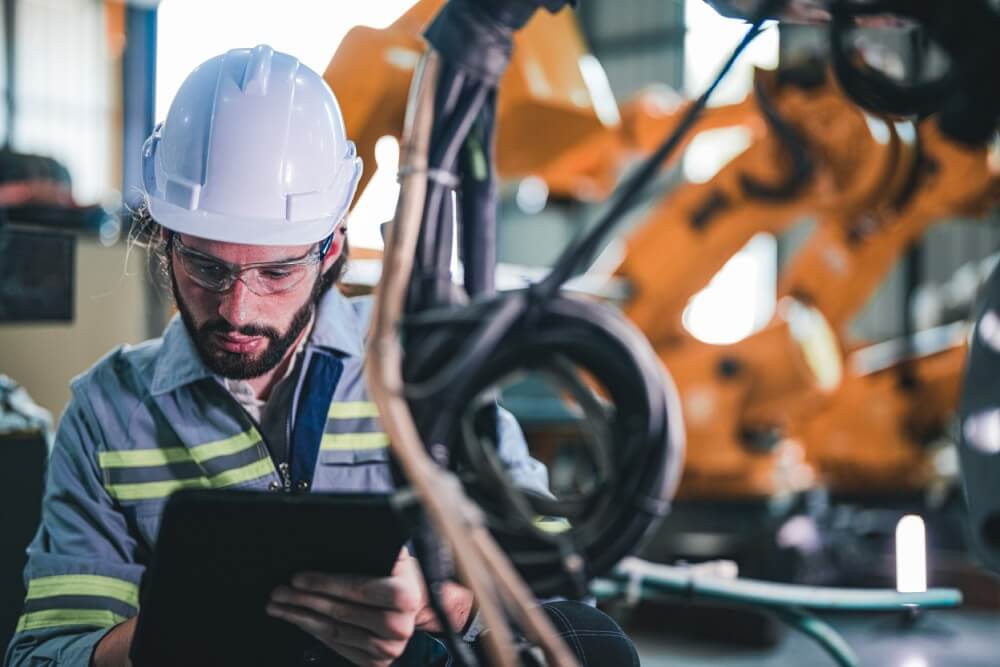
The "Old School" Manager: Many managers pride themselves on "knowing the machine" by sound or touch. This is "Windshield Driving",reacting only to what you see right now.
See our roundup of the analytics tools that replace gut feel.
The Dashboard: You wouldn't drive a car without a fuel gauge or a speedometer. You need instruments to tell you what is happening inside the machine, not just outside.
The Fuel Gauge (Inventory): Driving without looking at the fuel gauge means you eventually get stranded on the highway. Running a factory without inventory software means you eventually stop for a missing $5 part.
Want OEE captured straight from your machines, no manual logs?
See it liveQuick answer: Gut-feel maintenance ("the line always breaks on Thursday") is pattern recognition without measurement. Data-driven maintenance replaces those instincts with structured loss data, MTBF tracking, and root-cause categorization.
The dashboard analogy: gut feel is driving by feel; data-driven is driving with a fuel gauge, oil pressure, and engine temperature.
Related deep-dives: OEE data collection methods · MTTR + MTBF analytics · OEE benchmarks · why OEE improvement stalls.
There is a romantic idea in the manufacturing of the "Old School Manager."
He walks the floor. He puts his hand on a motor and says, "It's running a little rough today." He listens to a conveyor and says, "That belt needs tightening."
This is impressive. But it is not a strategy.
This is Management by Gut Feel. It relies entirely on one person being in the right place at the right time.
To scale a business, you need to move from "Gut Feel" to "Data-Driven."
To understand why, just think about driving your car.
When you drive, you use two things:
The Windshield: You look at the road. You see traffic. You react to the car braking in front of you. This is Reactive.
The Dashboard: You check your speed. You check your fuel. You check your engine temp. This is Proactive.
If you drove only looking out the windshield, you would eventually run out of gas. You wouldn't know you were speeding until the police stopped you. You wouldn't know the engine was overheating until steam poured from the hood.
Many factories are driven purely by the windshield. They react to breakdowns (traffic), but they ignore the data (dashboard).
Imagine driving cross-country with your fuel gauge covered up. You just guess when to stop for gas.
Eventually, you will be wrong. You will be stranded on the side of the road, walking miles to a gas station.
In the factory, Inventory Management is your fuel gauge.
Gut Feel: "I think we have plenty of hydraulic oil."
Data: "The system says we have 2 liters left. We need 10 for the week."
Fabrico is the light that turns on to say: "Low Fuel. Refill Now." It prevents the factory from being stranded waiting for a spare part.
Does 60 MPH feel different than 55 MPH? Not really. Without a speedometer, it's hard to tell.
But over a 10-hour drive, that small difference means arriving an hour late.
In the factory, OEE (Production Rate) is your speedometer.
Gut Feel: "The line looks like it's running fast."
Data: "The line is running at 85 units per minute. Target is 100."
You can't "see" a 15% speed loss with your eyes. You need software to measure the cycles and tell you: "You are driving too slow to hit your target."
Modern cars have sensors everywhere. When the computer detects a misfire, the yellow light turns on.
You can't feel the misfire yet. The car drives fine.
But if you ignore the light, two weeks later, the engine blows.
In the factory, Sensors and Inspection Logs are your Check Engine Light.
Gut Feel: "It sounds fine."
Data: "Vibration has increased by 10% this week."
Software captures these "Weak Signals" (The Yellow Light) so you can fix the issue before it becomes a "Red Light" (Breakdown).
Walking the floor is important. You still need to look out the windshield.
But you cannot manage a complex machine or a complex business without looking at the dashboard.
Stop guessing how much gas you have. Stop guessing how fast you are going.
Turn on the dashboard.
[Request a Demo] and let Fabrico show you the vital signs of your factory.
Turn downtime into a number your team can actually act on.
Get a demo


















 Login
Login
 Blog
Blog