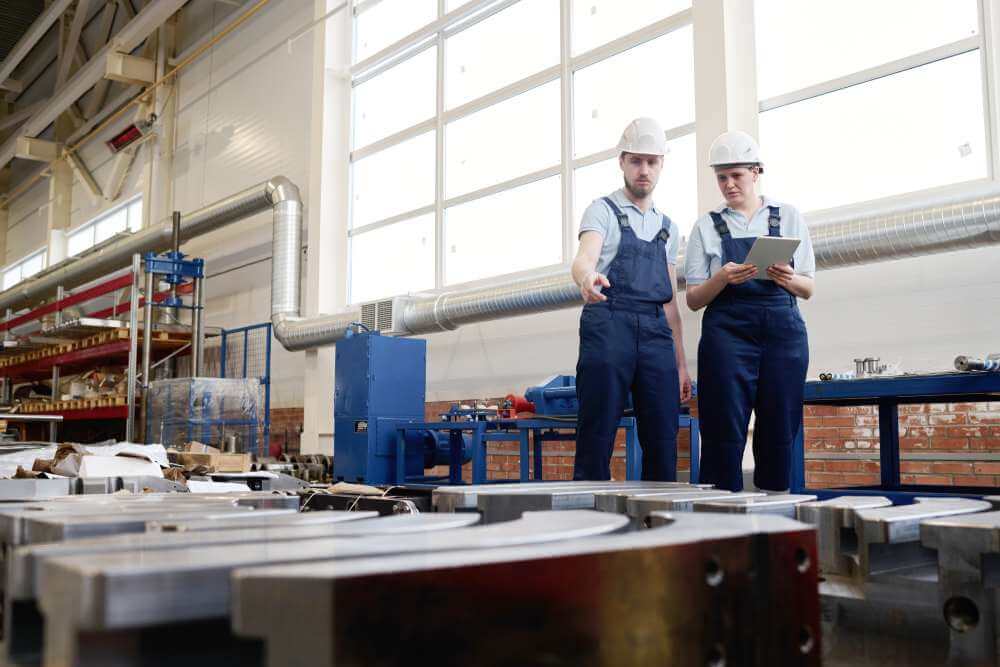
The Wrench Time Problem
Wrench time is the proportion of a maintenance technician's available shift time spent on hands-on maintenance work — the actual physical tasks of inspection, repair, replacement, and adjustment.
In most manufacturing maintenance operations, wrench time is between 25 and 35%.
This means that on a typical eight-hour shift, the average maintenance technician spends between two and three hours on hands-on work.
The other five to six hours are consumed by activities that are necessary — but that a better-designed work environment would reduce significantly.
Waiting for work orders to be assigned.
Traveling to the storeroom to collect parts — sometimes multiple trips per job when the first visit reveals that the required part is not where the inventory system says it should be.
Searching for machine history, schematics, and repair procedures in paper files, shared drives, and email threads.
Verbal coordination with supervisors, production operators, and other technicians.
Waiting for production to release an asset for maintenance.
Completing administrative paperwork — work order sign-off, time reporting, parts consumption recording — at a desktop at the end of the shift rather than at the machine during the job.
None of these activities is waste in the pejorative sense.
They are legitimate requirements of the maintenance function.
The question is whether the current work environment is designed to minimize the time each one consumes — or whether it has accumulated over years into an inefficient architecture that nobody has explicitly designed and nobody has explicitly challenged.
Step 1: Measure Where Time Actually Goes
Before designing any productivity intervention, measure the current state with enough specificity to identify which non-wrench time categories are consuming the most time.
The most practical measurement method for most manufacturing operations is a structured time study — asking each technician to categorize their activities in 15-minute increments for a representative two-week period.
The categories should be specific enough to reveal the root cause of non-productive time.
Hands-on repair work.
Parts collection — storeroom trips, waiting for parts to be located or delivered.
Information search — finding machine history, schematics, repair procedures, fault codes.
Travel — walking between jobs, between storeroom and work site, between work site and office.
Verbal coordination — receiving task assignments, discussing job scope, waiting for production clearance.
Administrative tasks — work order completion, time recording, parts consumption entry.
Waiting — for production to release the asset, for another technician to complete a preceding task, for a specialist or contractor to arrive.
A two-week time study across a team of six technicians produces enough data to identify the dominant non-wrench categories — and those dominant categories determine which interventions produce the greatest productivity recovery.
Two common patterns emerge from this analysis.
Pattern A: Parts and information dominate.
If parts collection and information search together represent 30 to 40% of non-wrench time, the primary productivity opportunity is in the information and logistics architecture — work order content, mobile access, storeroom organization, and parts staging.
Pattern B: Coordination and waiting dominate.
If verbal coordination and waiting together represent 30 to 40% of non-wrench time, the primary productivity opportunity is in the task assignment and scheduling architecture — work order management, production-maintenance alignment, and priority management.
Most operations have elements of both patterns — but one typically dominates, and the dominant pattern determines which lever to pull first.
The Five Maintenance Productivity Levers
Lever 1: Deliver Complete Work Orders Before the Technician Leaves for the Job
The single most impactful productivity intervention available to most maintenance teams is improving the information content of the work order before the technician departs for the asset.
A work order that contains only the fault description — "Line 3 filling machine stopped, alarm code E47" — sends the technician to the machine with no diagnostic context.
They arrive, read the alarm panel, and then return to the office or the storeroom to collect the information and parts they need.
A work order that contains the alarm code meaning, the three most common causes of this alarm on this machine model, the machine's last five work orders showing any pattern relevant to this fault, the correct SOP for the anticipated repair, and the parts list with storeroom location confirmed sends the technician to the machine with everything needed for a first-time fix.
The second technician spends more time at the machine and less time in transit.
The productivity gain from complete work order content is not primarily from faster repair execution — it is from eliminating the additional trips and delays that incomplete information generates.
A technician who makes one trip to the storeroom with a specific parts list is more productive than a technician who makes three trips as successive diagnoses reveal successive parts requirements.
Lever 2: Bring the Storeroom to the Technician
Parts collection is one of the most consistently underestimated productivity drains in manufacturing maintenance.
In most operations, the storeroom is a central location that technicians travel to before and during each job.
For a large facility where the storeroom is a ten-minute walk from the furthest production area, a two-trip parts collection process adds 40 minutes of non-wrench travel time to a job.
On a team executing 40 jobs per day, that is 1,600 minutes — 26 hours — of daily travel time attributable to storeroom trips alone.
Two interventions reduce this significantly.
Pre-staged parts kits: For planned PMs — where the parts required are known in advance — the storeroom team stages the complete parts kit and delivers it to the maintenance area closest to the asset before the PM window opens. The technician collects one package rather than making individual storeroom trips.
Mobile storeroom carts: For production areas with high fault frequency, a mobile cart stocked with the most commonly required consumables and wear parts for that area eliminates the storeroom trip entirely for the most frequent repair types.
Neither intervention requires significant technology investment.
Both require accurate consumption data — knowing which parts are most frequently used in which areas — which is a data quality problem that a well-adopted CMMS solves.
Lever 3: Eliminate the Desktop Work Order Completion Requirement
In operations where technicians complete work orders at a desktop at the end of the shift — entering fault codes, labor time, parts consumed, and repair notes from memory after six to eight hours of field work — two productivity problems compound each other.
The end-of-shift work order completion consumes 20 to 45 minutes of every technician's shift that could be spent on hands-on work.
The data quality produced by retrospective memory entry is significantly lower than data captured at the machine during the job.
Mobile work order completion — closing the work order at the machine immediately after the repair, while the diagnostic details are fresh — eliminates the end-of-shift administration time and simultaneously improves data quality.
For a team of six technicians each spending 30 minutes per shift on end-of-shift administration, shifting to mobile completion recovers three hours per day of maintenance capacity — 750 hours per year — without changing headcount or skill levels.
The prerequisite is a mobile CMMS interface that makes work order completion at the machine faster and simpler than desktop entry at the end of the shift.
If the mobile interface is more cumbersome than the desktop interface, the behavior does not change.
Lever 4: Shift Task Assignment From Pull to Push
In most manufacturing maintenance operations, task assignment follows a pull model — technicians complete their current job, return to the maintenance office or supervisor, and receive their next assignment verbally or from a paper queue.
The pull model creates two productivity gaps.
The travel time between completing a job and receiving the next assignment — returning to the office, waiting for the supervisor's attention, and then traveling to the next job location.
The idle time when the technician is between jobs and the supervisor is occupied with other priorities — a gap that can range from minutes to hours depending on how effectively the supervisor is managing the queue.
A push model — where the next work order is automatically delivered to the technician's mobile device as soon as the current work order is closed — eliminates both gaps.
The technician closes the current work order, receives the next assignment on their mobile device, and proceeds directly to the next job without returning to the office.
The supervisor manages the work order queue and priority assignment rather than serving as a human dispatch relay between the queue and the technicians.
Lever 5: Reduce Waiting Time Through Production-Maintenance Scheduling Alignment
Waiting for production to release an asset for maintenance is one of the most significant sources of non-wrench idle time — and one of the hardest to address without structural changes to how production and maintenance schedules are coordinated.
In most operations, the conflict between production requirements and maintenance needs is discovered at execution time — the maintenance team arrives to perform a PM and the asset is in production, or the production team books an asset to maximum capacity without knowing a PM is due.
The resolution happens on the shop floor — typically by deferring the PM until a window becomes available.
The structural fix is surfacing maintenance constraints in the production scheduling environment before production commitments are made.
When the production planner building next week's schedule can see that Machine 7 has a planned PM on Tuesday morning, they can schedule production orders around that constraint rather than discovering the conflict when the maintenance team arrives.
The waiting time that technicians experience at the asset — waiting for production to complete a run before the PM window opens — is a symptom of a planning alignment failure rather than a maintenance execution failure.
Resolving it requires either a shared planning process or a planning tool that shows both production orders and maintenance requirements in the same scheduling view.
Building the Productivity Improvement Business Case
The financial case for maintenance productivity improvement is straightforward to calculate.
Current wrench time baseline: Estimated from the time study in Step 1, or from the industry average of 25 to 35% as a starting point.
Target wrench time: 45 to 50% is a realistic 12-month target for operations implementing the five levers above.
Productivity recovery calculation:
Team size × Annual hours per technician × Wrench time improvement percentage = Annual productive hours recovered.
For a team of six technicians, each working 2,000 hours per year, improving wrench time from 30% to 45%:
6 × 2,000 × 15% = 1,800 hours per year recovered.
Value of recovered hours:
The value of recovered productive maintenance hours can be expressed in two ways.
As avoided contractor costs — if the operation currently uses contractors to cover maintenance capacity gaps, recovered internal productive hours reduce contractor dependency.
As accelerated PM compliance — if PMs are being deferred because the maintenance team lacks capacity, recovered hours enable the PM completion that reduces unplanned failure frequency.
At a fully-loaded internal technician cost of €45 per hour, 1,800 recovered hours represents €81,000 in maintenance capacity recovered annually — before the downstream OEE improvement from better PM compliance is calculated.
The Productivity-Adoption Connection
One point worth making explicitly.
Every productivity lever in this guide depends on technician behavior — specifically, on technicians using the work order system the way it was designed to be used rather than working around it.
The interventions that produce the highest productivity gains — mobile work order completion, push-based task assignment, complete work order content — only deliver their value if the maintenance team adopts the mobile execution environment consistently.
Low adoption produces the worst of both worlds — the cost of the system without the productivity benefit of the behavioral change.
The interventions that produce the highest adoption rates are those that make the technician's job demonstrably easier rather than adding administrative burden in exchange for management visibility.
A mobile work order completion process that saves the technician 30 minutes of end-of-shift administration produces adoption naturally.
A mobile work order completion process that adds five minutes of field data entry without any visible benefit to the technician produces resistance — regardless of the management visibility it creates.
Designing the productivity intervention from the technician's perspective — starting with what makes their job easier — produces both the adoption and the data quality that makes every other improvement initiative more effective.
Frequently Asked Questions
What is a realistic wrench time improvement target for a 12-month program?
Moving from 30% to 45% wrench time within 12 months is achievable for most manufacturing maintenance teams implementing the five levers in this guide.
The improvement is not linear — the first interventions typically produce the largest gains as the dominant non-wrench time categories are addressed.
Operations starting from particularly low wrench time baselines — below 25% — may achieve larger improvements as the most significant architectural barriers are resolved.
Does improving wrench time require hiring more technicians?
No — wrench time improvement recovers productive capacity from the existing team rather than adding headcount.
The recovered capacity can be directed toward PM compliance improvement, condition-based maintenance program development, or backlog reduction — depending on which of those priorities is most financially significant for the operation.
How does wrench time connect to MTTR?
Higher wrench time does not directly reduce MTTR — a technician who spends more time on hands-on work is not necessarily a faster repairer.
The connection is indirect.
The information quality and parts staging improvements that increase wrench time — by eliminating non-productive trips and delays — also reduce the diagnosis and dispatch components of MTTR.
A technician who arrives at the machine with complete information and pre-staged parts produces both higher wrench time and lower MTTR from the same set of architectural improvements.
The maintenance team that is working hard but producing poor OEE outcomes is almost never the problem. The architecture that surrounds them — the work orders they receive, the information they have access to, the parts they can find, the coordination they depend on — is almost always the problem. Fixing the architecture recovers the productivity that the team's effort is already generating but the system is currently wasting.


 Login
Login
 Blog
Blog