If you walk into a factory and see every machine running, every light green, and every operator moving, it looks like a successful day.
But appearances are deceiving.
That machine running at full speed might be producing defective parts. That conveyor might be running at 80% of its design speed. That operator might be building inventory that won't be sold for three months.
This is the danger of measuring success by Machine Utilization.
Utilization is a simple metric. It asks: "Is the machine on?"
In the past, this was enough. But in the modern factory, "Busy" does not equal "Productive."
To truly understand your performance, you must compare Utilization against Overall Equipment Effectiveness (OEE). Understanding the difference is the key to unlocking hidden capacity without burning out your equipment.
Here is the strategic guide to these two critical metrics in 2026.
1. What is Machine Utilization? (The "On" Switch)
Utilization is a measure of available time versus scheduled time. It is a raw calculation of uptime.
The Problem:
Utilization is blind. It does not care how the machine ran.
-
Did it run slow? Utilization says "Who cares."
-
Did it make scrap? Utilization says "Who cares."
-
Did it burn out the motor? Utilization says "Good job."
Utilization incentivizes operators to keep the machine running at all costs, even if it means skipping breaks, ignoring noises, or producing bad parts.
2. What is OEE? (The "Value" Metric)
OEE (Overall Equipment Effectiveness) is a measure of value. It asks: "Of the time we were running, how much of it was perfect?"
It multiplies three factors:
-
Availability: Did it run when scheduled? (Utilization).
-
Performance: Did it run at full speed?
-
Quality: Did it make good parts?
The Contrast:
Imagine a machine runs for 8 hours (100% Availability).
But the operator turned the speed dial down to 80% (Performance).
And 10% of the parts were rejected (Quality).
OEE reveals the truth that Utilization hides.
3. The "100% Utilization" Trap
Many executives set a goal of "maximize asset utilization" to improve Return on Investment (ROI). This sounds logical financially but is dangerous operationally.
The Inventory Trap:
If you force a non-bottleneck machine to run at 100% utilization, you create Overproduction. You build parts faster than the next machine can eat them. This creates piles of WIP (Work-In-Progress) inventory, which ties up cash and hides defects.
The Maintenance Trap:
If a machine is utilized 100% of the time, when do you change the oil? When do you tighten the belt?
High utilization destroys asset reliability. It forces you into a "Run to Failure" strategy because you never gave the maintenance team a window to enter the cage.
4. When to Use Which Metric?
You need both metrics, but you must apply them to the right assets.
Use Utilization for Bottlenecks:
Your bottleneck is the constraint of the factory. Every minute lost there is lost revenue.
Use OEE for Everything Else:
For the rest of your machines, "running all day" is not the goal. "Running efficiently" is the goal.
5. Capturing the Data Without Bias
The biggest challenge with both metrics is the source of the data.
-
Manual Logs: An operator will rarely write down that they ran the machine slow. They will fudge the numbers to make the OEE look good.
-
Paper Utilization: An operator will often leave the machine "Running" while they are at lunch just to keep the utilization timer ticking, even if no parts are being made.
The Solution: Automated Data Collection
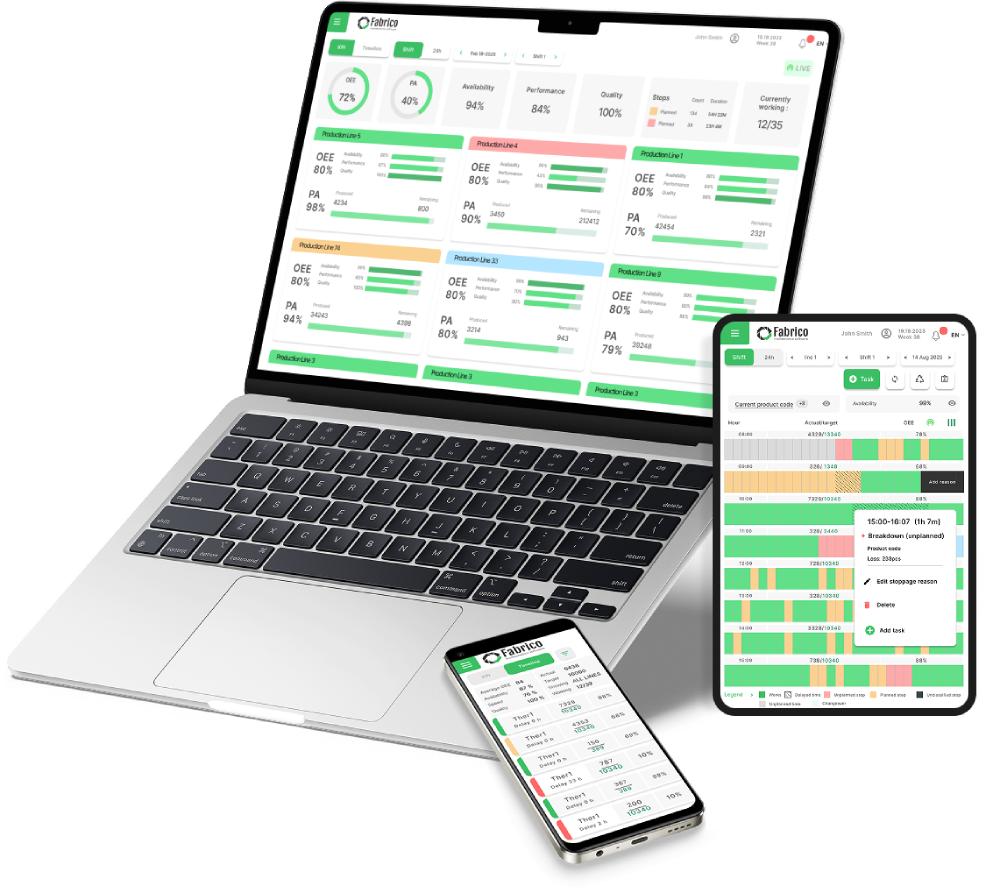
You need software like Fabrico that connects directly to the machine signals.
-
It counts actual cycles (Performance).
-
It tracks actual reject signals (Quality).
-
It logs the exact start/stop times (Availability).
This removes the human bias. It shows you the gap between "What we thought we did" (Utilization) and "What we actually sold" (OEE).
Conclusion: Stop Being Busy. Start Being Effective.
If your strategy is simply "Keep the machines running," you are likely wasting energy, materials, and maintenance budget.
Utilization is a measure of quantity. OEE is a measure of quality.
By shifting your focus to OEE, you stop rewarding busy work and start rewarding value creation. You might run your machines fewer hours, but you will produce more sellable product at a lower cost. That is true efficiency.


 Login
Login
 Blog
Blog