If you are managing a manufacturing plant, you don’t need "facility management" software. You don’t need a tool designed to fix leaky sinks in an office building.
You need a system that understands Throughput, OEE, and Cycle Times.
For years, manufacturers have been forced to choose between heavy, expensive ERP modules (like SAP PM) or lightweight, generic CMMS apps.
Both fail to address the core reality of the factory floor: Maintenance and Production are the same process.
If your maintenance software doesn't know when a machine is running, how fast it's cycling, or why it micro-stopped 50 times an hour, it isn't managing maintenance; it's just archiving your downtime.
Here is why 2026 is the year to switch to Manufacturing Maintenance Software that actually connects the dots.
What is Manufacturing Maintenance Software?
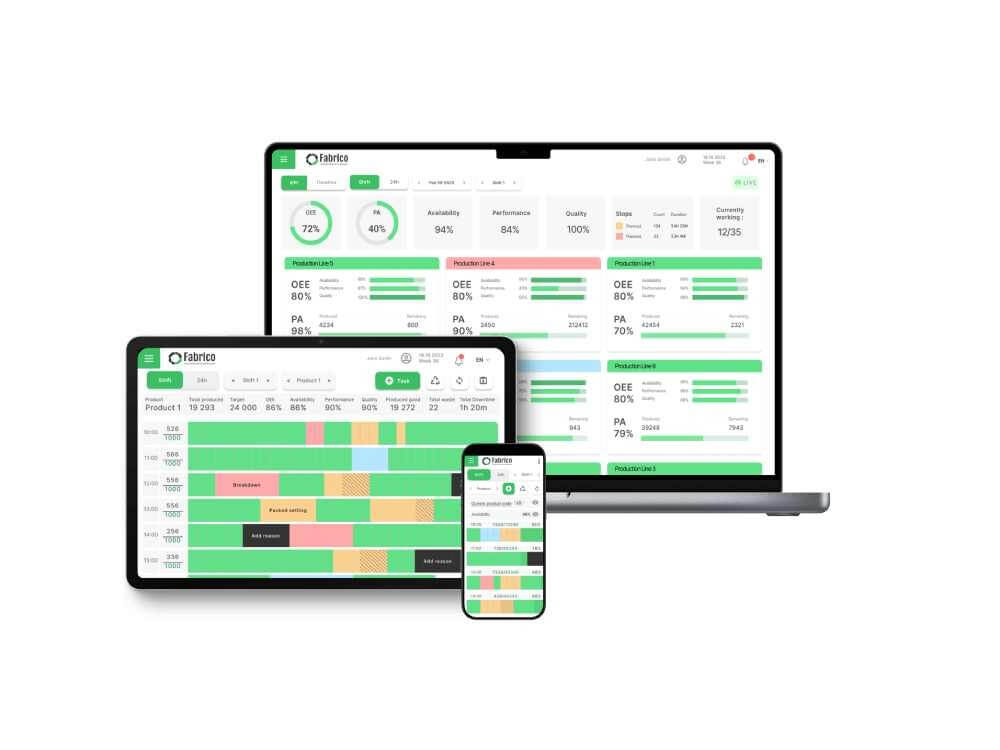
Manufacturing Maintenance Software is a specialized digital platform that combines maintenance execution (CMMS) with real-time production data (OEE/MES).
Unlike generic asset management tools, it connects machine health signals, operator inputs, and maintenance workflows into a single "System of Action" to maximize Effective Runtime and reduce manufacturing costs.
The "Hidden Factory" Problem
Most factories suffer from the "Hidden Factory"—the lost capacity caused by micro-stops, slow cycles, and changeover delays that never get logged in paper logbooks.
Standard CMMS tools rely on a technician manually creating a Work Order after a machine breaks. This is reactive.
Fabrico’s Unified Data Intelligence approach changes this by triangulating data from three sources:
-
Machine Signals (PLC/IoT): Hard data on stops and cycles.
-
Operator Inputs: Context from the people running the line.
-
Computer Vision: Visual evidence of why the stop happened.
By integrating these data streams, your maintenance software doesn't just track repairs; it identifies the Root Cause of lost OEE.
3 Capabilities Generic Software Can’t Match
1. The "Inefficiencies Zoom-In" (Computer Vision)
In a standard CMMS, if a machine stops for 2 minutes, an operator might log "Unknown" or nothing at all. Over a month, these unlogged stops kill your OEE.
Fabrico uses Computer Vision to bridge this gap. Cameras overseeing the line continuously buffer video. When a downtime event is detected (via PLC or anomaly), the system captures the exact footage of that moment.
-
The Benefit: You can "Zoom In" on the specific event. Was it a jam? A blocked sensor? An operator waiting for material?
-
The Result: You have visual proof for your Root Cause Analysis (RCA), allowing you to fix the process, not just the machine.
2. Condition-Based Maintenance (CBM) Triggers
Legacy systems rely on calendar-based PMs (e.g., "Change oil every 3 months"). This is inefficient. You are either over-maintaining (wasting parts/labor) or under-maintaining (risking failure).
True manufacturing software moves you to Usage-Based Maintenance.
-
How it works: Fabrico tracks actual run hours, cycle counts, or performance degradation via IoT/PLC connection.
-
The Action: When a threshold is breached (e.g., 10,000 cycles or temperature > 80°C), the system automatically generates a prioritized Work Order.
-
The ROI: You stop wasting money on unnecessary PMs and prevent breakdowns before they happen.
3. The "GenAI" Technician Assistant
Technicians spend up to 20% of their day looking for information—manuals, schematics, or past repair history.
Fabrico Assistant acts as a force multiplier. It indexes all your uploaded OEM manuals and historical repair logs.
-
The Scenario: A technician faces "Error Code 504" on a palletizer.
-
The Solution: Instead of digging through a PDF, they ask Fabrico Assistant: "How do I reset Error 504?" The AI provides the exact step-by-step procedure and highlights safety warnings immediately.
Comparison Matrix: Fabrico vs. Generic CMMS
Why "Manufacturing-Specific" matters for your bottom line.
| Feature |
Fabrico (Manufacturing Specialized) |
Generic CMMS (UpKeep, MaintainX) |
Legacy ERP (SAP PM, Maximo) |
| Core Philosophy |
System of Action (OEE + Maint) |
Digital Logbook (Chat/WO) |
System of Record (Finance) |
| Native OEE Tracking |
✅ Yes (Availability/Performance/Quality) |
❌ No (Requires 3rd party) |
❌ No (Requires MES module) |
| Video Root Cause |
✅ Inefficiencies Zoom-In |
❌ No |
❌ No |
| Condition-Based Triggers |
✅ Native & Automated |
⚠️ Limited (API heavy) |
⚠️ Complex Customization |
| Technician Experience |
✅ Field-Ready Mobile App (Offline) |
✅ Good Mobile App |
❌ Terrible UX (Desktop focus) |
| Production Scheduling |
✅ Interactive Planning Board |
❌ No |
✅ Yes (But complex) |
The Fabrico Framework: From Data to Action
Implementing Manufacturing Maintenance Software isn't just about buying an app; it's about changing how your teams interact.
-
Capture: Signals flow from PLCs and Cameras into Fabrico.
-
Analyze: The Fabrico Agent (AI) looks for patterns—bottlenecks, recurring micro-stops, or schedule conflicts.
-
Act: A Work Order is triggered automatically, or the Interactive Planning Board adjusts the production schedule to account for downtime.
-
Improve: Use the "Zoom-In" footage to run a Kaizen event and permanently eliminate the waste.
Conclusion: Stop Treating Maintenance as an Island
If your maintenance team is using one system and your production team is using another (or just Excel), you are creating data silos that hide inefficiency.
To reach World-Class OEE (85%+), you need a single source of truth. You need software that respects the complexity of manufacturing—where every minute of downtime costs money, and every cycle counts.
Ready to see the "Hidden Factory"?
[Request a Demo] and see how Fabrico connects OEE, Maintenance, and Quality in one platform.


 Login
Login
 Blog
Blog