
Key Takeaways
Selecting the best OEE software for BRC Global Standards (BRCGS) is the ultimate defense against failed audits and catastrophic product recalls.
Relying on paper-based sanitation logs and maintenance binders guarantees human error, lost data, and severe compliance violations.
Legacy financial tools like SAP PM create massive administrative friction, incentivizing frontline workers to "pencil whip" critical safety checks.
A true compliance platform must unify Overall Equipment Effectiveness (OEE), digital checklists, and a field-ready mobile CMMS into one digital audit trail.
Scanning the QR code on each asset opens its checklist, and every completed step is logged with the user and time, giving auditors a clear record of execution.
The BRC Global Standard for Food Safety is one of the most rigorous and globally recognized certification programs in the manufacturing industry.
Achieving and maintaining BRCGS certification is not a localized operational goal; it is a fundamental requirement to sell products to major global retailers.
During an audit, inspectors demand absolute proof that sanitation cycles, preventive maintenance (PM) routines, and quality checks were executed flawlessly.
If your facility relies on a disconnected tech stack, where OEE is tracked on a passive dashboard and maintenance is logged in a dusty paper binder, you are operating at extreme risk.
An auditor finding a single missing signature on a clean-in-place (CIP) checklist can trigger non-conformances that paralyze your supply chain.
The greatest threat to your BRCGS certification is the administrative fatigue of your frontline workers.
When operators and technicians are handed a stack of thirty paper checklists at the start of their shift, their primary goal shifts from food safety to paperwork completion.
This friction inevitably leads to "pencil whipping," where workers sign off on critical lubrication or sanitation tasks without actually performing the work.
To the naked eye, the paper logs look 100% compliant, but the physical asset is secretly degrading and harboring contamination risks.
You cannot protect your enterprise valuation if your compliance data is fundamentally fake.
Corporate IT departments frequently attempt to digitize compliance by forcing the factory to use legacy Enterprise Asset Management (EAM) modules.
Systems like IBM Maximo and SAP are powerful Systems of Record for accountants, but they are entirely user-hostile for mechanics covered in food-grade grease.
Forcing a technician to walk to a desktop portal to log a completed food safety inspection creates a massive "latency tax."
Because the software is incredibly slow and complex, technicians delay reporting their tasks, making real-time compliance tracking impossible for Quality Directors.
You must deploy a system that actively makes the frontline worker's job easier, not harder.
To survive unannounced audits with absolute confidence, you must automate the execution of your safety standards.
Here are the three rules for building a bulletproof BRCGS compliance architecture in 2026.
Paper checklists must be permanently eradicated from the shop floor.
Your OEE software must integrate directly with a field-ready mobile CMMS that delivers digital Clean, Inspect, and Lubricate (CIL) tasks to the operator's smartphone.
These digital Standard Operating Procedures (SOPs) have workers enter exact pressure readings, take photos of sanitized components, and provide digital sign-offs.
This creates an unalterable, time-stamped digital audit trail that gives even the strictest BRCGS inspector a complete record.
Pencil whipping a digital checklist gets much harder when it starts with a scan of the QR code on the machine.
When operators and technicians scan the unique QR code attached to the physical asset, your system records the scan with the user and time.
This action instantly opens the specific food safety work order.
If an auditor questions whether a critical control point was actually inspected, you have a time-stamped record of the inspection.
In food manufacturing, a shattered machine component or a jammed feeding mechanism poses a severe foreign object contamination risk.
Your compliance platform must augment raw machine data with Fabrico’s Inefficiencies Zoom-In module.
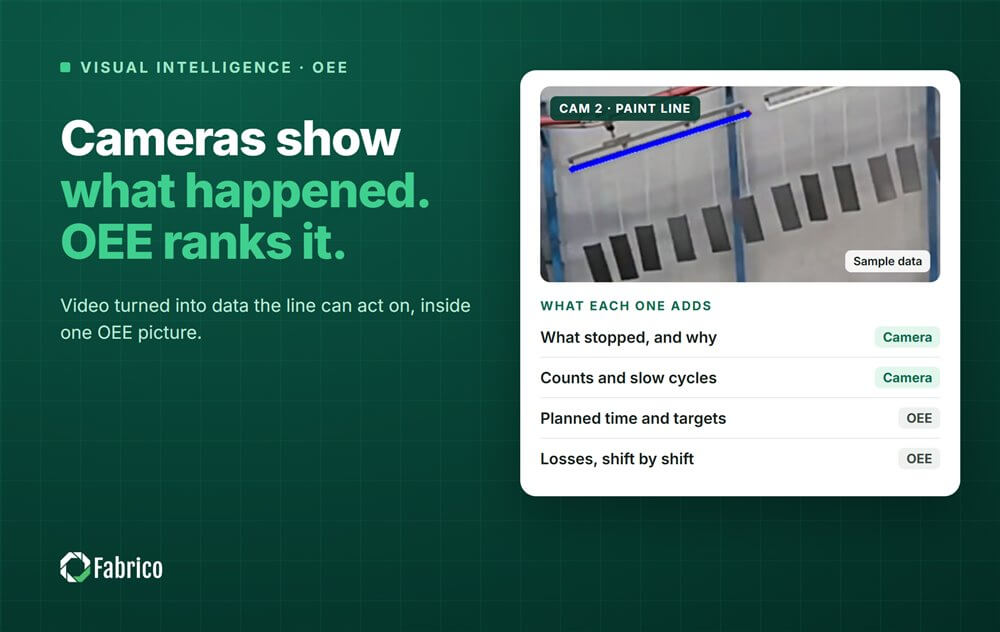
This industrial computer vision technology captures synchronized video clips of the exact moment a high-speed line stalls or crashes.
This visual evidence allows continuous improvement teams to verify immediately if any machine parts entered the food stream, drastically reducing recall liability.
Use this matrix to understand why standalone document systems fail compared to one platform for machine data and maintenance.
| Operational Capability | Passive OEE Dashboards | Legacy EAMs (SAP/Maximo) | The Fabrico platform |
| BRCGS Audit Readiness | Low (Missing Execution Data) | High (But Data is Often Fake) | Complete Digital Audit Trail |
| Digital CIL Enforcement | No | Requires Clunky Add-Ons | Yes (Native to Mobile App) |
| Frontline Mobile UX | Irrelevant | Highly Complex / Desktop Heavy | Frictionless (QR Code Driven) |
| Visual Quality Control | No | No | Yes (Inefficiencies Zoom-In) |
| Work Order from the Stop | No | Custom Middleware Required | Yes (opened from the logged stop in the CMMS) |
You cannot run a world-class food manufacturing group if your compliance data relies on human memory and paper binders.
Fabrico operates on a singular, unyielding philosophy: OEE diagnoses the problem, and the CMMS cures it.
Our unified platform acts as the ultimate compliance engine, providing your technicians with frictionless mobile workflows while generating the digital audit trails your QA team demands.
Looking forward, our technology roadmap is heavily focused on pushing this safety intelligence further through advanced artificial intelligence.
Simultaneously, the Fabrico Assistant is available today as a generative AI copilot, providing your technicians with instant answers derived directly from your machine manuals and maintenance records.
Stop losing sleep over unannounced food safety audits.
Request a demo with Fabrico today, and discover how one platform for machine data and maintenance strengthens your global compliance.
Turn downtime into a number your team can actually act on.
Request a demo









 Login
Login
 Blog
Blog