Work in Process (WIP) is often treated as an asset on the balance sheet, but on the factory floor, it is a liability.
WIP consumes floor space, requires transport labor, hides quality defects, and extends your lead time. If you have 5 days of WIP between Machine A and Machine B, it takes 5 days for a quality defect at Machine A to be discovered at Machine B. By then, you have 5 days of scrap.
For a Plant Manager, reducing WIP is a strategic lever. It turns a sluggish, cash hungry operation into an agile, lean machine.
However, you cannot simply ban WIP. WIP exists for a reason: usually to buffer against instability. To reduce WIP sustainably, you must remove the instability.
Here are 5 data driven strategies to reduce Work in Process in manufacturing in 2026.
1. Attack the "Fear Buffers" with Reliability
Why do operators stack up parts between machines? Fear.
They are afraid that the upstream machine will break down, starving them. Or they are afraid their machine will break down, so they build a pile to keep the downstream process running.
Unplanned downtime is the primary driver of excess WIP.
The Strategy:
-
Increase MTBF: Implement Condition Based Maintenance on the critical machines feeding the WIP piles. If the machine is reliable, the operator doesn't need the buffer.
-
Visual Uptime: Show operators the real time health of the upstream machine. If they know it is running well, they stop hoarding material.
-
Targeted Maintenance: Focus your maintenance resources specifically on the assets that are causing the "Starve/Block" events.
2. Shrink Batch Sizes (One Piece Flow)
Large batches guarantee high WIP.
If you produce 1,000 units at Step 1 before moving them to Step 2, you automatically have 1,000 units of WIP sitting idle.
Factories run large batches to avoid changeovers. "It takes 2 hours to set up, so we better run for 2 days." This logic optimizes the machine but sub-optimizes the system.
The Strategy:
-
Reduce Setup Time (SMED): Aggressively attack changeover times. If setup takes 10 minutes instead of 2 hours, you can run batches of 100 instead of 1,000.
-
Digital Setup Guides: Use digital checklists to standardize and speed up changeovers, making small batches economically viable.
-
Campaign Planning: Group similar products to minimize the "Major" changeovers while allowing for smaller "Minor" changeovers.
3. Balance the Line (Takt Time)
WIP accumulates where the flow stops. If Process A runs at 100 parts per minute, and Process B runs at 80 parts per minute, you will generate 20 parts of WIP every minute.
You cannot solve this by making Process A run faster. You solve it by balancing the line.
The Strategy:
-
OEE Analysis: Use data to find the true speed of each process step (not the nameplate speed).
-
Throttling: It may be counterintuitive, but you should slow down Process A to match Process B. This prevents the WIP pile from growing and saves energy/material.
-
Buffer Management: Define a standard maximum buffer (e.g., 1 pallet). If the buffer is full, Process A must stop. Use sensors to automate this stop.
4. Eliminate Rework Loops
Rework is "Zombie WIP." It is product that should have left the factory but is stuck in a loop of repair and re-inspection.
Rework piles clog up the aisles and confuse the schedule. They require extra handling, extra tracking, and often lead to lost orders.
The Strategy:
-
First Pass Yield Focus: Track quality at the source.
-
Machine Health Links: Often, defects are caused by machine drift (wear). Connect your quality data to your maintenance software. If a machine starts making bad parts, trigger a maintenance check immediately.
-
Disposition Speed: Don't let rework sit. Enforce a "24 Hour Disposition" rule. Either fix it today or scrap it today. Do not let it become WIP inventory.
5. Digitize WIP Tracking
In many plants, WIP is invisible to the planning system. The ERP knows raw material and finished goods, but the "black hole" in the middle is a mystery.
If you don't know where the WIP is, you will order more raw material than you need, creating even more WIP.
The Strategy:
-
Mobile WIP Logging: Operators should log production at each step using a tablet. "Job 123 moved to Station 4."
-
Barcode/QR Scanning: Attach a traveler to the WIP bin. Scanning it updates the central system instantly.
-
Visual Dashboard: Planners should see a "Heat Map" of the factory floor showing exactly where the inventory bubbles are building up in real time.
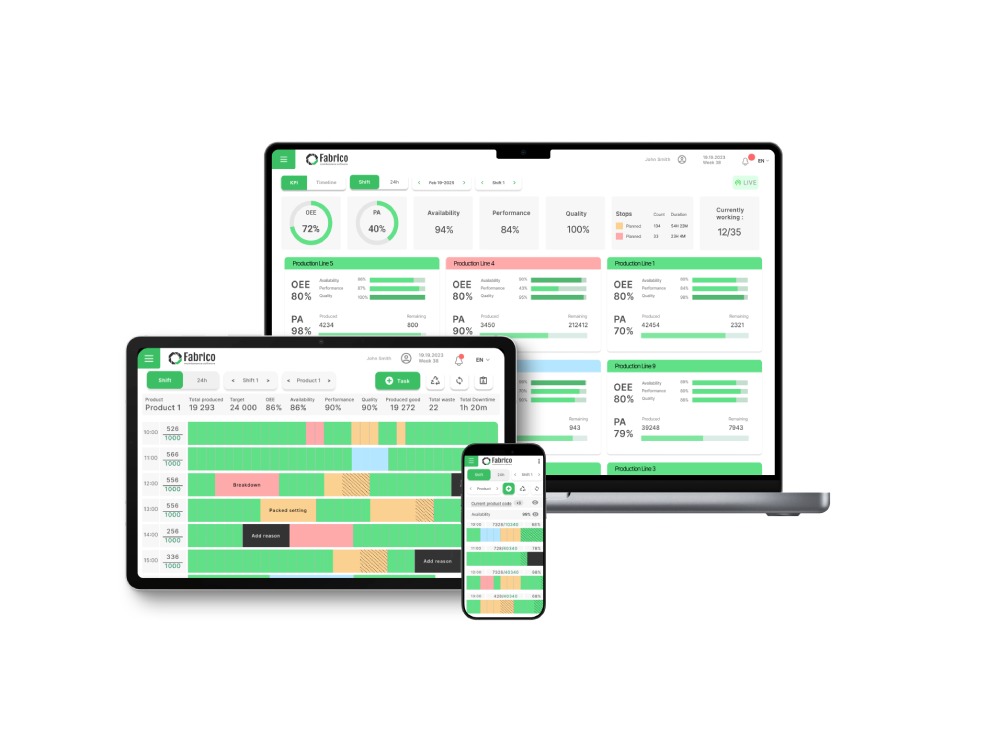
The Fabrico Framework: Flow Requires Stability
You cannot have a Low WIP factory with High Downtime machines.
Fabrico provides the stability you need to remove the buffers.
-
We Improve Reliability: So operators trust the machines and stop hoarding parts.
-
We Speed Up Changeovers: So you can run smaller batches with less inventory.
-
We Visualize Defects: So you can stop rework loops before they start.
Ready to free up your cash?
Stop paying to store unfinished product. [Request a Demo] to see how Fabrico helps you reduce Work in Process.


 Login
Login
 Blog
Blog