Most factories run on a 24 hour feedback loop. The shift ends, the reports are compiled, and the next morning, management reviews what went wrong.
This is Lagging Management. If the machine went down at 10:00 AM, and you discuss it at 8:00 AM the next day, you have lost 22 hours of opportunity. You cannot fix yesterday.
Short Interval Control (SIC) is the practice of reviewing production data at short, regular intervals (usually every 2 or 4 hours) during the shift to identify losses and take immediate corrective action.
It changes the question from "Why did we miss the target?" to "How do we hit the target by 5:00 PM?"
Here is how to implement a data driven Short Interval Control system in 2026.
1. Move from "End of Shift" to "Real Time" Data
The foundation of SIC is accurate, timely data. You cannot correct a course if you are driving with a blindfold.
In many plants, operators fill out a tally sheet at the end of the shift. This creates "batch data" that hides the specific hour where the loss occurred.
The Strategy:
-
Automated Counters: Use sensors or software to track production counts in real time.
-
The "Pace" Metric: Display the "Target vs. Actual" for the current hour. If the target is 100 and the machine is at 80, the operator knows instantly they are 20 units behind.
-
Visible Scoreboards: Place large screens or tablets at the line. The score must be visible to the person who can influence it (the operator), not just the manager in the office.
2. Digitize the "Hour by Hour" Board
The "Hour by Hour" board is a classic Lean tool. Operators write down their output every hour and list reasons for any misses.
While effective, paper boards have limits. They are messy, hard to analyze later, and require manual effort.
The Strategy:
-
Digital Entry: Replace the whiteboard with a tablet interface. Operators tap to log the reason for a miss (e.g., "Jam," "No Material," "Setup").
-
Pareto Analysis: The software instantly aggregates these reasons. You can see that "Jams" caused 80% of the losses in the last 4 hours.
-
Historical Trends: Unlike a whiteboard that gets erased, digital data is saved. You can analyze if the 10:00 AM hour is consistently bad across all shifts.
3. Establish the "Course Correction" Huddle
Data without conversation is just noise. SIC requires a structured review routine.
This is not a long meeting. It is a 5 minute "stand up" at the line between the Team Lead and the Operator.
The Strategy:
-
The Interval: Set a cadence. For high volume lines, check every 2 hours. For slower processes, every 4 hours.
-
The Trigger: If the line is Green (on target), no meeting is needed. If the line is Red (behind), the Team Lead goes to the line immediately.
-
The Question: Ask "What is stopping you right now?" and "What do you need to catch up?" The focus is on recovery, not blame.
4. Connect SIC to Maintenance and Support
Often, the operator knows why they are behind (e.g., "The wrapper is drifting"), but they cannot fix it alone. They need Maintenance.
If the operator has to leave the line to find a mechanic, the SIC process breaks down.
The Strategy:
-
Digital Andon: If an SIC review identifies a machine issue, trigger a maintenance request instantly from the interface.
-
Escalation Logic: If the issue cannot be resolved within the interval (e.g., 2 hours), escalate it to the Production Manager. Don't let a small problem burn the whole shift.
-
Resource Reallocation: If Line 1 is down waiting for parts, move the crew to Line 2 immediately. SIC gives you the visibility to make these labor moves dynamically.
5. Close the Loop with the Daily Management System (DMS)
SIC handles the hours. The Daily Management System (DMS) handles the days.
The issues found during SIC checks must flow up to the next morning's Tier 2 meeting. If the SIC logs show "Conveyor Jam" every 2 hours for 3 days, this is no longer a shift issue; it is a chronic engineering issue.
The Strategy:
-
Automated Reporting: The SIC software should generate a "Shift Summary" for the morning meeting.
-
Chronic vs. Acute: Use the morning meeting to solve the chronic problems identified by the SIC data.
-
Feedback: Tell the operators what you are doing to fix the chronic issue. If they see that their SIC logs lead to permanent fixes, they will trust the system.
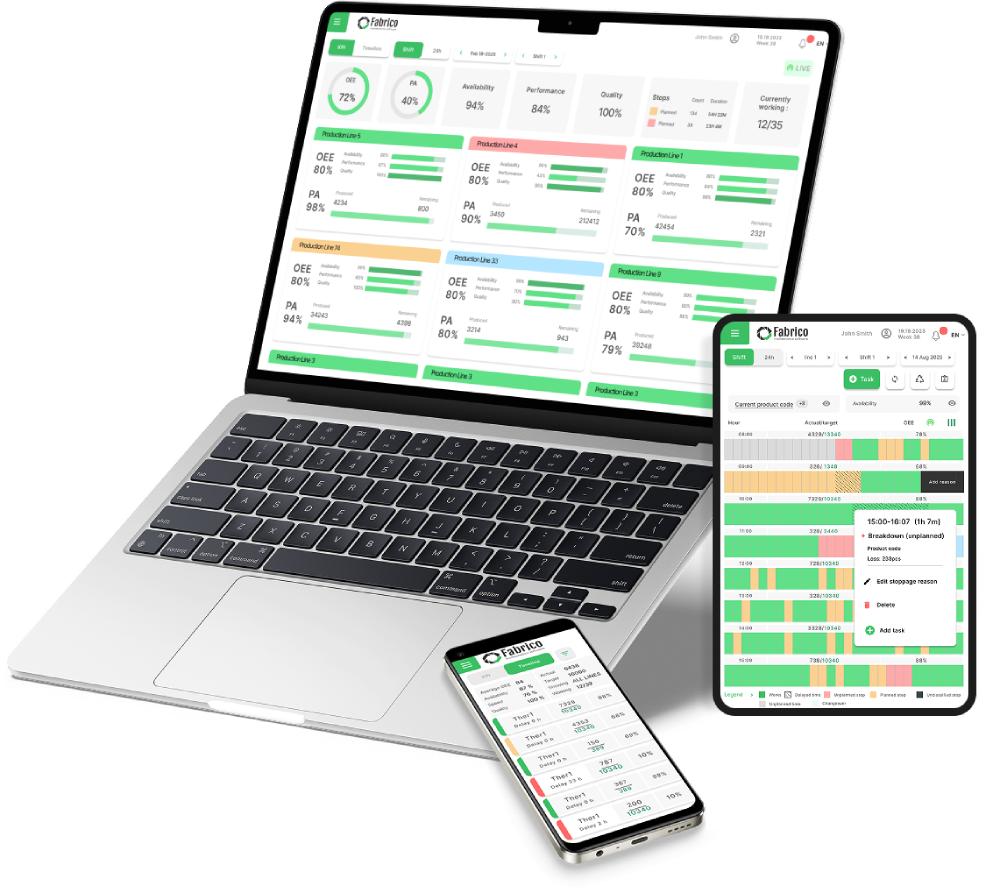
The Fabrico Framework: The Digital Pulse
Short Interval Control turns a factory from a reactive organization into a proactive one. It empowers the shop floor to own their hour.
Fabrico provides the digital platform to make SIC easy.
-
Real Time Targets: We show the operator exactly where they stand against the plan.
-
Instant Logging: We make it easy to record the "Why" behind the downtime.
-
Actionable Alerts: We connect the operator's need to the maintenance team's response.
Ready to win every hour?
Stop waiting for the end of the shift to find out you missed the target. [Request a Demo] to see how Fabrico powers Short Interval Control.


 Login
Login
 Blog
Blog