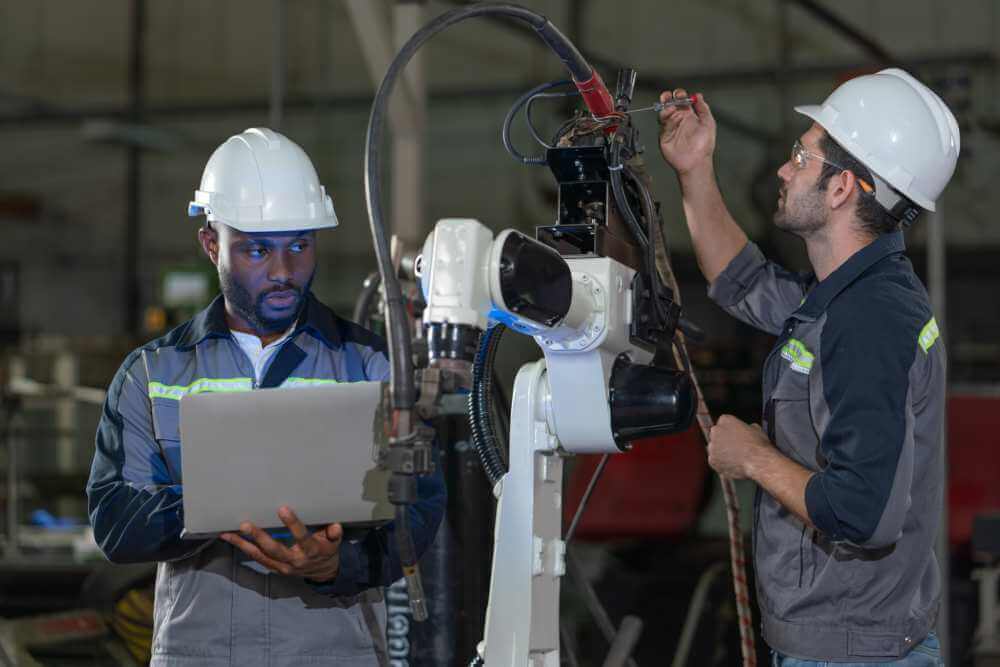

The Subjectivity Tax: Manual reporting and "gut feel" management create an invisible tax on your EBITDA through unrecovered revenue capacity.
See our roundup of the data tools that replace this subjectivity.
One system for data and action: strategic leaders are moving away from anecdotal shift reports and toward machine-validated truth to protect enterprise margins.
Data Integrity: Consolidating OEE and CMMS into a single layer is a fiduciary requirement to ensure your capital allocation is based on facts, not assumptions.
What is the Subjectivity Tax in manufacturing?
The Subjectivity Tax is the cumulative financial loss caused by making strategic decisions based on filtered, manual, or "pencil-whipped" operational data. This results in misallocated capital, under-utilized labor, and a "Hidden Factory" of unrecorded downtime.
For the CEO and CFO, the most dangerous data in the organization is "subjective" data.
When your OEE reports are manually entered by operators at the end of a shift, they are naturally filtered by human bias.
Robert C. Hansen identifies this as the "Hidden Factory", the 20% of revenue capacity that exists on your balance sheet but never reaches your P&L.
Legacy "Systems of Record" (ERPs) cannot liquidate this tax because they lack the real-time connectivity to the machine layer.
To protect your EBITDA, you must move beyond "reporting" and run one platform that acts on the data.
Fabrico provides the machine-validated foundation required to convert shop-floor reality into boardroom results.
| Strategic Metric | Manual / Siloed Reporting | Fabrico (MES and OEE Platform) |
| Data Fidelity | High risk of "Pencil Whipping" (Manual logs) | Validated: Direct PLC & Computer Vision |
| Diagnostic Context | Anecdotal: "I think it was a jam" | Visual: "Zoom-In" root-cause evidence |
| Execution Trigger | Slow: Requires manual communication | Native: Insights trigger maintenance tasks |
| Asset Health View | Text-based logs (Subjective) | Digital Medical Record: (Validated History) |
| Labor ROI | Unclear: High administrative latency | Maximized: High "Wrench Time" & adoption |
| Governance | Site-by-site "Tribal Knowledge" | Global: Master PM Standardization |
Strategic leaders know that the most profitable capacity is the time currently being stolen by unrecorded inefficiencies.
Traditional reporting focuses on "Major Failures," but the real margin is lost in the seconds between cycles.
Fabrico bridges this gap by establishing a direct OT/IT connection to your PLCs.
By capturing cycles and downtime at the machine level, you eliminate the "Subjectivity Tax" of manual entry.
Hansen’s "Value Fulcrum" requires that maintenance intensity perfectly supports maximum effective runtime.
Fabrico ensures this balance is met by linking Native OEE performance directly to maintenance execution.
When performance drops, the platform triggers a fix, replacing "hope-based management" with "fact-based governance."
In the boardroom, downtime is often explained away as "unavoidable variability."
Without visual evidence, leadership is forced to accept these subjective excuses for missed targets.
Fabrico’s Computer Vision "Zoom-In" module provides visual proof of every process deviation.
Leadership can see exactly when a manual intervention caused a micro-stop that sensors missed.
This transparency allows the Board to direct capital toward fixing the system rather than blaming the workforce.
It provides a level of accountability that traditional text-based logs cannot match.
It ensures your Continuous Improvement (CI) strategy is based on visual facts, not boardroom assumptions.
For the CFO, the "Residual Value" of a factory is a core component of enterprise valuation.
Fragmented paper logs and messy spreadsheets are viewed as "corrupted" data by potential buyers or auditors.
Fabrico creates an unalterable, machine-validated Digital Medical Record for every asset.
It proves that every machine has been maintained to Smith & Hinchcliffe’s RCM standards.
By turning "Tribal Knowledge" into an enterprise-wide digital asset, you protect the group against labor turnover.
Standardization is how you ensure that your enterprise valuation is backed by a predictable, standardized governance model.
Strategic leaders are building today for a future where operational truth is an automated, self-stabilizing process.
However, AI agents cannot optimize a factory that is currently running on unstructured or "dirty" data silos.
We are also working on the "Fabrico Assistant," a GenAI advisor designed to provide technicians with expert troubleshooting guidance.
Consolidating on Fabrico now ensures that your organization owns the high-resolution, validated dataset required for these future modules.
You are securing your "Data Moat" and moving from "reporting on the gap" to "automating the alignment."
Curious what honest, real-time OEE looks like on your floor?
Request a demo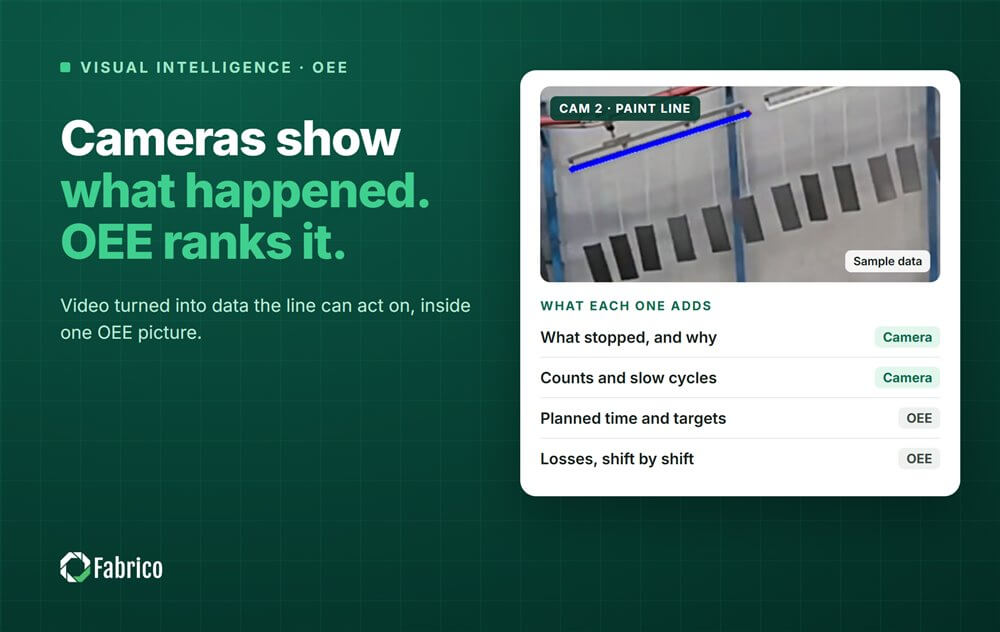











 Login
Login
 Blog
Blog