
Fabrico and MaintainX are both manufacturing CMMS platforms, but they start in different places. MaintainX is a mature, mobile-first work-order CMMS best for maintenance coordination and SMB or single-site teams. Fabrico adds native real-time OEE from PLCs and computer-vision downtime detection, and technicians open the work order straight from the logged stop, a link MaintainX handles via integrations.
See our roundup of affordable CMMS software.
If you run maintenance for a multi-site manufacturer, you have probably already met MaintainX. It is one of the most widely adopted mobile CMMS platforms on the floor.
The question this page answers is narrower and more practical: when your improvement program needs to connect production performance (OEE) to maintenance execution, does MaintainX close that loop, or do you need a different system?
This is a head-to-head for buyers who already understand what a CMMS does and are weighing whether to start a tool earlier, at the machine, rather than at the work order.
The honest framing is not "which tool is better." It is "which agenda are you funding." MaintainX manages the work order: creation, assignment, procedures, asset history, and parts logging.
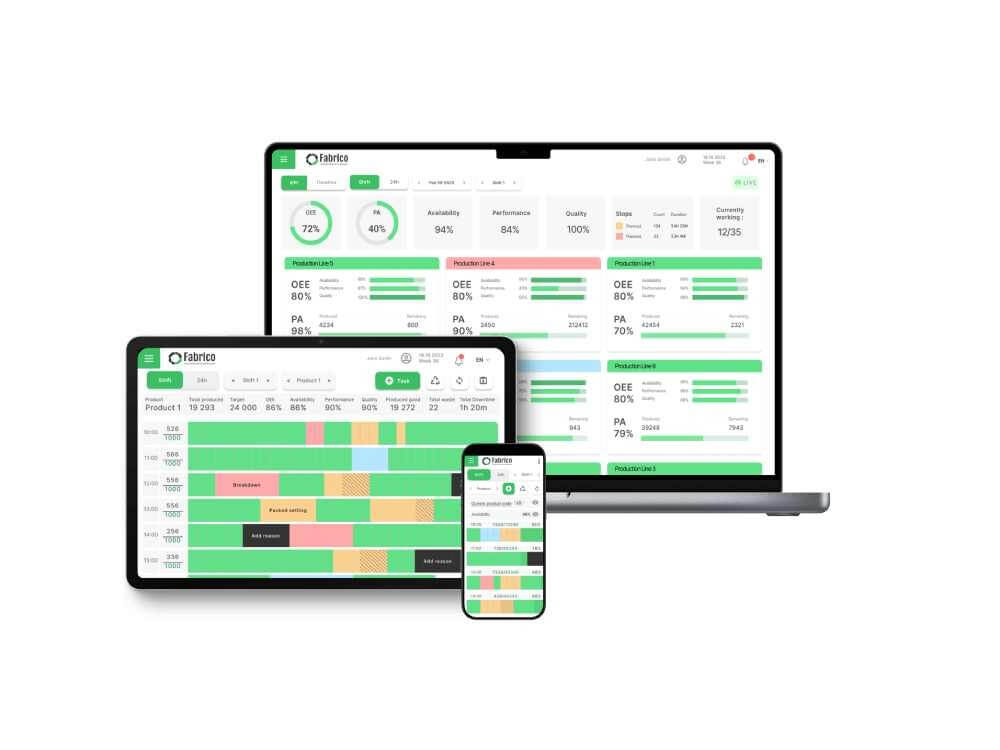
Fabrico starts one screen earlier: it reads the machine, logs the stop as it happens, and the technician opens the work order straight from that stop. Below is a fair, sourced comparison so you can defend the choice internally.
Pick MaintainX if your priority is maintenance coordination, fast shop-floor adoption, work-order and team communication workflow, and you are a single-site or SMB operation.
MaintainX is a mature, mobile-first CMMS and EAM platform, highly rated on G2 with thousands of verified reviews, and named the #1 CMMS and #1 EAM platform in G2's Winter 2026 reports (source: getmaintainx.com).
Pick Fabrico if your program connects production losses (OEE, the Six Big Losses, micro-stops) to maintenance action, and you want native real-time OEE read directly from machine PLCs plus computer vision that logs stops on manual or hybrid lines, with work orders your technicians open straight from the stop on a phone.
That stop-to-repair link runs natively in one platform, where MaintainX assembles a comparable setup only by combining partner integrations (for example its March 2026 Augury integration, which requires an Augury subscription and the MaintainX Enterprise plan).
MaintainX is a CMMS and enterprise asset management platform. It does work order management, digital procedures and inspections, asset history, and parts and inventory management, and it does them well.
Where buyers hit a wall is the gap between the production line and the maintenance team. The recurring switch triggers cited by manufacturing buyers tend to cluster around the same few structural limits:
None of this makes MaintainX a weak product. It makes it a work-order-first product. If your agenda is purely maintenance coordination, that is a fine architecture. If your agenda is connecting OEE to maintenance, you are now buying MaintainX plus a separate OEE or MES layer and stitching them together.
The cleanest way to see the difference is to follow a single downtime event through each system.
In a work-order-first model, a machine stops, an operator notices, an operator (or a sensor threshold) creates a record, someone selects a reason code, and a technician is dispatched.
Several of those steps depend on a human noticing and entering information after the fact. Micro-stops and minor stoppages, which is exactly where the Six Big Losses hide, are the ones humans most often miss or mislog.
Fabrico is built to remove that latency.
An industrial camera over the line detects when a machine is stopped even if sensors do not register it, validates micro-stops and idle time, and attaches the triggering video frame or clip as objective evidence of the cause.
That detection becomes a CMMS event, which becomes a high-priority work order routed to the right technician's phone or tablet based on machine, symptom, and shift, with the right spare parts surfaced for the job.
Closure is enforced: the technician scans a QR code to open the digital CIL (Clean, Inspect, Lubricate) steps and schematics, scans the spare part used (which deducts inventory), and cannot close the work order without the required photos and digital signature.
MaintainX is not blind to this loop. Through its Augury integration, an Alarm or Danger state detected by Augury's vibration and health sensors auto-creates a MaintainX work order enriched with fault details and recommended actions, and completion data syncs back.
The honest distinctions are three: that loop is triggered by a separate vendor's sensors rather than by MaintainX itself, it is condition and vibration-based rather than vision-based (so it is not positioned to capture micro-stops or a visual root cause), and it requires both an Augury subscription and the MaintainX Enterprise plan.
The distinction Fabrico draws is not that others ignore this loop, but that Fabrico runs detection, routing, and enforced closure as one native flow, with the triggering cause captured visually rather than entered after the fact.
For the underlying mechanics, see Fabrico's notes on visual downtime verification with computer vision and opening work orders from machine faults.
The table below maps the capabilities a manufacturing buyer actually evaluates. It states only what each vendor's own materials support.
| Capability | Fabrico | MaintainX |
|---|---|---|
| Native real-time OEE from PLCs | Native. OEE (Availability, Performance, Quality) computed in the same platform that runs work orders, from direct PLC and IoT-sensor signals. | Surfaces real-time asset data and acts on IoT/meter readings natively; OEE calculated directly from PLCs reaches it via third-party integrations (for example MachineMetrics). |
| Computer-vision downtime cause | Yes. Cameras recognise when a manual line stands still, and Inefficiencies Zoom-In links each stop to the video of that moment. | Not claimed. MaintainX's public materials describe AI-assisted troubleshooting and anomaly detection, not computer-vision downtime root-cause; we found no such claim (absence of a claim, not a stated denial). |
| Predictive-to-work-order flow | Native (PLC, IoT sensor or camera plus OEE). The stop is logged and the technician opens the work order from it in the same platform. | Yes, via the Augury integration (Augury subscription plus MaintainX Enterprise required); sensor and vibration-based, not vision-based. |
| Automatic vs manual downtime capture | Automatic capture. The PLC, an IoT sensor or a camera logs the stop, the operator tags the cause on a tablet, and the technician opens the work order from it. | Primarily manual at the native level (operator reason-code selection); automation via sensor thresholds or partner integrations. |
| Micro-stop / minor-stop detection | Yes. Short stops are logged from the PLC or a sensor, and cameras cover manual lines. | Not a stated native capability; depends on connected sensor data. |
| CMMS work orders | Yes. Full CMMS in the same platform as OEE. | Yes. Mature work order management is a core strength. |
| Spare parts on work orders | Yes. Spare parts inventory in the same CMMS, with min-stock notifications. | Yes. Parts and inventory management, with parts logged against work orders. |
| QR-code checklists | Yes. A QR scan opens the machine and its checklists on the technician's phone. | Supports digital procedures and scores completed steps; degree of hard, cannot-close-without-scan enforcement is for the buyer to confirm. |
| Audit-readiness | Digital checklists and a full work order history per machine replace paper logs with a digital record. ISO-certified for information security and service management alongside ISO 9001. | Asset maintenance history and digital procedures provide a digital record; required fields supported. |
| Pricing transparency | Pricing is provided on request; confirm current tiers with the vendor. | Published tiers: Basic free; Essential and Premium priced per user per month (billed annually or monthly, see MaintainX's published price list); Enterprise custom. |
The honest read of this table: MaintainX fills almost every CMMS row, and on pricing it is more transparent and publicly documented than most of the field.
The rows where Fabrico separates are the OEE-and-vision rows at the top, and the native (rather than integration-assembled) path from detection to fix.
That is the wedge, and it is the same row the wider alternative set (UpKeep, Fiix, Limble, Tractian, OxMaint) also leaves empty. If you are also weighing Fiix, see the three-way breakdown of Fabrico vs Fiix vs MaintainX.
A switch has to be justified in numbers an operations leader will be held to.
The mechanism Fabrico is built to influence is straightforward: removing detection and dispatch latency compresses mean time to repair, recovering micro-stops surfaces the hidden factory (capacity you already paid for but never ran), and enforced digital closure protects audit-readiness versus paper logs.
The business case for the first two rests on the true cost of downtime, which typically exceeds the reported figure once indirect losses (scrap, expedite, overtime, missed shipments) are counted, and on the math of reducing mean time to repair.
For the full cost picture, see Fabrico's breakdown of the true cost of unplanned downtime.
On the specific quantified results (availability uplift, downtime reduction, productivity gain, savings per line, MTTR before-and-after), the honest answer is that the only number worth taking to a CFO is the one measured on your own floor.
Run a scoped pilot on one or two lines, measure your own baseline MTTR and OEE, and let the delta on your floor be the proof.
MaintainX is the better fit in several situations. Four are common:
From paper logs. The move from paper to digital is the larger cultural change, and the payoff is the audit trail. Digital checklists on the technician's phone, opened by scanning the QR code on each machine, replace clipboards with records you can defend in an audit.
The discipline is the same as any CMMS rollout: clean asset list, defined work types, and a parts catalog.
From MaintainX. You are not throwing away your CMMS data model; you are extending it down to the machine. The data that migrates is familiar: assets, asset hierarchy, PM schedules, procedures and checklists, and parts inventory.
The new layer is the machine connection. Fabrico establishes a single source of truth by connecting directly to PLCs and IoT sensors, and covering legacy or manual stations with IoT sensors and camera-based output tracking.
The honest sequencing point: the computer-vision benefit depends on a per-line camera install with line-of-sight, so plan vision coverage line by line rather than assuming full coverage on day one.
The PLC and IoT side is where Fabrico explains how to connect PLCs to a CMMS for automated maintenance.
On a specific implementation timeline for your plant, the honest answer is that it varies by line count and how much of your asset list and parts catalog is already digital. Scope it to a pilot line first.
For pharma/GMP, food and beverage, and other regulated ICPs, the audit-readiness story is a real advantage over paper, but it comes with diligence items you should confirm directly rather than infer:
Use a simple maturity test. If your improvement agenda is maintenance coordination, MaintainX is a reasonable, well-supported tool and you may not need to move.
If your agenda connects production performance (OEE, micro-stops, the Six Big Losses) to maintenance execution, MaintainX is not positioned to connect the two from a single native stack; it reaches a comparable result by stitching in third-party machine-data and predictive partners (MachineMetrics, Augury).
Fabrico does this natively: native OEE reads the machine directly, computer vision logs stops on manual lines, and a technician opens the work order straight from the stop on a phone.
Choose on agenda, validate the outcomes on your own line, and confirm the diligence items above before you sign.
Not natively from machine PLCs. MaintainX surfaces real-time asset data and references OEE as a KPI, but OEE calculated directly from machine PLCs reaches it through third-party integrations such as MachineMetrics, which syncs live meters and triggers work orders from machine conditions. Its homepage does not claim direct, native real-time OEE pulled from PLCs.
Indirectly for OEE. MaintainX acts on IoT and meter readings natively, and gets real-time machine and condition data through third-party integrations (for example MachineMetrics for live machine data, and Augury for predictive machine-health alerts) and through sensor or meter thresholds, rather than through a native PLC connection. The MachineMetrics integration is managed by MachineMetrics.
Yes, depending on the architecture.
MaintainX can auto-trigger work orders from sensor or meter thresholds and partner integrations, including its Augury integration, where an Alarm or Danger state auto-creates an enriched work order (this requires an Augury subscription and the MaintainX Enterprise plan).
In Fabrico, the PLC, an IoT sensor or computer vision over the line logs the downtime event as it happens, the operator tags the cause on a tablet, and a technician opens the work order straight from that stop on a phone.
Fabrico is a single platform combining native real-time OEE (read directly from PLCs and IoT sensors) with a full CMMS, plus computer vision that logs stops on manual lines, so technicians open work orders straight from those stops on a phone.
MaintainX is a mature mobile-first CMMS and EAM platform that delivers machine-data and predictive capabilities through integration partners (such as MachineMetrics and Augury) rather than one native stack.
Yes, especially for maintenance coordination, fast shop-floor adoption, and single-site or SMB operations.
It is highly rated on G2 with thousands of verified reviews and was named the #1 CMMS and #1 EAM platform in G2's Winter 2026 reports.
Its limit for manufacturing is the production-to-maintenance gap: native real-time OEE and direct PLC connectivity are not its core, so OEE typically requires a separate layer or integration.
MaintainX publishes tiered pricing: Basic is free; Essential and Premium are priced per user per month (billed annually or monthly, with Premium labeled Most Popular); and Enterprise is custom pricing. Current rates are on MaintainX's published pricing page.
Some advanced and predictive capabilities sit in higher tiers, and the Augury integration requires the Enterprise plan.
The head-to-head comparison across the capabilities that manufacturing operations require:
| Capability | Fabrico | MaintainX |
|---|---|---|
| Mobile Work Orders | ✅ Native mobile app | ✅ Market strength |
| Operator Work Request Portal | ✅ Available | ✅ Well established |
| PM Scheduling and Automation | ✅ Full capability | ✅ Strong |
| Native OEE Monitoring | ✅ Full Six Big Losses | Varies |
| OEE stop → Work Order | ✅ Opened from the stop on a phone | Manual process |
| Computer Vision (micro-stops) | ✅ Inefficiencies Zoom-In | Varies |
| AI Agent (optimization) | Planned (on the roadmap) | Varies |
| Fabrico Assistant (manual AI) | ✅ Native | Varies |
| Complex Asset Hierarchy | ✅ Parent-child hierarchy | Varies Limited complexity |
| Multi-site governance | ✅ Group-level standardization | Varies Basic multi-site |
| Free tier available | Paid only | ✅ Free for 5 users |
The areas where MaintainX leads are real advantages, particularly the operator requester workflow and the free tier for small teams. These are adoption-focused features that serve operations in early CMMS deployment well.
The areas where Fabrico leads reflect a different design philosophy: an integrated operational platform built for manufacturing depth rather than universal accessibility. The OEE monitoring, computer vision and AI Assistant are not features added on top of CMMS, they're the core reason Fabrico was designed.
MaintainX's pricing is straightforward and published per user per month, from Essential up to Advanced; current rates are on MaintainX's pricing page. For a 15-person maintenance team on Advanced, the annual cost scales with seat count.
The true cost comparison for manufacturers who need OEE monitoring alongside CMMS:
Fabrico for the same scope:
Fabrico's integrated approach is slightly more expensive than MaintainX alone but comparable to the full two-tool stack, while delivering native integration that the two-tool combination is not positioned to replicate.
The manufacturer who should start with MaintainX: a small operation (under 50 employees) in the early stages of digital maintenance management where the primary challenge is getting off paper.
MaintainX's free tier or Essential pricing gets you functional CMMS in days with minimal investment. When you outgrow it, typically when OEE monitoring becomes a priority, migrating to Fabrico is a straightforward transition.
The manufacturer who should start with Fabrico: any operation where production performance data and maintenance management need to be connected from day one. Multi-line plants where OEE improvement is the primary business objective.
Operations with complex asset hierarchies that require parent-child structure. PE-backed manufacturers who need measurable impact in their first board reports. Multi-site operations that need group-level maintenance standardization and cross-site OEE benchmarking.
Starting with MaintainX and planning to add OEE monitoring later is a legitimate path, but it requires a second migration or a persistent integration project.
Starting with Fabrico means the OEE-CMMS connection is native from day one, and computer vision covers the manual lines that sensor-based monitoring cannot see.
Three changes to expect when production data and maintenance run in one platform:
Less coordination between production and maintenance. The technician opens the work order straight from the logged stop, so nobody re-types the fault into a second tool or chases the shift lead for the details.
Junior technicians find answers faster. The Fabrico Assistant answers from your own manuals and maintenance history, so a technician facing an unfamiliar fault code can look it up instead of calling a senior colleague every time.
Senior technicians are interrupted less, and junior technicians build confidence on unfamiliar failure modes.
Data to explain why maintenance investment matters. With PM compliance and OEE availability for the same assets in one system, maintenance managers can show how maintenance work relates to availability when they ask for budget.
These outcomes are outside MaintainX’s core focus. They require the production-maintenance data connection that an MES and OEE platform with CMMS built in provides.
See how a stop becomes a work order on your own lines: book a Fabrico demo.
Request a demo






















 Login
Login
 Blog
Blog