


 Login
 Blog
Good Count vs Total Count in OEE: Meaning and Example

Key takeaways
- Total count is every unit the machine made, good and bad. It goes into the Performance factor of OEE (Overall Equipment Effectiveness).
- Good count is the units made right the first time. It goes into Quality and into the one-step OEE check.
- Rework is never good count. Start-up rejects and destroyed test samples are not good count either.
- Take both counts at the same machine, in the same unit as the ideal cycle time.
By the numbers
- Coca-Cola's Ballina concentrate plant in Ireland, a WEF Global Lighthouse, reported a 53% improvement in OEE. (World Economic Forum, 2023)
- Danone's Opole dairy plant in Poland, a WEF Global Lighthouse, raised process OEE by 12%. (World Economic Forum, 2023)
- Haitian's soy sauce plant in Foshan cut product defect rates by 39.1% even as its SKU count rose 54%. (World Economic Forum, 2025)
Total count is every unit a machine or line made in a period, good and bad. Good count is the part of that total that was right the first time, with no rework. The gap between the two is the Quality loss in OEE.
Fabrico is a computer vision enabled Manufacturing Performance Platform. It is OEE and light MES (manufacturing execution system) software that logs stops automatically and shows OEE live by line and shift. This guide shows where each count goes, how to treat rework and samples, and which counting mistakes skew the score.
What is the difference between good count and total count?
Both come from the same machine and period. They differ in what you leave out.
| Question | Total count | Good count |
|---|---|---|
| What it includes | Every unit made, including scrap, rejects and rework | Units that passed every check the first time |
| Name in ISO 22400-2 | Produced quantity | Good quantity |
| Used in | Performance and Quality | Quality and the one-step check |
Where does each count go in the OEE formula?
OEE multiplies three factors. Two of them use the counts:
- Availability = run time / planned production time. No count here.
- Performance = (ideal cycle time x total count) / run time.
- Quality = good count / total count.
- OEE = Availability x Performance x Quality.
Why total count in Performance? The machine spent a full cycle on every unit, good or bad. Bad units are then charged once, in Quality.
Now multiply the three factors. Run time and total count cancel out, and you get the one-step check:
OEE = (good count x ideal cycle time) / planned production time.
In plain words, OEE is the time the machine needed to make the good units, divided by the time it had. If your three factors do not give the same number, a count or a time is wrong. Our guide to calculating OEE step by step walks through every input. For the other half of Performance, see how to set the ideal cycle time.
Do rework, start-up rejects and samples count as good?
Rework and start-up rejects never do. Samples depend on what happens to them.
- Rework: in total count, never in good count. A unit that needed a second pass was not right the first time. Christoph Roser of AllAboutLean lists counting rework as good among the three common OEE fudges.
- Start-up rejects: in total count, not in good count. Nakajima's six big losses call this reduced yield, a Quality loss.
- Destroyed test samples, such as seal or taste tests: in total count, not in good count. The line made them and nobody sold them.
- Samples weighed and put back unchanged: they stay in good count.
- Rejects found later, at a checkweigher or the case packer: feed them back to the machine that made them.
Write these rules down once and use them on every shift. Our guide to the OEE Quality factor covers reject codes, and first pass yield uses the same right-first-time idea.
What does a good count vs total count example look like?
Sample line (illustrative numbers, not a customer): a water bottling line, one 8 hour shift. The filler is the machine being measured.
- Planned production time: 450 minutes (480 minus a 30 minute break).
- Run time: 405 minutes, after 45 minutes of stops.
- Ideal cycle time: 0.5 seconds a bottle (120 bottles a minute).
- Total count at the filler: 43,200 bottles.
- Start-up rejects: 240 bottles. Bottles relabelled by hand (rework): 360.
The arithmetic:
- Good count = 43,200 minus 240 minus 360 = 42,600.
- Availability = 405 / 450 = 90.0%.
- Performance = (0.5 s x 43,200) / (405 x 60 s) = 21,600 / 24,300 = 88.9%.
- Quality = 42,600 / 43,200 = 98.6%.
- OEE = 0.900 x 0.889 x 0.986 = 78.9%.
- One-step check: 42,600 x 0.5 s = 355 minutes, and 355 / 450 = 78.9%. It ties out.
Now count the same shift three wrong ways:
| Counting rule | Total count | Good count | Performance | Quality | OEE |
|---|---|---|---|---|---|
| Correct: at the filler, rework not good | 43,200 | 42,600 | 88.9% | 98.6% | 78.9% |
| Rework counted as good | 43,200 | 42,960 | 88.9% | 99.4% | 79.6% |
| Total counted after the reject bin | 42,600 | 42,600 | 87.7% | No loss shown | 78.9% |
| Cases of 12, per-bottle cycle time | 3,600 | 3,550 | 7.4% | 98.6% | 6.6% |
Method note: Sample line, illustrative numbers, not a customer. Every result above comes from the inputs listed and the formula shown with it, so you can repeat the calculation with your own line's numbers.
Rework counted as good adds 0.7 points of OEE that the line never earned. Counting after the reject bin keeps OEE the same, but it moves the loss from Quality into Performance. The team then chases speed when the real problem is rejects.
The case count makes Performance absurd. With 6 seconds a case (0.5 x 12), it is back to 88.9%.
Which counting mistakes make OEE wrong?
- Counting at the wrong point. Read total count at the machine you measure, before any reject station.
- Mixing units and cases. The count and the ideal cycle time must use the same unit.
- Losing late rejects. Units written off downstream never reach the machine's good count. Track them with a scrap rate beside OEE.
- An unchecked counter. A dirty sensor can miss units or count one twice. Check it against packed cases each week.
- A Performance factor that looks too good. If Performance comes out above full speed, the ideal cycle time is too slow or the count is in the wrong unit.
Speed loss and short stops also hide inside Performance. Our guide to OEE Performance shows how to tell them apart.
How does Fabrico get the counts from the line?
A machine connects to Fabrico through its PLC (programmable logic controller), a Fabrico IoT device or an AI camera. The machine itself needs no PLC. Stops are logged automatically, and the operator confirms each stop reason in one tap.
- OEE live by line and shift, built the same way on every line.
- Losses ranked by money, so rejects and rework show up as a cost.
- A start on one line. Devices are connected in about one month, and full rollout takes 3 to 4 months.
There is no free plan and there are no tiers: each plant gets a quote. To see how counts, stops and OEE sit in one system, read what a light MES is.
Proof from a named plant: Ficosota raised factory-wide OEE from 53.1% to 59.6%, with good output up 23.2% a month from June to September 2026. Read the Ficosota case.
Toyota calls jidoka "automation with a human touch": the machine stops on a problem, and a person decides what happens next. (Toyota, Toyota Production System)
Frequently asked questions
Does total count include scrap?
Yes. Total count includes every unit the machine made in the period: good units, scrap, rejects, rework and start-up rejects. That is why Quality is good count divided by total count. If you leave scrap out of total count, Quality shows no loss and the loss moves into Performance instead.
Why does OEE Performance use total count and not good count?
Because the machine spent a full cycle on every unit, good or bad. Performance asks how fast the machine ran while it was running, so it counts all units. Bad units are charged once, in Quality. Using good count in Performance would charge the same bad unit twice.
Is a reworked unit part of the good count?
No. Good count means right the first time. A reworked unit needed a second pass, so it stays in total count but not in good count. Give rework its own reason code, so the team can see how much line time and labour the second pass costs each week.
Should I count bottles, packs or cases?
Count in the unit your ideal cycle time uses. If the ideal cycle time is in seconds a bottle, count bottles. If cases are easier to count, convert the ideal cycle time to seconds a case. Mixing the two makes Performance meaningless, even when the line ran well.
Where should the counter sit on the line?
At the machine you measure, before any reject station. For line OEE, count at the bottleneck machine, which on many food and drink packaging lines is the filler. A counter at the end of the line sees fewer units than the machine made, so rejects drop out of Quality.



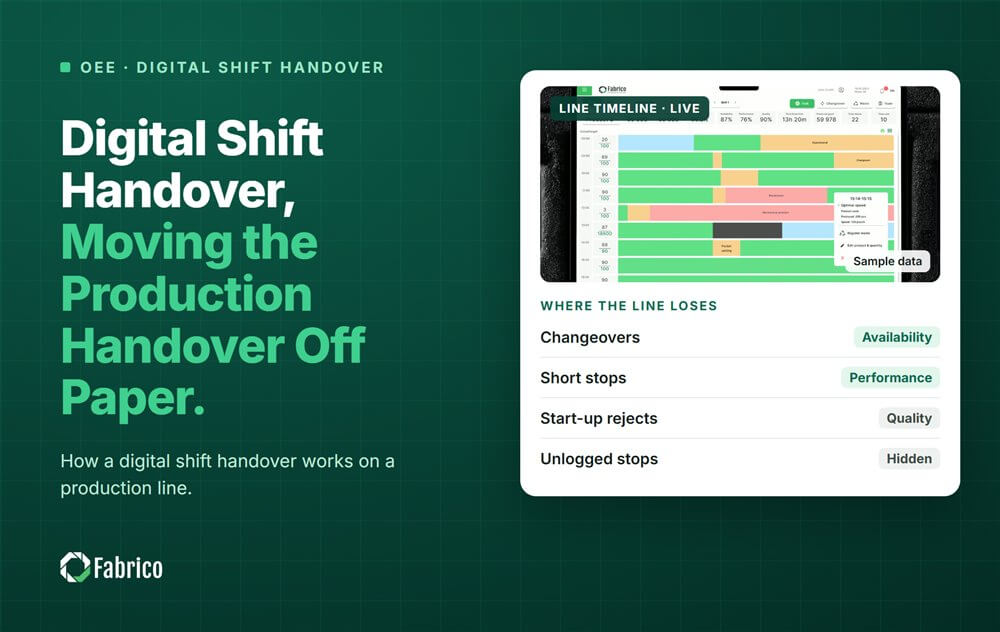




Real Fabrico tiles, sample data.