
Key takeaway:
Computer Vision OEE turns one camera over a line into a complete data source for Availability, Performance, and Quality. Studies of European plants show 10-15% of capacity is locked inside events too short for operators or PLCs to record.
Curious what honest, real-time OEE looks like on your floor?
Request a demoA camera that watches at 30 frames per second catches the 1.7-second jam that costs you 8 minutes a shift.
Cost: 300-800 EUR per line of hardware. Pilot live: 1-5 days. Integration with the machine: zero.
Quick answer: Computer Vision OEE uses industrial cameras and computer vision algorithms to track machine state, count parts, and detect downtime causes, all without PLC integration or extra sensors. It is the fastest way to instrument older lines, lines with proprietary controllers, or lines where retrofitting a PLC tap is expensive.
Typical time to first OEE score: 2 to 4 weeks.
When to use it: older equipment without OPC-UA, mixed-vendor lines, multi-tenant plants, or any line where the cost of PLC retrofit exceeds the value of automated OEE for 12 months.
For OEE basics, see the OEE Complete Guide. For benchmark context, how 250 plants score. For the data layer, OEE data collection methods compared. For the visual verification angle, 5 best CV OEE platforms.
Every plant has a black hole: the time the line is not running, but nobody can tell you why. The PLC reports cycle complete. The operator log says nothing happened. The OEE dashboard records 87 minutes of "minor stops" with no cause attached.
A 2024 study by McKinsey on industrial productivity showed that mid-size European manufacturers lose 10-15% of theoretical capacity to events under 5 minutes that never get logged. On a line running 6,000 units a shift, that is 600-900 units leaking out, every shift, every day.
Operators cannot write down a 30-second jam. PLCs only know "stopped" or "running", not why. The black hole exists because the data layer was never built to see it.
That is the gap Computer Vision OEE closes. See related: OEE Monitoring Without PLC and OEE Data Collection Methods Compared.
Related deep-dives: OEE without PLC integration · OEE complete guide · Best CV downtime-verification software 2026 · OEE data collection methods.
Manufacturing vision systems are often sold against OEE in general. It is more useful to ask which specific loss they resolve, because the answer is not all six.
Computer Vision is a camera plus AI software that watches the line and recognises what is happening, the same way an experienced operator would, but at 30 frames per second, every second, without fatigue.
The hardware: an industrial IP camera (typically 4-8 megapixels) mounted above the line with a clear view of the work. A small edge compute box or PoE link to a server runs the model. Total hardware cost 300-800 EUR per line.
The software: a vision model trained to recognise three things on your specific line: (1) good output coming through, (2) the machine is moving as expected, (3) anomalies like jams, missing parts, or off-spec product. The model improves with every shift as it sees more of your real production.
What it is NOT: it is not generic surveillance. It is not facial recognition. It is not a black box. Every detection comes with the frame that triggered it, so an operator can confirm or correct, exactly like reviewing a security camera clip.
See Fabrico's implementation: Computer Vision OEE feature page.
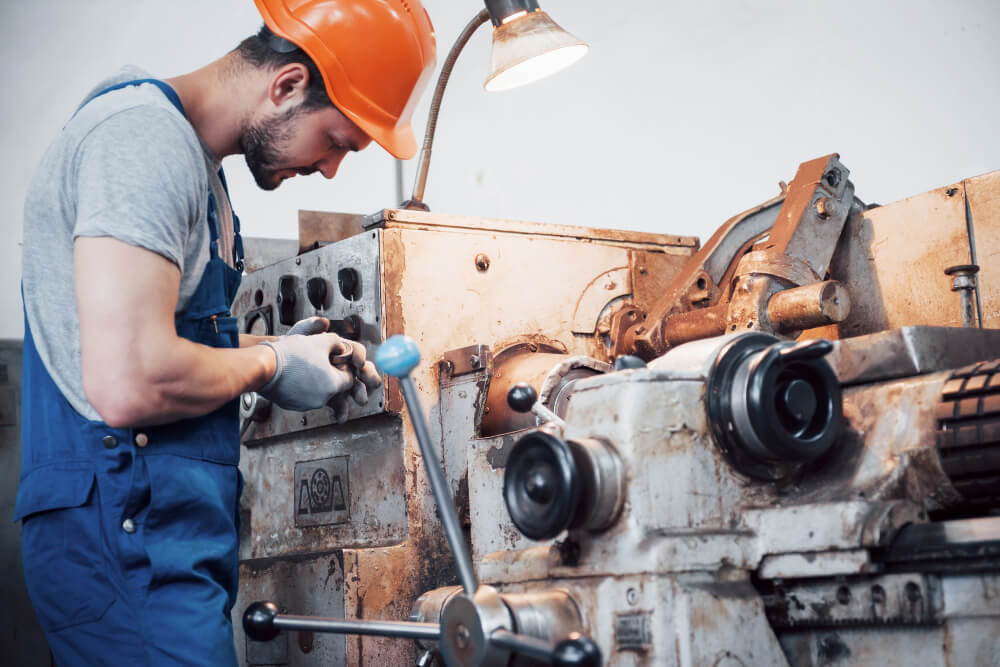
A 1995-era hydraulic press has no PLC interface you can tap. No Modbus, no OPC UA, no Ethernet at all.
The control cabinet is sealed by the OEM. Traditional answer: install IoT vibration sensors and a current clamp on the motor.
Cost per machine: 1,500-2,000 EUR + electrician + 6 weeks integration time.
Computer Vision answer: one camera with a view of the platen. The model is trained over 2-3 shifts to recognise the press cycle (idle, closing, hold, opening). From that moment forward, every cycle is logged with millisecond precision.
Stops are flagged automatically with timestamp and video frame. Time to live: 3-5 days. Cost: 600 EUR.
Machine integration: zero.
Real example: an FMCG plant with 47 mixed presses tried IoT retrofit. Quote came back 96,000 EUR + 14 weeks. Same coverage via Computer Vision: 28,000 EUR + 3 weeks. Same data quality once trained.
This is why tracking OEE without PLC is a solved problem when the camera does the integration work.
Performance loss is the silent killer. The line is running. The PLC reports normal operation. But you are doing 92 parts a minute on a 100 part-per-minute design rate. Where did the 8 parts go?
Computer Vision answers this in three ways:
One European packaging line found 8.4% performance recovery in the first 60 days after wiring Computer Vision to their existing OEE dashboard. That is around 220 EUR per hour of extra output on a typical line, with no capital spend on the machine itself.
Compare options: Best Real-time OEE Monitoring Systems.
Most quality control happens after the fact. End of line, off-line, sample-based. A defect is found, but 200 units of the same defect have already shipped.
Computer Vision does inline quality control on every unit. The model is trained on good versus bad examples (label crooked, fill short, lid missing, colour off) and rejects in real time. False positive rate after 4 weeks of training typically drops below 0.5%.
The bigger value is closing the OEE-CMMS loop. When the defect rate spikes, the system knows which station is drifting. A work order goes to the technician with the video clip attached. No "the line was producing scrap and we did not know" stories at the morning meeting.
This is the same Hansen Method "OEE Diagnoses, CMMS Cures" pattern we describe in OEE benchmarks guide. Quality data without action is a museum exhibit.
Do we need a clean room for cameras?
No. Industrial IP cameras handle 90% of factory environments (food, automotive, packaging, electronics). Only severe washdown zones (full sanitation cycles with 80°C water) require IP69K rated enclosures. Fabrico's standard kit is IP67.
What about lighting changes?
Models are trained on your actual lighting (shift-to-shift variation, sun through skylights, fluorescent flicker). Training takes 2-3 shifts. After that, false positives drop below 1%.
Is the video stored on the cloud or on-prem?
Your choice. Default is frame-only mode: only the trigger frame for each event is stored, not continuous video. Full video can be kept on-prem in a 7-day rolling buffer if compliance requires.
What is the ROI?
Typical payback: 4-9 months. The 10-15% capacity unlock on the first line covers the cost of rollout to 10 more lines.
See pilot pricing logic: How a CMMS Quote is Built.
A camera that just produces a dashboard is a more expensive version of the same problem. The reason Computer Vision matters is what happens after the detection.
The right architecture: camera detects micro-stop on Line 3. The detection becomes a CMMS event. The CMMS finds the right technician based on machine + symptom + shift.
A work order with the video frame attached lands on the technician's tablet. Mean time to response drops from 12 minutes (radio + finding supervisor) to 90 seconds.
That is the Fabrico approach: Computer Vision OEE wired natively to our CMMS. Not two systems pretending to talk. One system from sensor to fix.
If you want to test on one of your hardest lines, see the 1-day pilot path.
Computer vision is one pillar of a broader AI OEE software stack that also covers micro-stop detection and an AI assistant you can question.
See Fabrico live. Request a demo.
Request a demo
















 Login
Login
 Blog
Blog