


 Login
 Blog
Does the EU AI Act Apply to Production Line Cameras?

Key takeaways
- Banned since 2 February 2025: AI that infers the emotions of people at work, unless the reason is medical or safety (Article 5(1)(f)).
- High risk: AI that monitors and evaluates workers' performance and behaviour (Annex III, point 4(b)). These obligations now apply from 2 December 2027.
- A camera that watches the process (product moving, stops, cycles) does a different job from AI that rates people.
- Put it in writing: the purpose, no ranking of named operators, and OEE (overall equipment effectiveness) by line and shift.
By the numbers
- 29% of large US manufacturers use AI or machine learning at facility or network level, and another 23% are piloting it. (Deloitte, 2025)
- 51% of top global manufacturers in Europe were implementing at least one AI use case in operations in 2019, with product quality control among the three best starting use cases. (Capgemini Research Institute, 2019)
- Analytical AI and machine learning are embedded in nearly 62% of Lighthouse sites' top five use cases, and generative AI in 23%, up from 9% in 2024. (World Economic Forum, 2026)
Yes, in two places: the EU AI Act bans AI that reads workers' emotions, and treats AI that rates their performance as high risk. A camera that watches the process (product moving, stops, cycles) does a different job. For an OEE camera, what changes is the paperwork: a written scope that keeps it there.
Fabrico is a computer vision enabled Manufacturing Performance Platform. Its OEE and light MES (manufacturing execution system) software logs stops automatically, prices each loss in money and shows OEE live by line and shift. Its camera watches the process, not the person.
Which parts of the EU AI Act matter for line cameras?
Two provisions matter, and both describe what the AI does with people.
- Article 5(1)(f), banned: AI that infers the emotions of a person in the workplace. The ban has applied since 2 February 2025. Medical or safety reasons are the exception.
- Annex III, point 4(b), high risk: AI used to monitor and evaluate the performance and behaviour of workers. High-risk systems carry extra legal duties.
The Digital Omnibus on AI, Regulation (EU) 2026/1744 of 8 July 2026, moves Annex III obligations from 2 August 2026 to 2 December 2027. It was published in the Official Journal on 24 July 2026 and has been in force since 27 July 2026.
For the wider picture, read our guide to how the EU AI Act will reshape OEE.
Is a camera that watches the process the same as AI that rates people?
No. The plant decides which job its camera does.
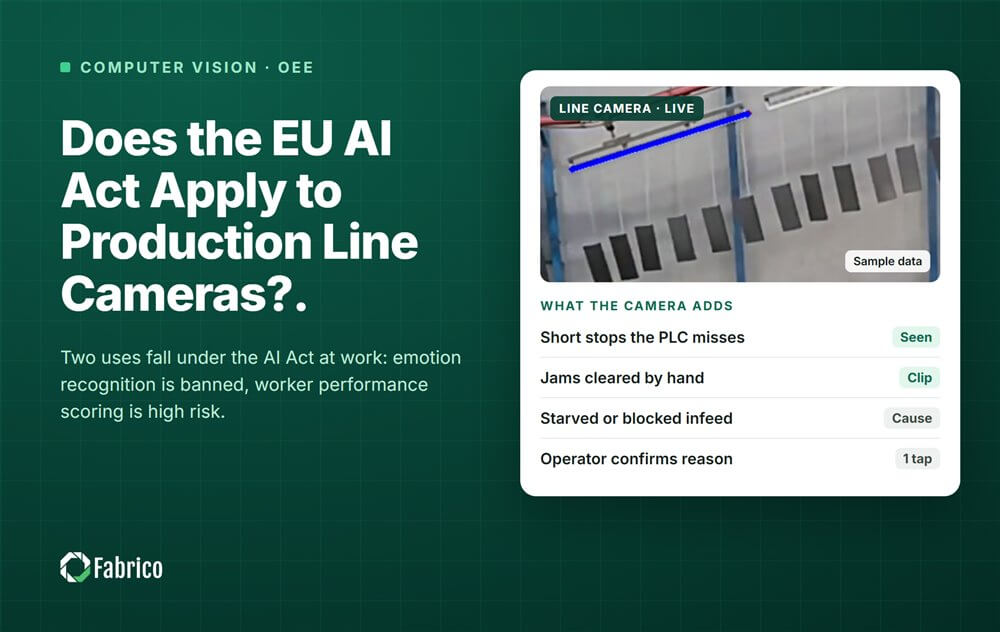
A process camera looks at the line: whether bottles move, when a station stops, when a cycle ends. Its output is events, such as stop start, stop end, cycle count and a short clip.
AI that rates people looks at a person: how fast someone works, how often they leave the station, how they look. Its output is a score next to a name, the kind of use Annex III, point 4(b) describes.
The risk usually enters through the reports, not the lens. A process camera drifts toward rating people the day someone adds a column of units by named operator to a dashboard. So keep one rule: measure the process, never the person.
The camera may suggest a likely stop reason; the operator confirms it in one tap. The clip stays as evidence and often protects the operator: it shows the jam, the late pallet or the empty infeed.
What does a camera use check look like in a worked example?
Sample line (illustrative numbers, not a customer). Line 2 bottles water over two shifts of 480 minutes, with one camera planned at the filler infeed and one at the labeller. The team lists five uses and checks each against the two provisions above.
| Use | What it watches | Sample verdict | Why |
|---|---|---|---|
| Count cycles at the filler | Bottles passing a point | Allowed; works agreement first in Germany | Watches product, not a person |
| Time stops and restarts | Whether product moves | Allowed; works agreement first in Germany | Watches the state of the line |
| Keep a 30 second clip of a jam | The jam at the infeed | Allowed with limits; works agreement first in Germany | People may pass through the frame: short clips, erased after a few days |
| Rate an operator by units per hour | A named person's work | High risk: dropped from the plan | Annex III, point 4(b): monitoring and evaluating performance |
| Read faces for mood | Workers' emotions | Banned: dropped from the plan | Article 5(1)(f), applies since 2 February 2025 |
Method note: Sample line, illustrative numbers, not a customer. Every result above comes from the inputs listed and the formula shown with it, so you can repeat the calculation with your own line's numbers.
"Allowed" in this sample means the use is neither of the two above. Data protection rules and, in Germany, the works council still apply.
The three kept uses feed the OEE math. Inputs for one early shift: planned time 480 minutes, camera-timed stops 60 minutes, ideal rate 200 bottles a minute, 73,500 bottles counted and 72,030 good.
- Availability = 420 / 480 = 87.5%.
- Performance = 73,500 / (420 x 200) = 73,500 / 84,000 = 87.5%.
- Quality = 72,030 / 73,500 = 98.0%.
- OEE = 87.5% x 87.5% x 98.0% = 75.0%. Check: 72,030 / 200 = 360.2 minutes, and 360.2 / 480 = 75.0%.
Result: three of five uses stay and two are struck out. Line 2 shows an OEE of 75.0% on the early shift, with a clip on each stop and no name next to any number. The two dropped uses added nothing to the OEE math.
What should the plant put in writing?
Write the camera's job down before it goes up:
- Purpose: count cycles, time stops and keep a short clip of each stop, to find and price line losses.
- Exclusions: no ranking or scoring of named operators, no mood or emotion reading, no face recognition.
- Reports: OEE by line and shift, with no metric for a named person.
- Clips: who can view them, and when they are erased.
- Changes: any new use goes through the same check before it is switched on.
Data protection and, in Germany, labour law matter too. The European Data Protection Board's video guidelines (3/2019) say employers should not rely on consent for video at work; see our GDPR buyer's guide. In Germany, even a camera that records nothing needs a works agreement under section 87(1) no. 6 BetrVG; see our works council approval guide.
Our guide to cameras on the production line without surveillance lists what a camera policy should contain.
This is not legal advice: check with your data protection officer and, in Germany, your works council.
What should you ask the camera vendor?
Ask in writing, and get the answers from the vendor's technical team.
- What does the AI output? You want events: stop start, stop end, cycle count, a clip. Not scores.
- Does any feature read faces, mood or emotions? For an OEE camera the answer should be no.
- Can any report show a metric for a named operator? Ask how it is switched off and who could switch it on.
- Who decides the stop reason? The operator should confirm it in one tap.
- Where is video processed, how long are clips kept, and can parts of the image be masked? Put the answers in your camera policy.
Fabrico starts with a pilot on one line. See how a stop gets its clip and its confirmed reason on our computer vision OEE page. There is no free plan and there are no tiers: each plant gets a quote.
Proof from a named plant: Ficosota raised factory-wide OEE from 53.1% to 59.6%, with good output up 23.2% a month from June to September 2026. Read the Ficosota case.
The European Data Protection Board notes that an employee "is in most cases not likely expecting to be monitored by his or her employer." (EDPB, Guidelines 3/2019 on video devices)
Frequently asked questions
Is an OEE camera high risk under the EU AI Act?
Annex III, point 4(b) lists AI that monitors and evaluates the performance and behaviour of workers as high risk. A camera that counts cycles and times stops watches the process instead. Keep it there: report OEE by line and shift, never rank named operators, and check the setup with your data protection officer.
When do the high-risk rules apply?
Under the Digital Omnibus on AI, Regulation (EU) 2026/1744, Annex III obligations apply from 2 December 2027 instead of 2 August 2026. The regulation has been in force since 27 July 2026. The workplace emotion ban is older: it has applied since 2 February 2025.
Can a line camera read how operators feel?
Article 5(1)(f) of the EU AI Act bans AI that infers emotions in the workplace, except for medical or safety reasons. An OEE camera has no reason to read faces. Leave mood and emotion out of the plan, and ask the vendor to confirm that in writing.
Do we need the works council's agreement in Germany?
Yes: under section 87(1) no. 6 BetrVG, the works council co-determines technical equipment that can monitor behaviour or performance, and objective suitability is enough. So a camera that records nothing still needs a works agreement. Bring the written purpose and exclusions to the first meeting.

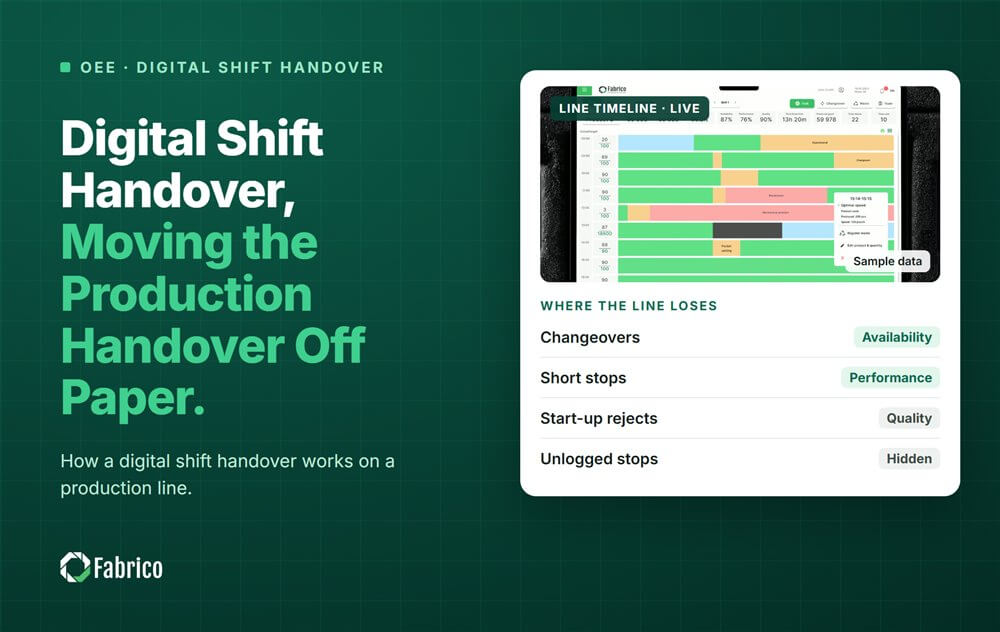





Real Fabrico tiles, sample data.