


 Login
 Blog
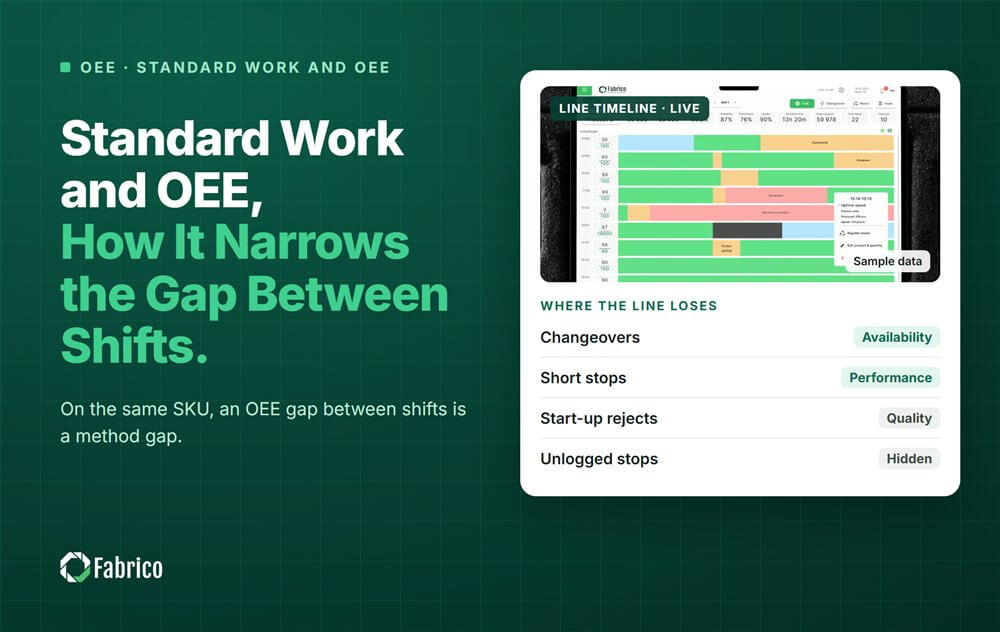
Standard Work and OEE: How It Narrows the Gap Between Shifts

Key takeaways
- On the same line and SKU, a lasting OEE gap between shifts is a method gap, not a people gap.
- Standard work fixes the method: one speed set point, one way to clear a jam, one restart check, on each shift.
- It shows up mostly in Performance and Quality: less slow running and fewer rejects after restarts.
- Track the spread between the best and worst shift on the same SKU. A shrinking spread is the proof.
- In the worked example, a coffee pouch line's shift spread falls from 10.2 to 3.1 OEE points. That is worth $229,500 a year if the pouches sell.
Standard work raises OEE by making each shift run the line the same way. In the data, it shows up as a narrower gap between shifts, less slow running and fewer rejects after restarts, mostly in Performance and Quality.
This guide is from Fabrico, the OEE (overall equipment effectiveness) and light MES platform. It shows which losses standard work removes, how to read it in shift data and how one packing line closes its gap. For the basics, see our standard work guide.
Why does OEE differ from shift to shift on the same line?
Same machine, same SKU, same rated speed. Yet one shift runs at a clearly higher OEE than another. When the gap holds over many shifts, the usual cause is the method.
Common method gaps on a packing line:
- Speed set point. One shift runs at rated speed. Another turns it down to be safe.
- Jam clearing. One shift clears a jam and restarts at full speed. Another restarts slow and ramps up by feel.
- Material loading. Film reels, cartons or labels loaded at different times and in different ways.
- Checks. Seal or weight checks done at different moments, with different reactions.
- Settings by feel. Temperatures or guides adjusted without a written value.
None of this is about effort. Each shift does what it learned. Measure the process, never the person.
Which OEE losses does standard work reduce?
- Slow running, in Performance: a written speed set point per SKU, and a reason code when the line runs below it.
- Short stops, in Performance: one way to load material and clear a jam, so the same jam does not repeat.
- Restart rejects, in Quality: set points for seal or glue temperature, and a check before full speed after a stop.
- Long stops, in Availability: a standard clearing sequence shortens each stop. This gain is often the smallest.
Jeffrey Liker's The Toyota Way (2004) puts it as principle 6: standardized tasks are the foundation for continuous improvement. Without one method, a gain found on one shift never reaches the others.
How do you see standard work in OEE data?
Compare shifts on the same SKU and the same planned time. Then look at four things:
- The spread: best shift OEE minus worst shift OEE, over a fixed run of shifts.
- The factor that differs: if Availability is close and Performance is not, the gap is speed and short stops.
- Stop count against stop length: the same number of jams but longer stops points at the clearing method.
- Rejects after restarts: rejects in the first minutes after a stop, by shift.
Our shift comparison method keeps the comparison fair, and our guide to reduced speed versus minor stops shows how to split the Performance loss.
What does a standard work example look like in shift OEE?
Sample line (illustrative numbers, not a customer): a coffee pouch line whose filler sealer is the slowest machine, rated at 120 pouches a minute. Each shift has 450 minutes of planned production time. Shifts A, B and C run the same SKU. Each figure is an average over 15 shifts.
Before. Availability was close on all three shifts. Performance and Quality were not. Shifts B and C turned the sealer below rated speed for part of the run. They also restarted slowly after jams and set the seal temperature by feel.
| Before | Shift A | Shift B | Shift C |
|---|---|---|---|
| Stops | 70 min | 74 min | 80 min |
| Short stops | 22 min | 26 min | 30 min |
| Slow running | 8 min | 22 min | 30 min |
| Rejects | 840 | 1,200 | 1,560 |
| Availability | 84.4% | 83.6% | 82.2% |
| Performance | 92.1% | 87.2% | 83.8% |
| Quality | 98.0% | 97.0% | 95.8% |
| OEE | 76.2% | 70.7% | 66.0% |
The standard. The three shifts wrote it together from what worked best:
- rated speed as the set point, with a reason code to go lower;
- one jam clearing and restart sequence;
- seal temperature set points per SKU.
| After | Shift A | Shift B | Shift C |
|---|---|---|---|
| Stops | 70 min | 72 min | 75 min |
| Short stops | 22 min | 23 min | 25 min |
| Slow running | 8 min | 10 min | 12 min |
| Rejects | 840 | 960 | 1,080 |
| Availability | 84.4% | 84.0% | 83.3% |
| Performance | 92.1% | 91.3% | 90.1% |
| Quality | 98.0% | 97.7% | 97.3% |
| OEE | 76.2% | 74.9% | 73.1% |
- Shift C before: run time is 450 minus 80 = 370 minutes. Net at rated speed is 370 minus 30 minus 30 = 310, so 37,200 pouches are made and 35,640 are good. OEE: 35,640 / 54,000 = 66.0%.
- Spread: 76.2 minus 66.0 = 10.2 points before, and 76.2 minus 73.1 = 3.1 points after.
- Good pouches over the three shifts: 41,160 + 38,160 + 35,640 = 114,960 before, and 41,160 + 40,440 + 39,480 = 121,080 after.
- Line OEE: 114,960 / (3 x 450 x 120) = 71.0% before, and 121,080 / 162,000 = 74.7% after.
- The gain is 6,120 pouches per three shifts, or 2,040 a shift. At a contribution of $0.15 a pouch: $306 a shift, or €306 in a euro plant.
- Over 750 shifts a year: $229,500, or €229,500, if the pouches sell.
Shift A did not improve. Standard work brought the other shifts close to the best method. Raising the standard itself is the next kaizen.
How do you keep standard work from drifting?
- Post the set points at the machine, per SKU, where the operator sees them.
- Give running below the set point its own reason code, so drift shows as a bar.
- Review the shift spread at the daily meeting, as a line number, not a crew score.
- Change the standard when a better method is proven, then train each shift on it.
- When a shift departs from the standard for a good reason, find out why. The standard may be wrong.
The cost of keeping methods in people's heads is real. Our guide to the cost of tribal knowledge covers it.
What mistakes stop standard work from showing in OEE?
- Writing standard work for the job steps but leaving out speed and temperature set points.
- Comparing shifts on different SKU mixes, so the spread is the mix, not the method.
- Treating the spread as a crew score. People then hide stops, and the data gets worse.
- Copying the best shift's numbers without learning its method.
- Mixing line start-ups and changeovers into the comparison. They need their own standards and their own bars.
Where Fabrico fits
Fabrico is a computer vision enabled Manufacturing Performance Platform. OEE and light MES come first: stops are logged automatically, and OEE is live by line and shift.
- OEE live by line and shift, so the spread between shifts is a number, not an argument.
- Short stops counted, including the ones that never reach a paper log.
- The operator confirms the reason in one tap, so jams get the same reason on each shift.
- Losses priced in money and ranked, so the team writes standard work where the gap costs most.
- A camera clip as evidence for a stop, where a camera watches the machine.
Fabrico measures the shifts. Your team writes and keeps the standard work. You start on one line, with a baseline and a decision date agreed in advance. There is no free plan and there are no tiers: each plant gets a quote. See how stops are captured on our computer vision OEE page.
Frequently asked questions
How does standard work improve OEE?
It makes each shift run the line the same way, at the same speed set point, with the same jam clearing and restart checks. That cuts slow running and short stops, which lifts Performance. It also cuts rejects after restarts, which lifts Quality.
Which OEE factor does standard work affect most?
Often Performance, then Quality. Shifts tend to differ in speed set points and in how they restart after a jam. Availability differs less, unless jam clearing or material loading takes much longer on one shift. Look at the factor that differs most between shifts on the same SKU.
How do you measure the effect of standard work?
Compare OEE by shift on the same SKU over a fixed run of shifts, before and after. Track the spread between the best and worst shift, and which factor makes it. On the sample line, the spread fell from 10.2 to 3.1 points.
Is a gap between shifts always a method problem?
No. Check the SKU mix, the planned time and the staffing first. Night shifts may run different products or have fewer people on hand. Compare like with like. If the gap holds, look at the method, never at the person.
Does standard work slow down improvement?
No. It is the baseline improvement starts from. A better method found on one shift becomes the new standard for all three. Without a standard, a gain on one shift fades, and the next kaizen has no fair baseline. Liker's sixth principle makes the same point.
See your shift gap in a demo
Bring one line and a few recent shifts. We will show its OEE by shift on the same SKU, and which loss makes the gap.
Latest from our blog





Real Fabrico tiles, sample data.