


 Login
 Blog
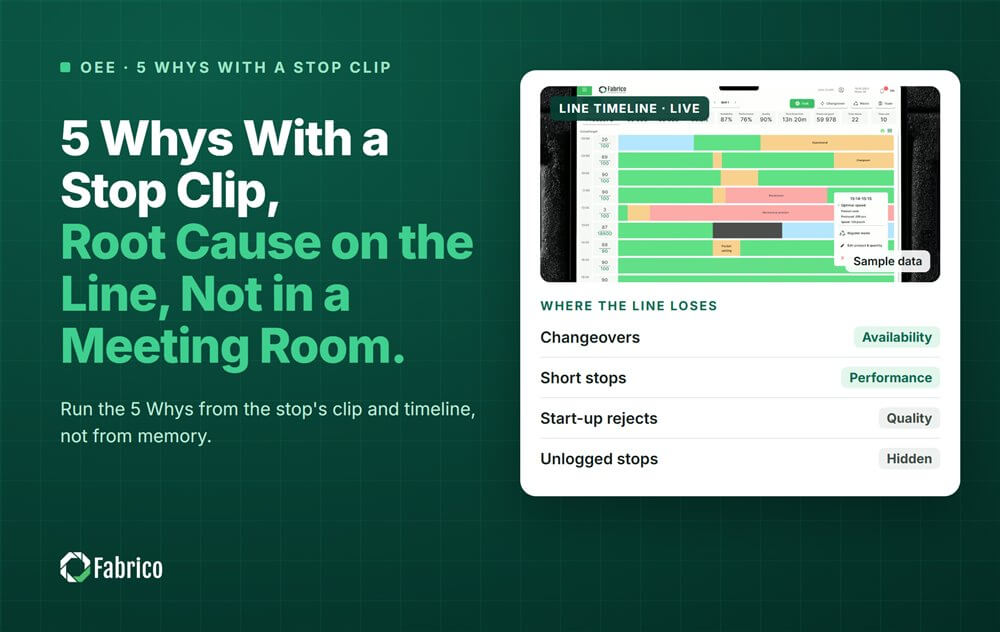
5 Whys With a Stop Clip: Root Cause on the Line, Not in a Meeting Room

Key takeaways
- A 5 Whys run from memory turns each answer into a guess, and the chain often ends at the crew.
- Start from the stop's clip and the line timeline: the seconds and minutes before it.
- Write the evidence next to every why.
- On the sample line, a repeated wrapper jam traced back to one missing setting. The fix gave back 120 minutes a week.
To run the 5 Whys with a stop clip, pick one stop that keeps coming back, play its clip and read the timeline before it. Answer each why only with evidence you can point to, fix the cause, and check the numbers a week later.
Fabrico, OEE and light MES software with AI cameras, logs each stop from the machine signal. Where a camera watches the station, it marks each stop and keeps the clip, and the operator confirms the reason in one tap. Cameras are an add-on; the OEE comes first.
Below, one repeated micro stop goes through five whys on a sample line. For the method itself, see our guide to the 5 Whys.
What is the 5 Whys, and why does it fail on memory?
The 5 Whys is a root cause method: you ask why a problem happened, then why that answer is true, until you reach a cause you can change.
Most plants run it in a meeting room, days after the stop. Then three things go wrong:
- Each why is a guess. One wrong guess sends the chain down the wrong branch.
- Short stops leave no memory. A micro stop is typically a minute or two, cleared by the operator alone, and soon forgotten.
- The chain ends at a person. "The operator ran it too fast" is blame, not a cause. In Amy Edmondson's 1999 study of 51 teams in one manufacturing company, teams that felt safe to speak up learned more. Blame means the next stop goes unlogged.
Masaaki Imai's first two gemba rules: when a problem arises, go to the real place, and check the actual machine and part. A stop clip does not replace that walk. It tells you where to stand.
What does a stop clip add to each why?
A stop clip is the short video a line camera saves for one stop. The camera keeps a rolling buffer, so the clip starts before the stop. In Fabrico, each vision event gets a clip of 10 to 30 seconds with that lead-in.
The timeline adds the minutes around it: machine signals, sensor signals and camera events on one line, so you see what happened 30 seconds before the stop. Four kinds of evidence:
- The clip: what the product or a guide did just before the stop.
- The timeline: another stop, a restart, a changeover, a new roll.
- The pattern: how many stops look alike, and on which SKU or shift.
- The documents: the change sheet, the set point, the centerline.
The camera does not answer the whys. It suggests a reason, the operator confirms it, and people think.
How do you run the 5 Whys from a stop clip?
- Pick one repeated pattern. Rank last week's stops by money and take the top one.
- State it in numbers: station, stop type, count, minutes, SKU, shift.
- Watch 3 clips from different shifts. If they differ, one code may hide two problems.
- Write each answer next to its evidence. No proof? Go and look.
- Stop at a condition you can change: a setting, a standard, a part or a material. Never a person.
- Set a temporary fix today and a root fix with an owner. Check a week later.
Keep it on one page. An A3 puts causes before countermeasures on purpose; see our guide to A3 problem solving.
Worked example: how do 5 whys run on one repeated micro stop?
Sample line (illustrative numbers, not a customer): a snack bar line where the flow wrapper sets the pace at 150 packs a minute. A camera watches the wrapper infeed. The line runs 15 shifts a week of 450 planned minutes, on 4 SKUs, with short buffers.
The problem: infeed jams were last week's top loss by money. There were 270 jams of about 40 seconds, 180 minutes in all, and 210 of them came on the 150 g bar.
The meeting room version: why did it jam? The crew runs it too fast. Action: a talk with the crew. The clip version:
| Why | Answer | Evidence |
|---|---|---|
| 1. Why did the wrapper stop? | A bar rode up on a flight lug and the jam sensor tripped. | Clip: 3 of 3 clips show a bar on a lug at the same spot. |
| 2. Why did the bar ride up? | Two bars came into one pitch, touching. | Clip lead-in: bars arrive nose to tail just before the stop. |
| 3. Why were the bars touching? | They queued during an earlier stop and restarted as one block. | Timeline: 189 of the 270 jams started within 60 seconds of another stop. |
| 4. Why did the block not split? | On the 150 g bar, the gap belt ran at the speed set for the longer 300 g bar. | Pattern: 210 of 270 jams on that bar. The set point on the wrapper screen. |
| 5. Why was it set for the 300 g bar? | The 150 g change sheet was copied from the 300 g sheet, with no gap belt line. | Document: the change sheet. The other 3 sheets list a gap belt speed. |
Five answers, five pieces of evidence, and the chain ended at a sheet of paper, not at the crew.
- Temporary, today: the line lead sets the gap belt faster on the 150 g bar and notes the value.
- Root, this week: the speed goes onto the 150 g change sheet as a centerline, checked at each changeover. Owner: the CI lead.
The cost: 180 minutes x 150 packs = 27,000 packs a week. At a contribution of $0.06 a pack (or €0.06 in a euro plant), that is $1,620 a week, if the line is sold out or the packs cost overtime. Agree that rule with your controller.
What did the check a week later show on the sample line?
- Jams on the 150 g bar fell from 210 to 30, or from 140 minutes to 20.
- Jams on the other 3 SKUs stayed at 60, or 40 minutes.
- Each jam still lasted about 40 seconds, so the fix cut the count, not only the length.
- Stops at the cartoner stayed level, so the jam did not just move one station down.
The line got back 120 minutes a week, or 18,000 packs: $1,080 a week, and $51,840 a year over 48 weeks (or €51,840). On a 6,750 minute week, that is 1.8 points of OEE, all in Performance.
Clips of the 30 jams left show a new pattern, bars with a broken corner: next week's first why. Audit the new setting for two weeks, because unwritten settings slide back.
When is the clip not enough?
A camera sees one field of view in one lighting range. It stops helping when:
- The cause starts out of frame: upstream, inside the machine or in the store room.
- The view is blocked by a hand, a tool or a guard, or spoiled by glare or steam.
- The cause is a material or a setting: the clip shows only the effect.
Then go to the line. Our guide to micro stops and computer vision shows how cameras and PLC signals split the work.
How do you keep the 5 Whys about the process, not the person?
Point the camera at the product flow, never at people. Report by line and shift, never by named operator. In Germany and France, agree camera use with the works council or CSE first. Our guide to line cameras without surveillance covers the design.
Where Fabrico fits
Fabrico is a computer vision enabled Manufacturing Performance Platform. It runs OEE and light MES first. It does not run the 5 Whys; it gives the team the stop, the clip, the timeline and the before and after.
- Automatic downtime logging, down to short stops, on one timeline with camera events.
- AI cameras count output and record stops, each with a short clip.
- The operator confirms the reason in one tap.
- Losses ranked by money and OEE live by line and shift.
Named results: ABB, 20% less downtime, and Ficosota (see the Ficosota story). You start on one line, with devices connected in about a month, and the full rollout takes 3 to 4 months. There is no free plan and there are no tiers: each plant gets a quote. See the computer vision OEE and MES page.
Frequently asked questions
Does the 5 Whys always need exactly five whys?
No. Five is a habit, not a rule. Stop when the answer is a condition you can change: a setting, a standard, a part or a material. Some chains end at why 3, some need 7. If the last answer is a person, ask why the line allowed it.
Can a camera find the root cause on its own?
No. The camera marks the stop and keeps a short clip, and the screen can suggest a reason. The operator confirms it in one tap, and the team runs the whys with the clip as evidence. A clip shows a scene, not a verdict.
What if a stop has no clip?
Use the stop log and the timeline: the count, the minutes, the SKU and what happened just before. Then watch the station while the pattern runs. A station where unexplained stops pile up is a good place for a camera.
Which people should run a 5 Whys on a stop?
The line lead and an operator from the shift that cleared the stops, a person able to change the setting, and the CI lead to keep the evidence column honest. Three or four people are enough. Meet at the line, the same day or the next morning.
Bring one repeated stop to a demo
Bring one line and last week's top stop. We will show its clips, timeline and cost.
Latest from our blog


Real Fabrico tiles, sample data.