


 Login
 Blog
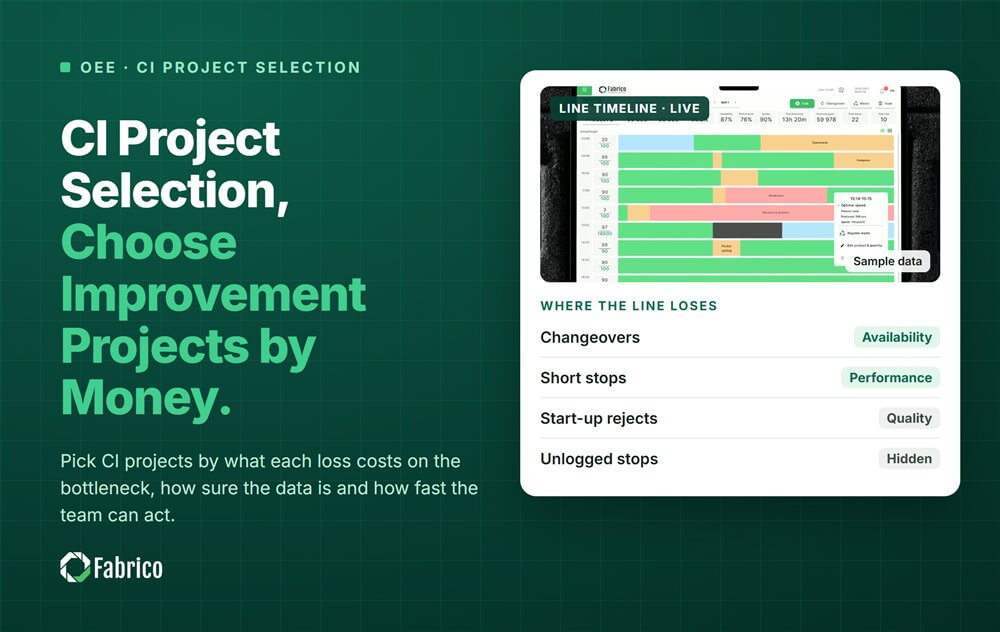
CI Project Selection: Choose Improvement Projects by Money

Key takeaways
- Rank losses by money first, then pick the projects.
- Losses that never reach the bottleneck are rarely the best first project.
- Score each idea on value, data confidence, effort and time to result.
- World Class Manufacturing's Cost Deployment pillar works the same way: it starts from the losses inside the costs.
- Keep few projects open. Three per line finish faster than ten.
In the sample below, the winning project is a loss nobody talked about: 620 minutes of film splice stops in four weeks.
Fabrico is OEE and light MES software with AI cameras. It ranks a line's losses by money, which is where project selection starts. This guide is for CI leads who need a fair, simple way to pick the next improvement projects.
Why do CI projects get picked by opinion?
Because opinion is fast and data is slow. In most plants, the next project is chosen by one of three things:
- The loudest stop. The big breakdown last Tuesday that everyone saw.
- The senior person's idea. A good idea, but not checked against the losses.
- The easy project. It looks good in the report but frees little output.
None of these is wrong by itself. The problem is that the biggest loss, often twenty small stops on the bottleneck, never gets a project because nobody notices it.
How do you rank losses by money?
- Find the constraint machine on each line.
- Price a lost minute on the constraint at throughput: selling price minus truly variable cost, for what it makes in a minute.
- Add up the minutes per loss reason over four weeks, counting only minutes that reached the constraint.
- Multiply, and sort from the most expensive loss down.
This is a Pareto chart in money instead of minutes. Our guide to Pareto analysis for downtime shows the method, and loss tree vs Pareto explains when to use each view.
What should a project score include?
| Criterion | Question | Score 1 to 5 |
|---|---|---|
| Value | How much money does the loss cost on the constraint? | 5 = biggest loss on the list |
| Data confidence | Is the loss measured from the machine, with reasons? | 5 = machine data, confirmed reasons |
| Effort | How many people and days will it take? | 5 = small team, days not months |
| Time to result | How soon will the loss go down? | 5 = within a month |
Keep the scoring simple. A four line score that everyone understands beats a 20 column matrix nobody trusts.
Worked example: how do you score five project ideas?
Sample line (illustrative numbers, not a customer): a snack bagging line where the bagger is the constraint. One constraint minute is worth USD 60. Four weeks of machine data. Total = 2 x Value + Confidence + Effort + Time, because value matters most.
| Idea | Minutes on the constraint (4 weeks) | Cost | Value | Confidence | Effort | Time | Total |
|---|---|---|---|---|---|---|---|
| Film splice stops | 620 | USD 37,200 | 5 | 5 | 4 | 4 | 23 |
| Long changeovers between bag sizes | 540 | USD 32,400 | 4 | 5 | 3 | 3 | 19 |
| Waiting for QA release | 300 | USD 18,000 | 3 | 3 | 4 | 4 | 17 |
| Checkweigher stops | 90 | USD 5,400 | 1 | 4 | 4 | 5 | 15 |
| New conveyor layout | 200 | USD 12,000 | 2 | 2 | 1 | 1 | 8 |
The film splice stops win. They are many short stops, so nobody talked about them, but together they cost the most. The checkweigher stops felt big on the floor, yet most of them never reached the bagger. The conveyor layout was the senior idea; it scores low on every criterion.
How many CI projects should run at once?
Fewer than you think. Little's law, which John Little proved in 1961, says work in progress = throughput x flow time. It applies to projects too. If a team finishes two projects a month and keeps ten open, each one takes about five months.
Cut the team's open list to three, and at two finished a month each project takes about six weeks. The losses go down sooner, and the team sees results. Our guide to Little's law explains the formula.
What does World Class Manufacturing say about choosing projects?
World Class Manufacturing (WCM) has 10 technical pillars. One of them is Cost Deployment, the "analysis of the losses and costs (losses within the costs)". It was developed at Fiat with Hajime Yamashina from 2005.
The idea is the same as this guide: find the losses, price them, and point the projects at the most expensive ones. Pricing every loss in money every day is cost deployment done daily, instead of at audit time.
How do you make sure the project solves the right problem?
- Write the problem with the loss, the minutes and the money, before any solution.
- Use a structured method, such as an A3, for the root cause.
- Measure the same loss again after the project, on the same definitions.
- Close the project only when the loss stays down for a month.
Where does Fabrico fit?
Fabrico is a computer vision enabled Manufacturing Performance Platform. It logs stops automatically from the machine signal, prices each loss in money and ranks the losses by what they cost. The operator confirms the reason in one tap. So the money Pareto is ready every morning, and the project list starts from data instead of opinion.
There is no free plan and there are no tiers: each plant gets a quote.
Frequently asked questions
How do you prioritise continuous improvement projects?
Rank the losses by money on the constraint machine, then score each project idea on value, data confidence, effort and time to result. Start with the highest score. Keep only a few projects open per line, so each one finishes quickly and the team sees the loss go down.
Why rank losses by money instead of minutes?
A minute on the bottleneck is worth far more than a minute on a machine with spare capacity. Ranking by minutes makes a minute on any machine look the same. Ranking by money shows which loss really costs output, and it gives finance a number it can follow.
What is a good scoring model for CI projects?
A simple one with four criteria: value, data confidence, effort and time to result, each scored 1 to 5. The team should understand it without a manual. Complex matrices with many weights invite arguments about the weights instead of action on the losses.
How many improvement projects should a line run at once?
Usually two or three. Little's law says that more work in progress means a longer flow time for each item. A team that keeps ten projects open finishes each one slowly. A team that keeps three open finishes them in weeks and moves on.
What is cost deployment in WCM?
Cost Deployment is one of the 10 technical pillars of World Class Manufacturing. It analyses the losses inside the plant's costs and points improvement work at the most expensive ones. WCM was developed at Fiat with Hajime Yamashina from 2005.
Pick your next projects from data
Bring one line and your current project list. We will show the money Pareto from the machine data and how the list compares.
Latest from our blog


Real Fabrico tiles, sample data.