


 Login
 Blog
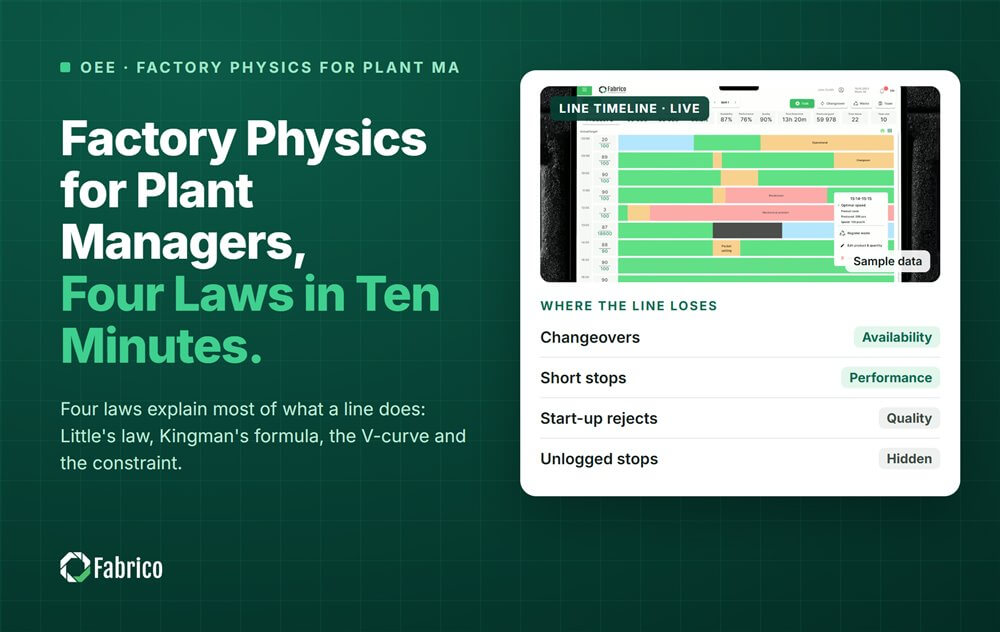
Factory Physics for Plant Managers: Four Laws in Ten Minutes

Key takeaways
- Little's law: work in progress = throughput x flow time. A 1,500 bottle table before a 500 a minute filler is 3 minutes of protection.
- Kingman: waiting grows fast as a machine fills up. The utilisation term is 4 at 80%, 9 at 90%, 19 at 95%.
- High utilisation belongs at the bottleneck only.
- The V-curve: the machines next to the critical machine run 10% faster in recovery speed.
- The constraint sets the output of the whole line.
In the sample line below, the machine with the worst OEE, the labeller at 58%, is the wrong one to fix first.
Fabrico is OEE and light MES software with AI cameras. It logs stops automatically from the machine signal and shows OEE live by line and shift. This guide explains the four laws in plain words, with one bottling line worked through all four.
What is factory physics?
Factory physics is the name for the few laws that describe how work flows through a line. Little's law and Kingman's formula are maths. The V-curve and the constraint are rules built on them.
You do not need the maths to use them. You need to know what each law predicts, so you can spot it on the floor.
What does Little's law tell a plant manager?
John Little proved it in 1961: work in progress = throughput x flow time. It needs almost no assumptions, so it works on any line.
The most useful version on a packaging line is about buffers. The time a buffer protects you = units on the table / the rate of the machine after it. A 1,500 bottle table in front of a filler that takes 500 a minute is 3 minutes of protection.
So any stop upstream that lasts longer than 3 minutes stops the filler too. Our guide to Little's law has more examples.
Why do queues explode near full utilisation?
John Kingman described it, also in 1961. The waiting time in front of a machine depends on how busy it is and how much its timing varies. The part that depends on how busy it is grows very fast near the top:
- At 80% utilisation the term is 4.
- At 90% it is 9.
- At 95% it is 19.
Going from 90% to 95% busy roughly doubles the waiting. That is why running every machine flat out builds queues and stretches flow time without adding output. High utilisation belongs at the bottleneck only. Our page on Kingman's formula shows the full equation.
How should machine speeds be set around the bottleneck?
The V-curve answers this. The slowest machine is the critical machine. Its two neighbours run 10% faster in recovery speed, and each machine further out runs another 10% faster.
Only the critical machine runs at a steady speed. The others stop now and then, either because no product is arriving (lack) or because the conveyor after them is full (buildback). That is by design. A labeller that waits because the filler has not sent bottles is doing its job, not losing time.
What does the constraint mean for OEE?
Eliyahu Goldratt's Theory of Constraints, from his 1984 book The Goal, says the constraint sets the output. Identify it, exploit it, subordinate everything else to it, raise its capacity, and start again if it moves.
For OEE this means one thing: the OEE of the constraint matters most. A higher OEE on another machine may not add one unit of output. Our article on OEE vs throughput explains why.
Worked example: how do the four laws apply to one bottling line?
Sample line (illustrative numbers, not a customer): a bottling line with a depalletiser, a rinser, a filler, a capper, a labeller and a case packer. The filler is the critical machine.
| Law | What the line data shows | What the plant manager does |
|---|---|---|
| Little's law | The table after the depalletiser holds 1,200 bottles; the filler takes 400 a minute, so 3 minutes of protection. 11 depalletiser stops last week lasted longer than 3 minutes. | Fix the long depalletiser stops first. They are the ones that reach the filler. |
| Kingman | The case packer runs at 95% of its capacity, with bottles arriving unevenly. | Smooth the flow into the packer before asking for more speed. The queue in front of it is a utilisation problem. |
| V-curve | The labeller runs at the same speed as the filler, so it never catches up after a stop. | Set the labeller about 10% faster than the filler in recovery speed. |
| Constraint | Filler OEE is 66%, the labeller's is 58%. | Improve the filler first. Most of the labeller's loss is time starved by the filler, not its own stops. |
Without the four laws, the team would chase the labeller, because its OEE looks worst. With them, the team fixes the long depalletiser stops, the flow into the case packer and the filler, which are the losses that cost output.
How do you use these laws in the morning meeting?
Turn each law into one question for the meeting:
- Little: which upstream stops lasted longer than our buffer?
- Kingman: which machine is running too close to full, with uneven input?
- V-curve: are the machines next to the bottleneck fast enough to recover?
- Constraint: what did the bottleneck lose yesterday, and why?
Short stops matter in all four. They are hard to see by eye, so they need machine data. Our guide to micro stops explains how to catch them.
Where does Fabrico fit?
Fabrico is a computer vision enabled Manufacturing Performance Platform. It logs stops automatically from the machine signal, including the short ones, and shows OEE live by line and shift. Losses are priced in money and ranked, so the bottleneck's losses come first.
Where a camera is fitted, a stop keeps a short clip as evidence, and the operator confirms the reason in one tap. Our page on computer vision OEE shows how it works on a line.
There is no free plan and there are no tiers: each plant gets a quote.
Frequently asked questions
What is factory physics in simple terms?
Factory physics is a small set of laws that describe how work flows through a production line. The best known are Little's law, Kingman's queue formula, the V-curve for line speeds and the Theory of Constraints. Two are maths and two are rules built on them, so together they help managers predict where losses will appear.
What is Little's law used for in manufacturing?
Little's law links work in progress, throughput and flow time. On a packaging line it tells you how long a buffer protects the next machine. Divide the units on the table by the rate of the machine after it to get the minutes of protection.
Why should non-bottleneck machines not run at full utilisation?
Kingman's formula shows that waiting grows very fast as a machine gets close to full. The utilisation term is 4 at 80%, 9 at 90% and 19 at 95%. Running every machine flat out builds queues and stretches flow time without adding output, so keep high utilisation for the bottleneck.
What is the V-curve for line speeds?
The V-curve sets machine speeds around the critical machine. Its neighbours run 10% faster in recovery speed, and machines further out run another 10% faster. Only the critical machine runs steadily. The others stop at times by design, so they can catch up after a stop.
Which machine's OEE matters most?
The constraint's. It sets the output of the whole line, so every minute it loses is output lost for good. A better OEE on another machine may add nothing. Improve the constraint first, then check whether the constraint has moved to another machine.
See the four laws on your own line
Bring one line and a week of stop data. We will show the line's stops ranked by money, machine by machine.
Latest from our blog





Real Fabrico tiles, sample data.