Menu
Free field guide · 51 pagesPublished by Fabrico

Your line loses more hours than anyone writes down.

Price one stopped hour in 20 minutes. Get a baseline nobody argues with in one week. Then fix the three losses that cost you most.

11 chapters, one line at a time10 worksheets you fill in on paper1 week to a baseline nobody argues with

By sending, you agree that a Fabrico consultant may get in touch with you about the guide. Ask us to stop at any time. Privacy policy.

Nothing to buy to start. The guide opens right here after you send.

Your copy

Your guide is ready.

Start with chapter 1. In 20 minutes you know what one stopped hour costs on your line.

Download the PDF. On a phone? Read the phone edition.

Want to see your own lost hours on the screens? Request a demo. Bring the cost of one hour.

Sent. Open the guide (PDF)

Price one stopped hour first, no e-mail needed.

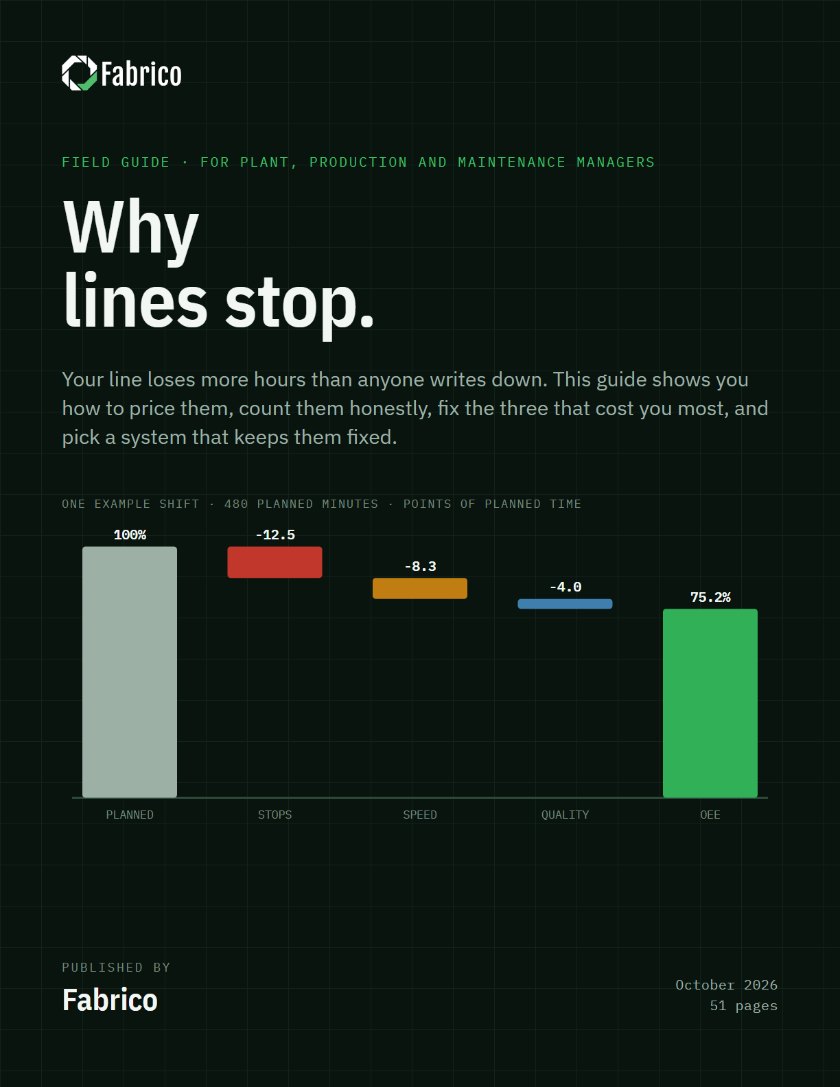
The cover of the field guide Why Lines Stop: one example shift of 480 planned minutes, from 100 percent planned to 75.2 percent OEE
Real pages, real screens with sample data.
Price one stopped hour, no e-mail needed

What does one stopped hour cost on your line?

Someone in your plant already has each number. Put in yours. Leave repair labour and parts out: your maintenance budget already counts them.

1Lost margin: units an hour × margin a unitYour controller has it
2Idle labour: operators left waiting × loaded cost an hourPayroll has it
3Scrap and restart: restart scrap a year ÷ lost hoursYour quality lead has it
4Overtime and express freight a year ÷ lost hoursYour planner has it
5Late penalties a year ÷ lost hoursSales has it
hHours this line lost to stops in a yearYour stop log, or chapter 4's baseline

Written for you if your lines lose hours to the same things every line does: jams, short stops, slow running, changeovers, startup scrap.

Fabrico's customer stories come from food, FMCG, metal, electronics, aerospace, medical, textile and industrial equipment plants.
schaefflerHitachi EnergyAkzoNobelFicosotaEWELLIXBiovetZobeleAgropolychim

Why this guide is free

Everything in this guide works on paper first.

You need one line, one week, a pencil, and one hour each with your production, maintenance and quality leads. Nothing to buy.

We make money when your plant decides to run this method in Fabrico. You may run it on paper first, and that is fine: the method works either way.

The Fabrico team

What is inside

What you get when you open it

pp. 5 to 6

What a stopped hour costs. Five terms, and who in your plant already has each number.

p. 8

One page for finance. Every line, its lost hours, its cost an hour and a year.

p. 9

Where the 85% comes from. And what plants that measure honestly find.

p. 14

Five ways your OEE number gets inflated. Every yes means part of your number is not real.

p. 13

The six losses, one at a time. With your first move and an owner for each.

pp. 16 to 18

Days 1 to 7: a baseline on one line. The week, day by day, on paper.

p. 17

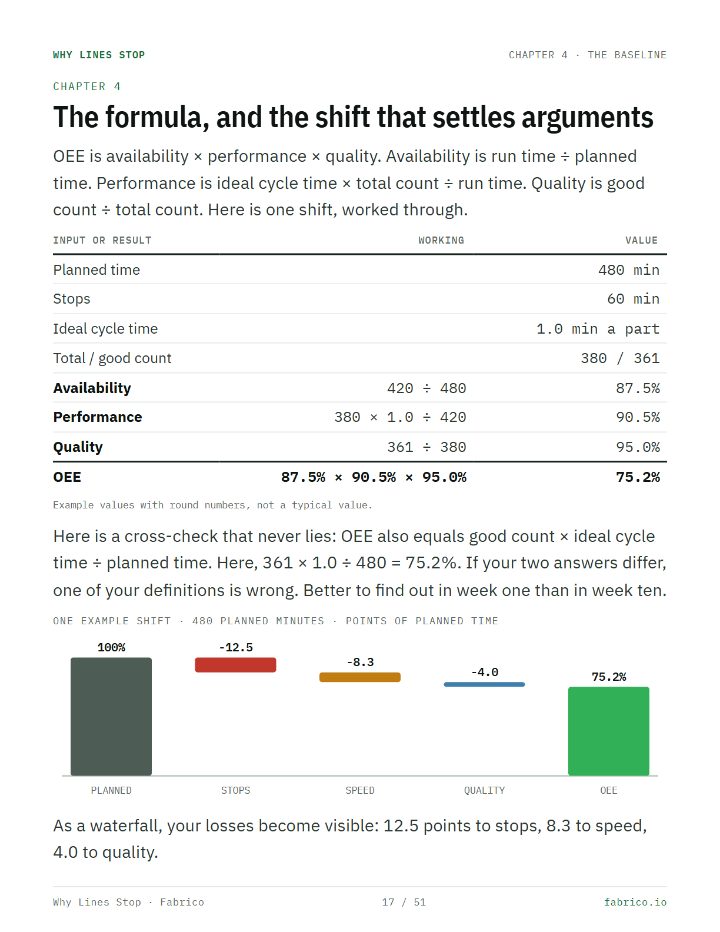
The shift that settles arguments. The formula, worked through, and a cross-check that never lies.

pp. 21 to 23

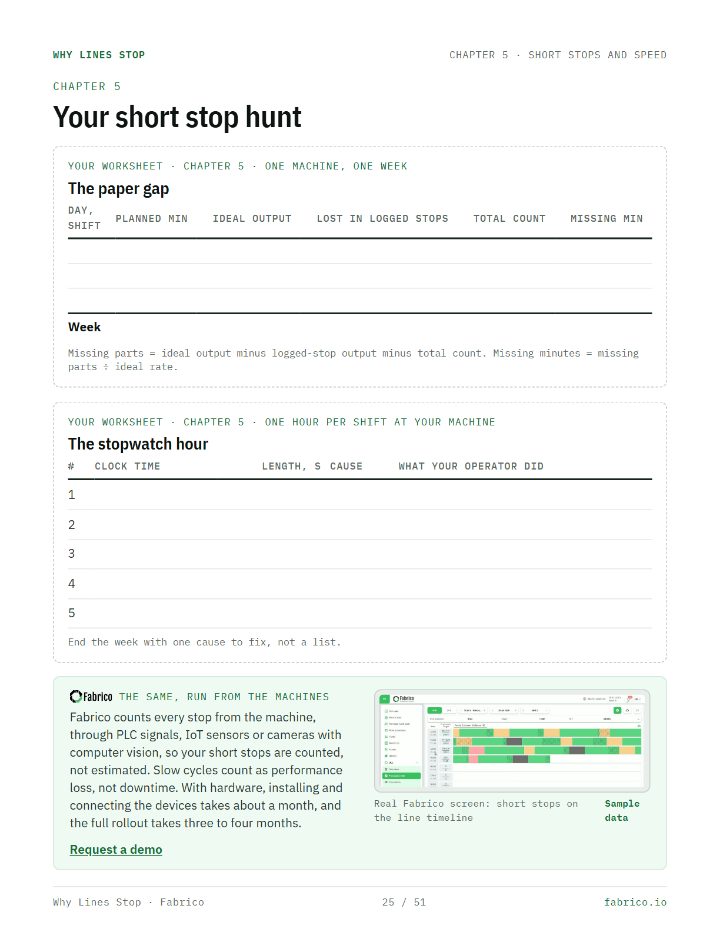
The stops paper never sees. Short stops, slow running, and the stopwatch hour that finds them.

p. 24

"Is it filming me?" What to tell your crew before a camera goes up.

pp. 29 to 31

The ten-minute daily meeting. One board, one agenda, every day.

pp. 32 to 35

From stop reason to work card. One record from the stop to the fix.

pp. 39 to 48

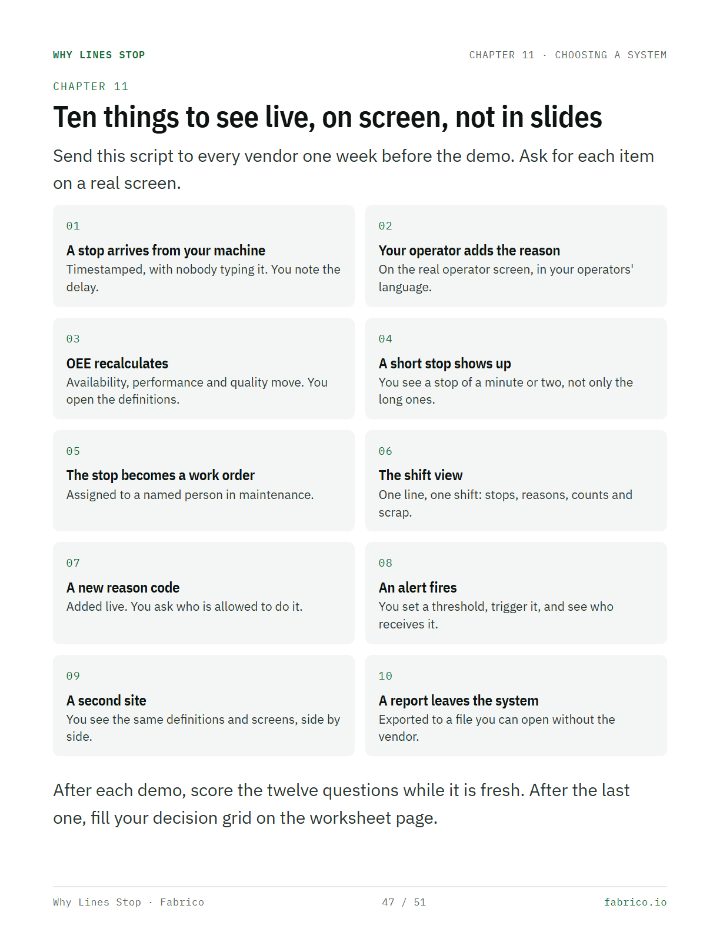
The 90-day plan and choosing a system. The case finance can sign, twelve questions for every vendor, and ten things to see live.

Built for you to fill in, one line at a time

Who this is for. And who should close the tab.

For
  • You run a plant, a production area or a maintenance team, and your lines stop more than you would like.
  • You have an OEE number, but you do not quite believe it.
  • You want one line to improve in 90 days, with proof that finance accepts.
Not for
  • You want theory. The sources at the back go deeper.
  • You want a tool before a method. In this guide the method comes first and the tool comes last.

What you can count on

  • Every published figure names its source on the page.
  • Every worked example says it is an example. None is a customer.
  • The screens are real Fabrico screens from a demonstration plant, with sample data.
  • Nothing to buy to start. The method works on paper.
  • The guide right after you send, here on the page. A Fabrico consultant may get in touch; ask, and we stop.

The benchmarks you will see come from Nakajima's work on total productive maintenance and two studies from Chalmers University in Sweden. Page 51 lists every source for you to check.

Where Fabrico fits

When you want this method to run every shift without the paper, this is where Fabrico fits: a cloud MES and OEE platform with maintenance (CMMS) built in.

  • You see availability, performance and quality per line and shift, from PLC signals, IoT sensors or cameras with computer vision.
  • Your operator picks the reason at the line while the stop is happening.
  • Your technician opens a work card straight from the stop, and writes off the parts used against it.
  • Plan on this: with hardware, installing and connecting the devices takes about a month, and the full rollout takes three to four months.

ISO/IEC 27001 certified (DNV), hosted on AWS. Ask for the certificate and its scope, as you would from any vendor.

Your own automation team, a partner you work with, or the Fabrico team connects the machines. Fabrico's R&D team is in Bulgaria, with teams in the US, the UK, Germany, the Netherlands, Spain, France, Poland and Serbia, and your data is hosted on AWS in the EU.

No commitment.

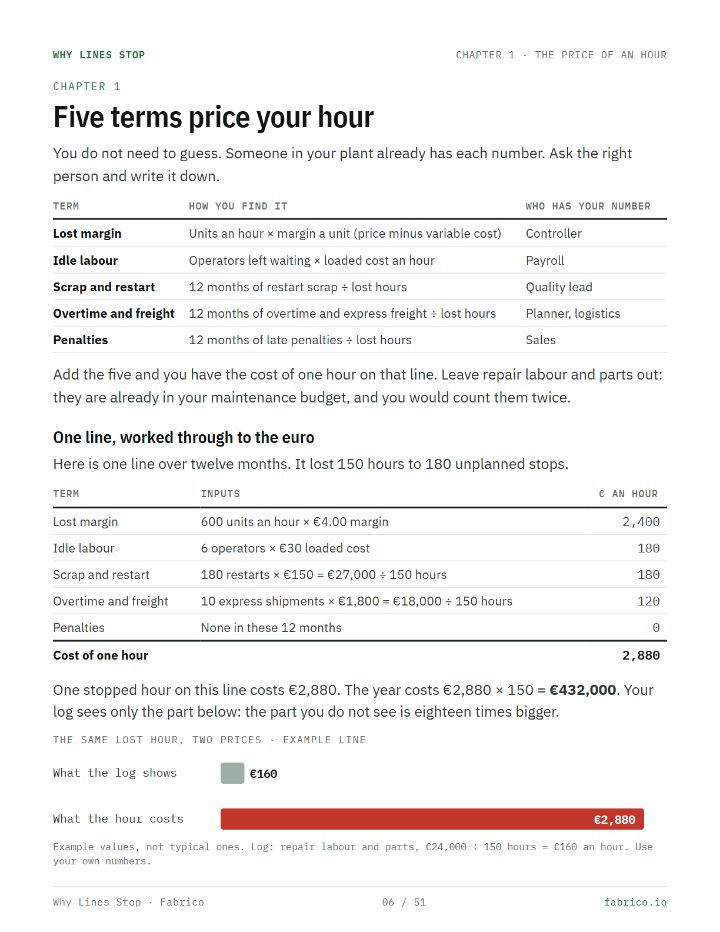
Page 6 · the same lost hour, two prices
What the log shows€160
What the hour costs€2,880

Example values, not typical ones.

Questions a sceptical plant manager asks

Why is a 51-page guide free?

Fabrico makes money only if your plant later decides to run the method in Fabrico. The guide works without it.

Do I need sensors or cameras to start?

No. Your first week runs on a tick sheet and a stopwatch. Chapter 4 gives you the sheets, and chapter 5 shows you how to find the short stops by hand.

Is this a sales pitch in disguise?

No. Fabrico shows up in a short box at the end of chapters 1 to 10, "The same, run from the machines", on page 24 about the camera, and on pages 49 and 50. Everything else is the method, and you can run all of it on paper.

We already have an OEE number. Is this for us?

Yes, if you do not quite believe it. Page 14 lists five ways a number gets inflated without anyone lying.

Does it name the systems to buy?

No. Chapter 11 gives you twelve questions, weighted by your own team, and ten things to see live in any vendor's demo.

Is it in my language?

The guide is in English.

What happens after I sign up?

The guide opens right here, to read on the page or as a PDF. A Fabrico consultant may get in touch about it; ask, and we stop.

What happens in the 30-minute demo?

You bring the cost of one hour from chapter 1, or your scorecard from chapter 11. A Fabrico consultant shows a stop arriving, a reason added, OEE moving and a technician opening a work card, on a line like yours. Then your questions. No commitment.

The guide is free

Get the guide

Start with chapter 1. In 20 minutes you know what one stopped hour costs you.

  • p. 4Start here: the guide on one page.
  • p. 8Your first worksheet: the cost of one hour.
  • p. 44Choosing a system: twelve questions and ten things to see live.

Digital edition

Free

By sending, you agree that a Fabrico consultant may get in touch with you about the guide. Ask us to stop at any time. Privacy policy.

Nothing to buy to start. The guide opens right here after you send.

Your copy

Your guide is ready.

Start with chapter 1. In 20 minutes you know what one stopped hour costs on your line.

Download the PDF. On a phone? Read the phone edition.

Want to see your own lost hours on the screens? Request a demo. Bring the cost of one hour.

Sent. Open the guide (PDF)

Already know your worst loss? Skip the guide and request a demo. Bring the cost of one hour.

By clicking the Accept button, you are giving your consent to the use of cookies when accessing this website and utilizing our services. To learn more about how cookies are used and managed, please refer to our Privacy Policy and Cookies Declaration