

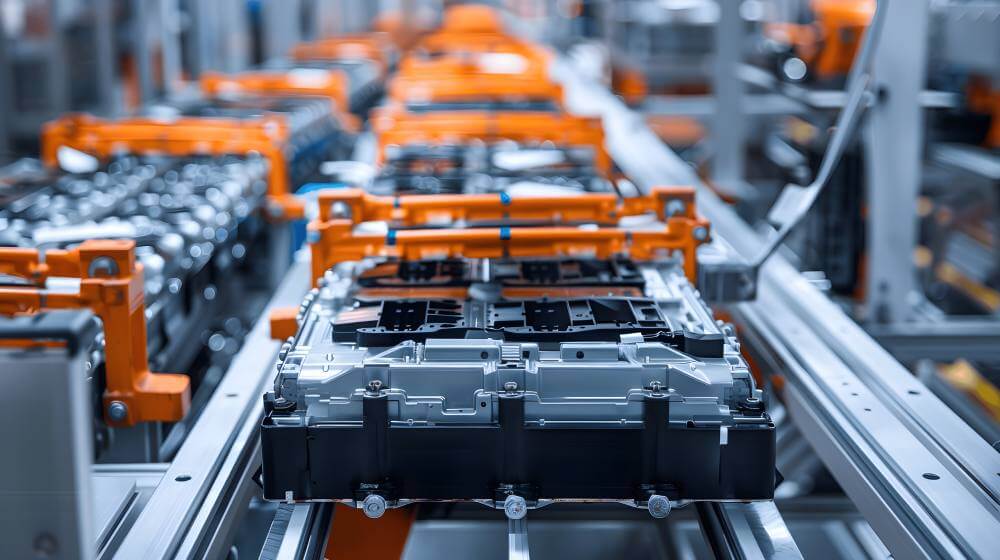

Lithium-ion battery manufacturing combines high-speed precision coating processes with rigorous environmental control requirements.
Electrode coating lines, the primary production asset in cell manufacturing, run at high speed with tight thickness and porosity specifications, making OEE performance monitoring critical for both throughput and quality management.
Coating line speed reduction (OEE performance loss) and coating defects (OEE quality loss) are both maintenance-linked: die lip wear, solvent recovery system degradation, and calendar roll surface condition all affect coating quality.
Integrated OEE+CMMS connects coating line performance data directly to maintenance scheduling for these quality-critical components, enabling condition-based maintenance triggered by OEE quality trend rather than calendar interval.
Dry room environment maintenance, controlling dew point below -40 degrees C to prevent moisture contamination, is a critical PM requirement with direct product quality implications.
CMMS dry room PM scheduling linked to OEE quality rate monitoring creates an early warning system for moisture-related quality excursions before they produce defective cells.
Whichever OEE platform you shortlist, the decisive question is data quality. Sensors and manual logs miss the short stops, micro-stops, and idle time that quietly erode availability. Fabrico is computer-vision-verified OEE plus closed-loop maintenance execution: cameras catch the losses other systems miss, and maintenance work orders close the loop from detection to fix. See our guide to OEE for manufacturing and how to calculate OEE, or book a Fabrico demo to see it on your line.
Battery formation, the first charge-discharge cycle that activates cell chemistry, and aging are time-consuming processes that determine cell capacity and cycle life.
Formation cycling equipment maintenance directly affects product quality: a formation unit running off-specification voltage or current due to calibration drift produces cells with below-specification capacity.
Integrated OEE+CMMS tracks formation cycling equipment OEE (cycle completion rates, yield from formation to specification) alongside CMMS calibration records for formation current and voltage measurement equipment.
When formation yield drops below threshold, the integrated system cross-references calibration status of formation equipment to identify measurement drift as a potential root cause, reducing the investigation time for formation yield excursions that currently takes days in separate system environments.
For battery cell manufacturers supplying to automotive OEMs, cell traceability requirements include the formation equipment calibration status at time of formation, integrated data provides this traceability automatically.
Battery manufacturers evaluating integrated OEE+CMMS should prioritize: coating line OEE quality monitoring integration with maintenance scheduling, dry room equipment PM management, formation cycling equipment calibration traceability, and rapid production line scaling capability for gigafactory buildouts.
Fabrico provides integrated OEE and CMMS with the quality-linked maintenance traceability and scalable line configuration that battery manufacturing requires.
For battery manufacturers supplying to automotive OEMs under IATF 16949 requirements, the integrated IATF TPM evidence capability provides supply chain qualification support.
The gigafactory scale of new battery manufacturing facilities, often 10 to 50 production lines deployed within 24 months, creates an implementation challenge that favors cloud-based integrated platforms with rapid line configuration over enterprise legacy systems with long deployment timelines.























 Login
Login
 Blog
Blog