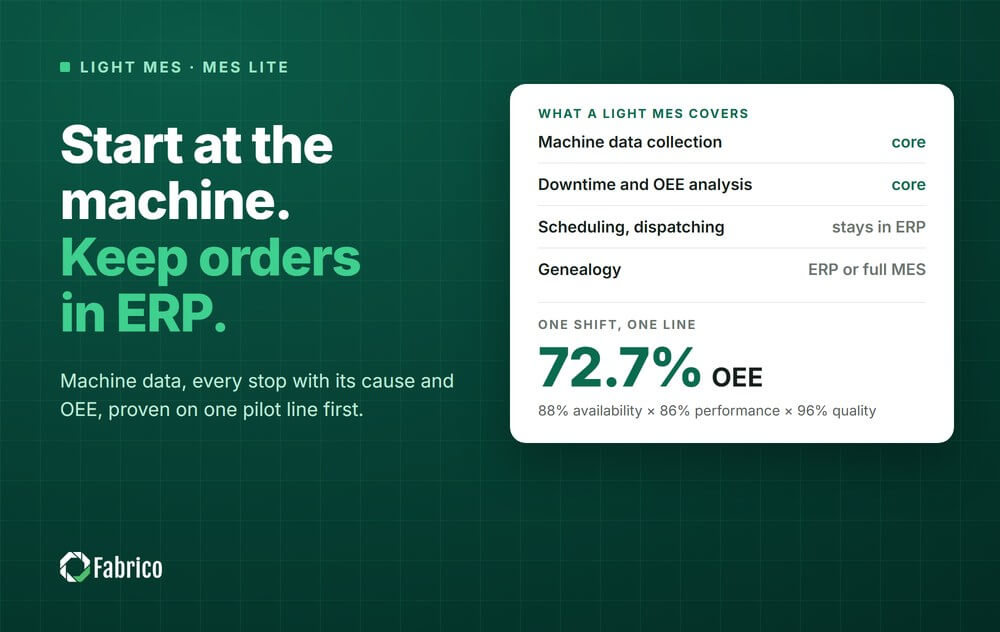

Choosing the best OEE software for standardized work enforcement is how you eliminate the "Shift-to-Shift Variance" that kills manufacturing consistency.
In high-speed production, if Shift A runs a machine differently than Shift B, your OEE Quality and MTBF (Mean Time Between Failures) will suffer. To achieve world-class results in 2026, you must run one platform that forces adherence to "Golden Settings" through integrated production and maintenance data.
Standardized work is only one thing to compare. For the wider market, see our comparison of the best OEE software.
Consistency is the foundation of OEE Quality. Enforcing standardized work via digital checklists reduces scrap by up to 20%.
"Dial Twiddling" is a profit drain. Unauthorized adjustments made by operators to mask mechanical wear destroy asset integrity.
Integration slashes Process Drift. The best tools natively link performance drifts to digital SOPs, ensuring the "Cure" is always standardized.
Whichever OEE platform you shortlist, the decisive question is data quality. Sensors and manual logs miss the short stops, micro-stops, and idle time that quietly erode availability.
Fabrico is a cloud-based MES and OEE platform for manufacturers, with maintenance management (CMMS) built in. Its AI computer vision names the cause of a stop from the line camera.
See our guide to the meaning of OEE and how to calculate OEE, or book a Fabrico demo to see it on your line.
Standardized work enforcement in OEE software is a digital manufacturing capability that establishing the "Best Way" to perform a task, such as a machine setup, a CIL (Clean, Inspect, Lubricate) round, or a repair, and utilizes mobile checklists and real-time machine data to ensure every operator and technician follows that exact process.
For Mike (the Tactical Manager), this is the end of the "Post-Shift Correction."
Instead of walking in to find Line 4 has been adjusted out of tolerance, he uses Fabrico to ensure that machine settings are verified and timestamped at the start of every run. He also sees every stop with its cause and duration, straight from the machine.
Fabrico brings OEE by line and shift, automatic downtime tracking and maintenance management (CMMS) together in one cloud-based platform.
Why it wins for standardized work: Fabrico treats the "Standard" as a requirement for production. When the system detects a cycle-speed slowdown via PLC, it doesn't just show a red bar; it natively triggers a prioritized task in the Field-Ready CMMS.
Technicians scan the machine’s QR Code to access version-controlled digital SOPs. By utilizing the Inefficiencies Zoom-In (Computer Vision) module, Fabrico captures visual proof of manual interventions, ensuring that "Tribal Knowledge" is replaced by documented best practices.
This protects the Value Fulcrum, ensuring maintenance effort is always applied to restore the process to its optimized state.
Poka is a leading "Connected Worker" platform that specializes in digital knowledge management and operator training through user-generated video content.
The Trade-off: Poka is an exceptional tool for teaching workers the "Best Way" to do a job. However, it is not a technical maintenance engine.
It puts less emphasis on the native high-frequency PLC integration required to automatically detect when a machine has drifted from the standard. For Paula (the Strategic Leader), this means she has a great training tool but still puts less emphasis on the data-driven "Action Loop."
Redzone focuses on "Social OEE," using gamification and shop-floor coaching to improve operator behavior and daily communication.
The Trade-off: Redzone excels at making standardized work visible through shift-start huddles and social feeds. However, it functions primarily as a "System of Culture."
It puts less emphasis on the deep engineering asset data and native MRO inventory management required to manage the mechanical root causes identified by those standards.
Parsable provides a flexible "Dynamic Work Instructions" platform designed to digitize complex industrial workflows and compliance checklists.
The Trade-off: Parsable is highly sophisticated for capturing human-in-the-loop data. The challenge is the "Complexity Tax."
Implementation often takes 6-12 months, and without a native, built-in OEE monitoring module, it remains disconnected from the real-time machine performance it is meant to optimize.
Tulip provides a "no-code" platform that allows manufacturers to build their own custom frontline apps for data collection and standardized task guidance.
The Trade-off: Tulip offers extreme flexibility. However, it places the burden of "building the system" on the customer.
Many mid-sized plants find themselves in a "Development Loop," spending more on custom coding than they reclaim in capacity. In short, Tulip is a tool for building your own system.
| Feature | Fabrico (MES and OEE Platform) | Poka | Redzone | Parsable | Tulip |
| Response Trigger | Auto-Work Order | Manual Chat | Social Feed | Dashboard | Custom App |
| OEE Native Link | High / Real-Time | Third-Party | Native / High | None | DIY Bridge |
| Visual Proof (RCA) | Advanced (Video) | Manual Video | Photo-Only | Photo-Only | Photo-Only |
| Adoption Logic | Field-Ready App | Training | Gamification | Process-Based | App-Based |
| Decision Latency | Zero (Automated) | Moderate | Moderate | Moderate | High |
| Implementation | 3-4 Months | 4-6 Months | 4-6 Months | 6-12 Months | Ongoing |
For Paula (the Strategic Leader), the business case for standardized work is built on Capacity Reclamation.
By ensuring every operator follows the "Centerline" parameters, you reduce the total cost of quality and ensure your multi-million dollar assets reach their full residual value. Reclaiming just 15 minutes of "Adjustment Waste" per shift is often more profitable than adding a new production shift.
As you build 12 months of clean data via digital SOPs and OEE pulses, you are preparing your plant for the future of autonomous optimizations.
See Fabrico live. Request a demo.
Request a demo








 Login
Login
 Blog
Blog