


 Login
 Blog
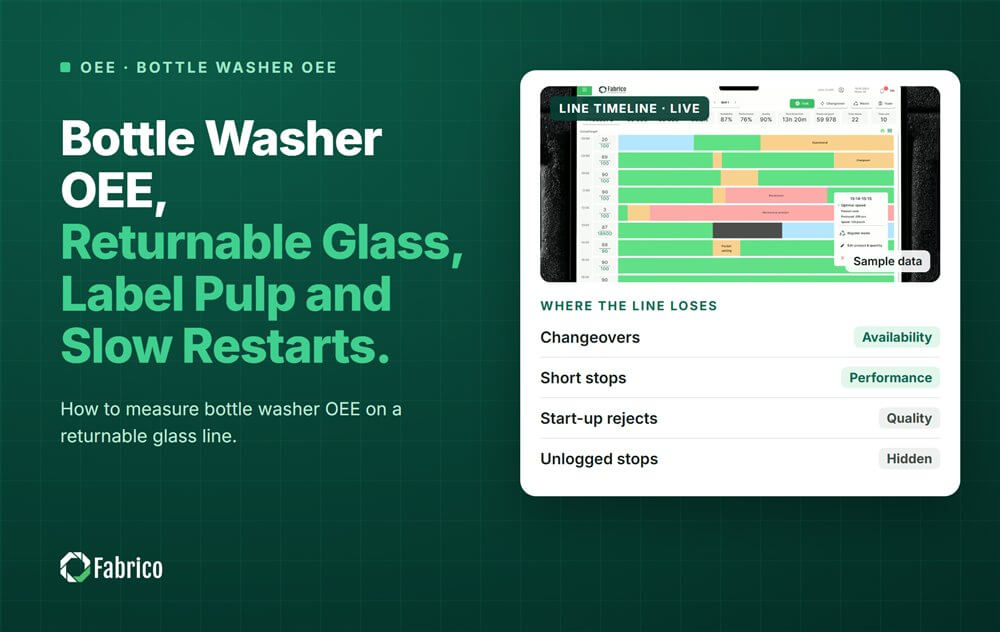
Bottle Washer OEE: Returnable Glass, Label Pulp and Slow Restarts

Key takeaways
- A bottle washer's typical losses are infeed jams and broken glass, label pulp problems, temperature waits and slow restarts.
- Empty bottle inspector rejects mix two things: bottles the washer did not clean and bottles that came back damaged.
- Code those two apart, or the washer carries the market's broken bottles.
- A washer stop costs line output only when it outlasts the buffer before the filler.
- Never shorten a cleaning or caustic step to win OEE; measure it instead.
Bottle washer OEE measures the machine that cleans returnable glass bottles before the filler: how long it runs, how close to its rated speed, and how many bottles come out clean. Its typical losses are infeed jams, label pulp clogging the label removal, waits for temperature or concentration, and rejects at the empty bottle inspector after it.
Fabrico, an OEE and light MES platform, logs each washer stop with its reason and shows rejects next to downtime by line and shift. This guide is for line managers on returnable glass lines for beer, soft drinks and water. It covers where the washer's time goes, how to measure each factor and a worked shift.
Where does the bottle washer's time go?
Returned bottles arrive in crates, are unpacked, and enter the washer. Inside, they pass soak and caustic zones, label removal and rinses, and leave clean for the empty bottle inspector, which rejects bottles that are still dirty, chipped or contain foreign objects.
| Station | Typical stops | Usually whose loss |
|---|---|---|
| Infeed | Bottle jams, broken glass, wrong or mixed bottles from the market | Line crew or returns |
| Soak and caustic zones | Temperature or concentration out of range, waiting to recover | Process or utilities |
| Label removal | Label pulp screens or presses clogged | Line crew |
| Rinse and discharge | Discharge jams, bottles falling at the outfeed | Line crew |
| Empty bottle inspector | Rejects for dirt, chips, foreign objects, residual liquid | Washer or the market |
| Outfeed backed up | Clean bottles waiting for the filler | Filler (blocked) |
The washer is a long, heavy machine. A stop with bottles inside it is harder to restart than a stop on a short machine, which is why restart time deserves its own code.
How do you measure Availability, Performance and Quality on a bottle washer?
- Availability = run time / planned production time. Jams, clogs, temperature waits and slow restarts reduce it. Planned cleaning belongs in planned time, measured.
- Performance = bottles washed / (run time x rated bottles a minute). The washer usually has some spare speed over the filler.
- Quality = bottles passed by the inspector / bottles washed. Split the rejects: not clean (the washer's) and damaged or foreign (the market's).
The washer's chemistry and temperatures are food safety and cleaning steps. Never shorten a caustic contact time or a cleaning cycle to improve the figure; measure it and agree it with quality.
How do you separate the washer's own losses from what the market sends back?
- Give the inspector two reject groups: not clean, and damaged or foreign.
- Charge damaged and foreign bottles to returns, not to the washer.
- Code temperature and concentration waits apart from mechanical stops, so utilities see them.
- Charge blocked time to the filler or the machine after it.
Then check which washer stops reached the filler. Our guide to starvation and blocking shows how to read the states, and filler OEE on a bottling line shows the same stops from the filler's side.
What happens at a changeover on a bottle washer?
A change of bottle size can mean new carriers or pockets and new guides at the infeed and discharge. Measure it from the last good bottle of the old size to a steady flow of the new one. Settings recorded per bottle, change parts ready before the change and the first bottles checked at the inspector are the usual first wins. Our SMED guide explains how to split internal and external steps.
A worked shift on a bottle washer
Sample line (illustrative numbers, not a customer): a returnable beer line where the filler runs 500 bottles a minute and the washer is rated at 550. The conveyor between the inspector and the filler holds 3 minutes. The shift has 450 minutes of planned production time, and the contribution margin is $0.08 a bottle, or €0.08 in a euro plant.
| State | Minutes | Charged to |
|---|---|---|
| Running | 404 | None |
| Infeed jams and broken glass, 6 x 3 minutes | 18 | Washer |
| Label pulp screen clogged, 2 x 6 minutes | 12 | Washer |
| Waiting for caustic temperature, 1 x 10 minutes | 10 | Utilities |
| Discharge jams, 6 x 1 minute | 6 | Washer |
| Total | 450 |
- Availability = 404 / 450 = 89.8%.
- Performance against its rated speed = 500 / 550 = 90.9%, the designed spare speed.
- Quality: 202,000 bottles washed, 3,030 rejected at the inspector: 198,970 / 202,000 = 98.5%. But 2,430 of the rejects were damaged or foreign bottles from the market; only 600 were not clean. The washer's own Quality is 201,400 / 202,000 = 99.7%.
- Which stops reached the filler: the 3 minute infeed jams ended inside the buffer; each label pulp clog starved it for 6 minus 3 = 3 minutes, 6 in total; the temperature wait for 10 minus 3 = 7.
- 13 filler minutes x 500 = 6,500 bottles, at $0.08 = $520 this shift, or €520.
Without the split, the washer would be blamed for every rejected bottle. With it, most rejects go to returns, and the washer's own work list is label pulp and the temperature wait.
Which mistakes do plants make with bottle washer OEE?
- Charging the market's damaged bottles to the washer's Quality.
- One code for "washer stopped", so label pulp, jams and temperature waits look the same.
- No code for restart time after a long stop.
- Shortening a cleaning or caustic step to make the number look better. That is a food safety risk, never a gain.
- Ranking stops by minutes instead of by what reached the filler.
Where Fabrico fits
Fabrico is a computer vision enabled Manufacturing Performance Platform. OEE and light MES come first: automatic downtime logging that keeps own stops, waits and starved or blocked time apart, and OEE live by line and shift.
- The operator confirms the reason in one tap, so label pulp and a temperature wait get different codes.
- A camera clip as evidence for a stop, where a camera watches the infeed or the discharge.
- Losses priced in money and ranked, rejects and downtime together.
- One view across plants for returnable lines on different sites.
You start with a pilot on one line, with a baseline and a decision date agreed in advance. There is no free plan and there are no tiers: each plant gets a quote. Read how a light MES starts on one line in our light MES guide.
Frequently asked questions
How do you calculate bottle washer OEE?
Availability is run time over planned production time, Performance is bottles washed over what it could wash at rated speed, and Quality is bottles passed by the inspector over bottles washed. Multiply the three.
What causes bottle washer stops?
Infeed jams and broken glass, label pulp clogging the label removal, temperature or concentration waits, and discharge jams.
Should empty bottle inspector rejects count against the washer?
Only the bottles that are not clean. Damaged and foreign bottles came back from the market that way; code them apart.
Is washer cleaning planned time?
Scheduled cleaning is usually planned time. Measure it, keep it in its own code, and never shorten it to improve OEE.
When does a bottle washer stop the filler?
When a stop lasts longer than the buffer between the inspector and the filler.
See your washer's losses in a demo
Bring one returnable line and its current downtime log. We will show the washer's own stops, its rejects and what reached the filler.
Latest from our blog


Real Fabrico tiles, sample data.