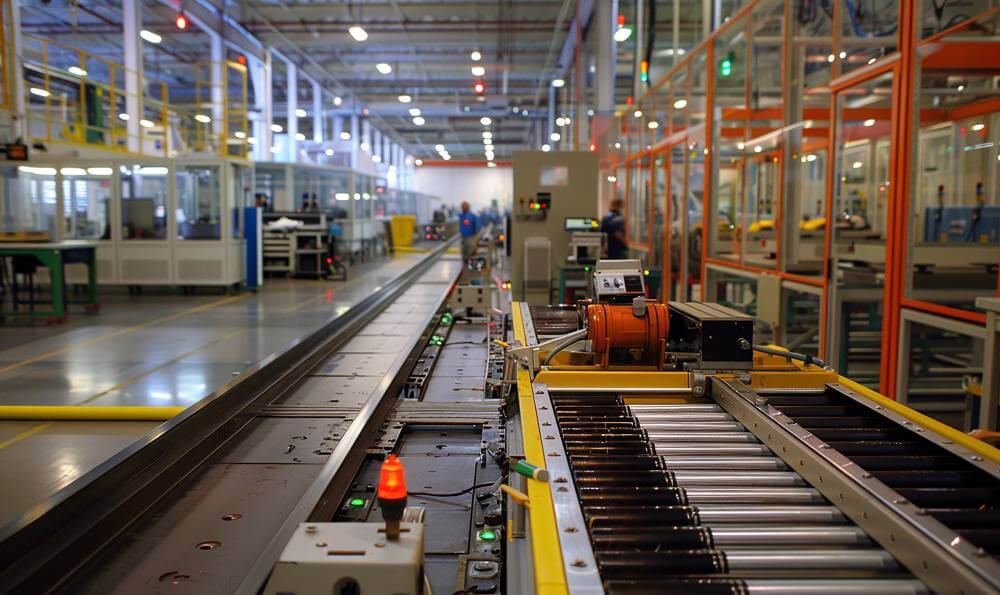

Conveyor belt mistracking is the condition in which a running belt drifts off its centered path, so the belt edge wanders toward one side of the conveyor structure. It is the single most common failure mode on belt conveyors, and it rarely presents as a clean breakdown.
Instead it shows up as frayed edges, spillage, and a steady drip of short stops that erode availability. This guide covers the four root causes, a diagnosis sequence, and how to turn each fix into a standing inspection route.
The governing physics fits in one sentence: a belt moves toward the end of the roller it contacts first . When an idler is skewed or tilted, one end of the roll touches the belt fractionally earlier, and friction steers the belt toward that side.
Every root cause below works through this mechanism: either the rollers are genuinely out of square, or buildup, loading, or tension makes the belt behave as if they were.
If the belt always drifts at the same spot, in the same direction, loaded or empty, suspect alignment:
Safety first: lock out and tag out the conveyor before you clean rollers, check alignment, adjust idlers or pulleys, or reach past a guard, and verify it cannot restart. Pulleys and idlers form nip points that can pull in a hand or a sleeve. Watch tracking on a running belt only from outside the guards, never touch a moving belt or idler, and refit every guard before the test run.
The fix: string-line or laser-check idlers against the conveyor centerline, square the head and tail pulleys first (they dominate steering), then correct idlers from the tail forward. Put a quarterly alignment survey on the asset's preventive plan and record offsets so structural creep is visible between surveys.
A few millimeters of compacted product turns a cylindrical roller into a conical one, and the belt steers off it unpredictably. Suspect buildup when tracking wanders from day to day, worsens with sticky or damp product, and improves temporarily after cleaning.
The fix: clean the rollers, then eliminate the source: scraper wear and pressure, skirting, and washdown practice. A weekly check of scrapers and roller surfaces catches buildup long before it steers the belt: condition-based maintenance at its cheapest.
If the belt runs true when empty but drifts as soon as product flows, the load is landing off-center: the material presses one side of the belt harder into the idlers and the belt walks sideways. Worn chute liners, a shifted deflector plate, or an upstream conveyor discharging at an angle all place material off the centerline.
The fix: adjust the chute or deflector so material lands centered and moving in the direction of belt travel. A centered load ends a whole family of tracking, spillage, and edge wear problems at once.
The fix: verify take-up travel and counterweight setting against specification, and check splice squareness whenever a once-per-revolution drift appears. Log splice dates and belt batch numbers in the asset history so a bad belt shows up as a pattern.
Jumping straight to adjustment is textbook reactive maintenance, and it is why the same belt gets "fixed" every month.
Take a packaging line conveyor running two 7.5 hour shifts, five days a week: 4,500 minutes of planned time. The belt trips a misalignment switch four times a week, and each event takes 20 minutes to re-center and clean up.
That is roughly 69 hours of lost production per year from short stops alone. On the line's Pareto analysis of stop reasons, mistracking was the second tallest bar; a two hour chute adjustment plus a quarterly alignment route removed it.
Fixing mistracking once is a repair; keeping it fixed is a data problem, and Fabrico provides the real-time foundation for both.
Real-time OEE and production monitoring captures the short stops mistracking causes, so they stop hiding between shift reports; on conveyors with no PLC access, Fabrico's computer vision detects stoppages directly from the machine.
Fabrico's CMMS then turns these fixes into standing work: alignment surveys and scraper checks as recurring inspection routes, corrective work orders with photos from the floor, and idlers, scrapers, and belts managed as spare parts per conveyor asset. Built in the EU with EU data residency, it is designed for the plant floor.
The belt must stay fully on every idler and pulley face, with the edge clear of the structure at all points; many plants also set an internal limit of total drift within about 10 percent of belt width. Edge contact or a tripped misalignment switch always needs correction, not observation.
They compensate; they do not correct the root cause. Trainers help where the cause genuinely varies, such as reversing belts or fluctuating loads, but installed over a skewed idler or buildup they mask a defect that keeps damaging the belt. Align and clean first.
A visual check by operators every shift, a tracking walkdown weekly or monthly depending on duty, and a full alignment survey quarterly, plus a check after any belt, splice, pulley, or chute change, when tracking problems are most often introduced.
Stop re-centering the same belt every week: read how Fabrico tracks downtime and see how inspection routes, work orders, and real-time stop tracking keep conveyors running centered.
Fabrico is software for OEE, downtime tracking and maintenance. We do not sell parts or repair services.























 Login
Login
 Blog
Blog