


 Login
 Blog
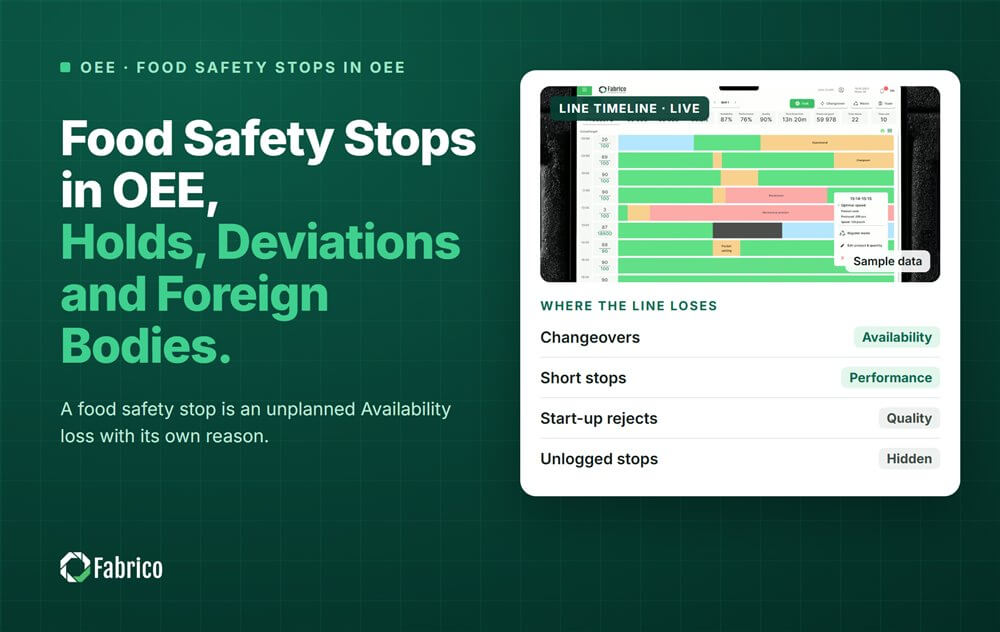
Food Safety Stops in OEE: Holds, Deviations and Foreign Bodies

Key takeaways
- Food safety stops get their own reason group, apart from breakdowns.
- They are unplanned. While the line is stopped, the minutes are an Availability loss.
- Held product is not good count until it is released without rework.
- Destroyed product is a Quality loss, priced like any other reject.
- The food safety team decides the restart. OEE never puts pressure on that call.
When a line stops for food safety, OEE should record what it cost and nothing more. The stop is an unplanned Availability loss under its own reason. Any product put on hold stays out of good count until the food safety team releases it.
Fabrico, OEE and light MES software with AI cameras, logs the stop automatically. The operator gives it a food safety reason in one tap. It makes no food safety claim of its own: the hold, the release and the record stay with your food safety team.
What counts as a food safety stop?
Any stop where the line halts because product safety is in question, not because a machine failed. Common groups:
- CCP deviation: a check finds a value outside its critical limit.
- Foreign body: metal, glass or plastic found in product, or a missing machine part.
- Allergen or label issue: the wrong label, the wrong ingredient, or a missed clean.
- Hygiene event: a spill or a contamination risk near open product.
- Pack integrity: a run of leaking or badly sealed packs.
A broken machine part can cause a foreign body stop. Code the stop as food safety first, then link the repair. Otherwise the trend in food safety stops disappears inside the breakdown numbers.
Are food safety holds planned or unplanned downtime?
Unplanned. Planned stops are the ones in the shift plan before it starts, such as breaks. Nobody plans a deviation or a foreign body. So the minutes from the stop to the restart are an Availability loss.
The wait for the release decision is part of the stop. If the line waits 20 minutes for someone to sign it off, those 20 minutes belong to the food safety stop, not to "Other". Our guide to unplanned downtime covers the wider picture.
How should held product count in OEE?
- Total count: yes. The units were made.
- Good count: only once they are released without rework.
- Reworked units: not good at first pass. Counting rework as good is one of the three common ways OEE gets fudged.
- Destroyed units: a Quality loss.
Because the release can come a day later, the shift's Quality and OEE can change after the shift ends. Show the shift as provisional until its holds are decided. Our guides to quality hold process design and holds and OEE together show how plants run the release.
Worked example: a foreign body stop on one shift
Sample line (illustrative numbers, not a customer). A snack line packs 120 packs a minute over a 480 minute shift. The last good detector test was at 14:00. At 14:20 the metal detector rejects a pack, and a metal fragment is found.
The crew stops the line. The 20 minutes of product since the last good test go on hold: 20 x 120 = 2,400 packs. A broken guide is found and replaced. The food safety team releases the line at 15:05, so the stop lasts 45 minutes.
| Item | At the end of the shift | After the release decision |
|---|---|---|
| Run time | 400 of 480 minutes | 400 of 480 minutes |
| Packs made (total count) | 46,800 | 46,800 |
| Packs on hold | 2,400 | 0 (2,040 released, 360 destroyed) |
| Good count | 44,100 | 46,140 |
| OEE | 76.6% (provisional) | 80.1% |
OEE = good count x ideal cycle / planned time. At the end of the shift: 44,100 / 120 / 480 = 76.6%. After the release: 46,140 / 120 / 480 = 80.1%. The food safety stop alone cost 45 / 480 = 9.4 points of Availability.
In money, at a margin of USD 0.10 a pack: the 45 minute stop lost 5,400 packs, or USD 540 (about EUR 500). The 360 destroyed packs add USD 36 of margin, plus their materials.
How do you log food safety stops?
- Create a food safety reason group with a few clear reasons, such as the five above.
- Let the machine signal time the stop, and let the operator confirm the reason in one tap.
- Keep the clock running until the release, including any wait for sign-off.
- Link the repair when a machine part caused the stop, so the fix is tracked too.
- Keep the details in the food safety record, and link it to the stop by line and time.
Which mistakes do plants make with food safety stops?
- Coding them as breakdowns, so food safety trends are invisible.
- Counting held product as good before it is released.
- Leaving the hold out of the shift report, so the next shift inherits a surprise.
- Pushing for an early restart because the OEE screen looks bad. Never.
Where does Fabrico fit?
Fabrico is a computer vision enabled Manufacturing Performance Platform. OEE and light MES come first, so food safety stops sit on the same stop log as everything else.
- Automatic downtime logging, timed by the machine signal.
- The operator confirms the reason in one tap, from a food safety reason group.
- A camera clip as evidence for a stop, where a camera watches the station.
- A work order to the right technician, with its cost, when a machine part caused it.
It is the OEE layer of a light MES. You start on one line, with a baseline and a decision date agreed in advance. There is no free plan and there are no tiers: each plant gets a quote.
Frequently asked questions
Is a food safety hold planned or unplanned downtime?
Unplanned. Planned stops are in the shift plan before it starts, and nobody plans a deviation or a foreign body. Count the minutes from the stop until the release as an Availability loss, under a food safety reason, including any wait for the sign-off.
Does held product count as good in OEE?
Not while it is on hold. It counts in total count because it was made. It becomes good count only if it is released without rework. Reworked product is not good at first pass, and destroyed product is a Quality loss.
How should a foreign body stop be coded?
Under a food safety reason, such as "foreign body", even when a broken machine part caused it. Link the repair to the stop so the fix is tracked. That keeps the food safety trend visible, instead of hiding it inside breakdown minutes.
Who decides when the line restarts?
The food safety team, following your food safety plan. OEE only measures how long the stop took and what it cost. A bad OEE number is never a reason to restart early, and the screen at the line should not be used to push that decision.
Can a shift's OEE change after it ends?
Yes, when product was on hold. Once the food safety team releases or rejects it, good count changes and so do Quality and OEE. Show the shift as provisional until its holds are decided, so nobody acts on a number that will still move.
See your food safety stops in one place
Bring one month of stops and holds. We will show them as one reason group, with minutes and cost.
Latest from our blog


Real Fabrico tiles, sample data.