


 Login
 Blog
TRS vs OEE: What TRS, TRG and TRE Mean in English

Key takeaways
- Same formula: TRS (taux de rendement synthétique) and OEE both divide useful time by the time planned to produce.
- TRG (taux de rendement global) is never higher than TRS, because planned stops count against it.
- TRE (taux de rendement économique) is a capacity figure, read against 168 hours a week.
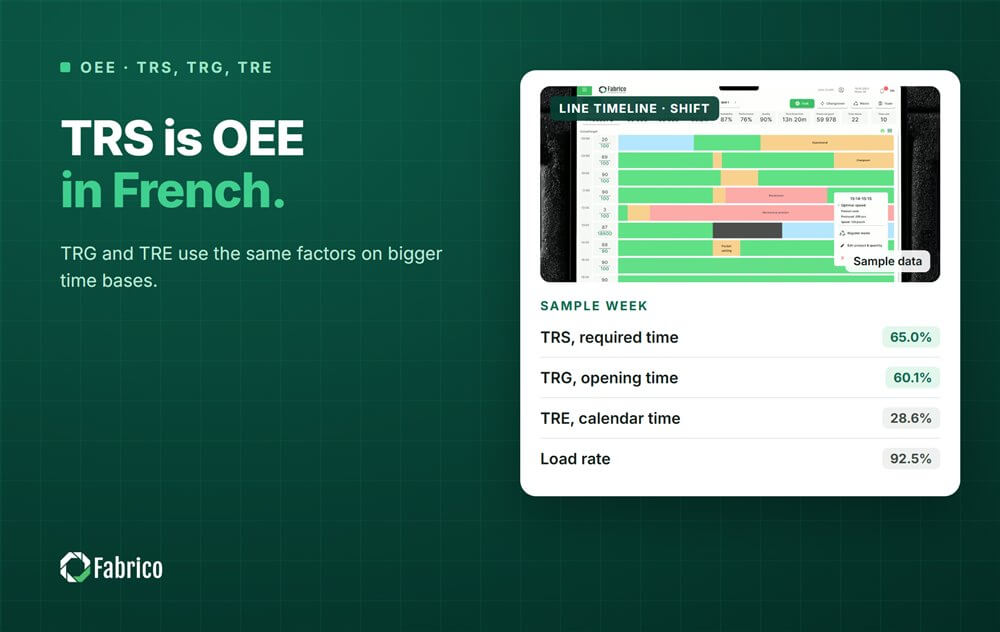
- In the worked example one week reads 65.0% TRS, 60.1% TRG and 28.6% TRE.
Fabrico, OEE and light MES (manufacturing execution system) software with AI cameras, logs stops automatically and gives one view across plants.
If your group runs French-speaking plants (France, Wallonia, western Switzerland), their reports often say TRS where others say OEE. Below: what each French term means, how it maps to the English ones, and a worked week.
What does TRS mean?
TRS stands for taux de rendement synthétique, the French name for OEE. The French standard NF E60-182 defines it, with two related rates, TRG and TRE.
TRS = useful time / required time. Useful time (temps utile) is the time the good parts would need at the ideal rate. Required time (temps requis) is the time the plant decided to produce.
That is the count method of OEE: good count x ideal cycle time / planned production time. Our OEE calculation guide shows the same formula in English terms.
How do TRS, TRG and TRE map to OEE, OOE and TEEP?
| French rate | Time base | English twin |
|---|---|---|
| TRS | Required time (temps requis) | OEE |
| TRG | Opening time (temps d'ouverture) | OOE |
| TRE | Total time (temps total) | TEEP |
The three English rates work the same way. OEE uses planned production time, OOE (overall operations effectiveness) uses operating time, and TEEP (total effective equipment performance) uses all time, 8,760 hours a year.
So each French rate is never higher than the one before it. Our TEEP guide and our OOE guide explain the English pair.
Are TRS and OEE always the same number?
Only when the time base matches. Required time is the opening time minus the planned stops, such as planned maintenance, planned meetings or a planned clean. Each plant decides what counts as planned.
Say a French plant books a long changeover as a planned stop, and a UK plant does not. Their TRS and OEE then differ even on identical lines. Some French plants also say TRS for a figure on opening time, which is really TRG. Check the base on the sheet before you compare the numbers.
What does a worked example of TRS, TRG and TRE look like?
Sample line (illustrative numbers, not a customer): a filling line that opens for 2 shifts of 8 hours, 5 days a week. That is an opening time of 80 hours.
The plant plans 6 hours of stops for cleaning, maintenance and a team meeting, so the required time is 74 hours. The good bottles made in the week would need 48.1 hours at the ideal rate.
- TRS = 48.1 / 74 = 65.0%.
- TRG = 48.1 / 80 = 60.1%.
- TRE = 48.1 / 168 = 28.6%.
- Load rate (taux de charge) = 74 / 80 = 92.5%, and TRG = 65.0% x 92.5% = 60.1%.
- Use rate (taux d'utilisation) = 80 / 168 = 47.6%, and TRE = 60.1% x 47.6% = 28.6%.
| Rate | Time base | Result |
|---|---|---|
| TRS | 74 hours | 65.0% |
| TRG | 80 hours | 60.1% |
| TRE | 168 hours | 28.6% |
The same week gives three numbers. A group report that puts this plant's TRG next to another plant's OEE compares 60.1% with a figure on a smaller time base. The French plant then looks about 5 points worse than it is.
Which French terms sit inside TRS?
TRS splits into the same three factors as OEE, under French names:
- Disponibilité opérationnelle: Availability, run time over required time.
- Taux de performance: Performance, the speed while running against the ideal rate.
- Taux de qualité: Quality, good parts over all parts made.
The time names follow the same order as the OEE time model, with one extra step between total time and required time. The steps are total time, opening time, required time, run time, net time and useful time. Our OEE time model guide shows the English steps.
How do you report TRS and OEE across a group?
- Write one definitions sheet in both languages: what counts as planned, the ideal rate per product, what counts as good.
- Report TRS from French plants and OEE from the others only when both leave out the same planned stops.
- Show TRG and TRE as capacity figures, next to OOE and TEEP, not next to OEE.
- Keep the French names on the French shop floor. Operators read their own words faster.
What mistakes do groups make with TRS and OEE?
- Putting a French plant's TRG next to another plant's OEE.
- Assuming TRS and OEE match when the plants book planned stops differently.
- Translating TRS as "efficiency" in the group report.
- Forcing English terms onto the French shop floor.
Where Fabrico fits
Fabrico is a computer vision enabled Manufacturing Performance Platform. OEE and light MES come first. Automatic downtime logging and OEE live by line and shift run on one time model in every plant.
- One view across plants, so a French and a German line are read on the same definitions.
- Every loss priced in money, so plants compare costs as well as rates.
- The operator confirms the reason in one tap, so each stop gets a reason from the code list the plants agree.
Read what a light MES covers in our light MES guide. You start on one line, with a baseline and a decision date agreed in advance. There is no free plan and there are no tiers: each plant gets a quote.
Frequently asked questions
Is TRS the same as OEE?
Yes, in method. TRS, the taux de rendement synthétique, is good output at the ideal rate against required time, the same as OEE against planned production time. The two numbers match only when both plants book planned stops the same way, so check the definitions before you compare them.
What is the difference between TRS and TRG?
The time base. TRS uses required time, which leaves out planned stops. TRG, the taux de rendement global, uses the full opening time, so planned stops count against it. TRG is therefore never higher than TRS, and it is the French twin of OOE in English reports.
What is TRE?
TRE, the taux de rendement économique, uses all calendar time: 168 hours a week, or 8,760 hours a year. It is the French twin of TEEP. It shows how much of the calendar became good product, so it is a capacity figure, not a daily performance figure.
How do you calculate TRS?
Divide useful time by required time. Useful time is the good parts made x the ideal cycle time. Required time is the opening time minus planned stops. In the worked example, 48.1 hours of useful time over 74 hours of required time gives a TRS of 65.0%.
Which number should a group report?
Report TRS or OEE for daily performance, on one shared definition of planned time. Report TRG or OOE, and TRE or TEEP, as capacity figures. Never mix the rows: a TRG next to an OEE compares different time bases and makes one plant look worse than it is.
See your French and other plants side by side in a demo
Bring one French line and one line elsewhere, with a week of data each. We will show both on one time model.
Latest from our blog






Real Fabrico tiles, sample data.