


 Login
 Blog
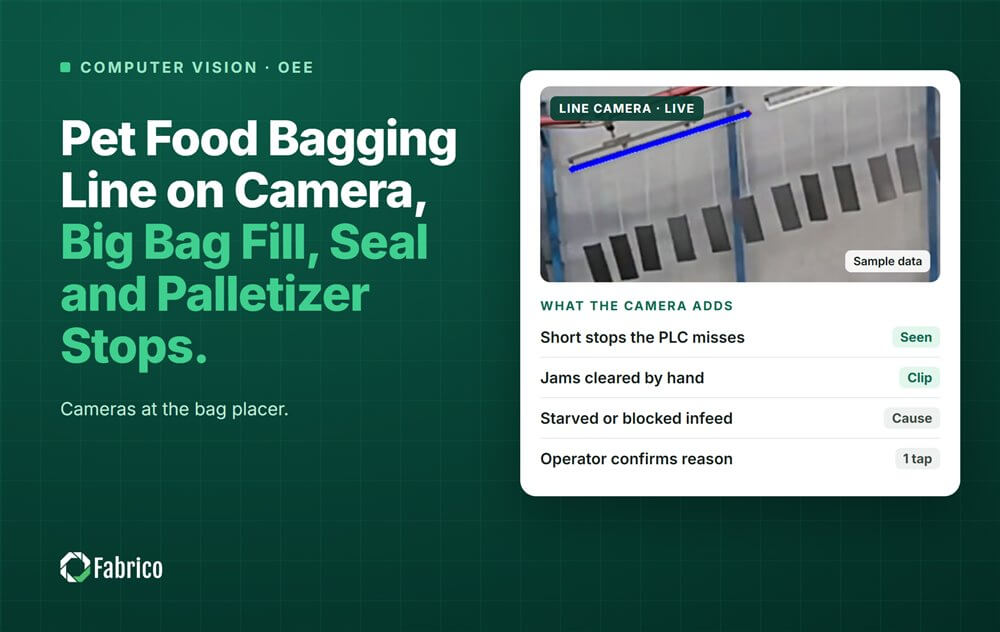
Pet Food Bagging Line on Camera: Big Bag Fill, Seal and Palletizer Stops

Key takeaways
- A bagger's PLC (programmable logic controller) often files different stops under one code, such as "bag not present".
- Three camera views do most of the work: the bag placer and spout, the bag top sealer and the palletizer layer.
- Dust is the camera's main enemy. Mount away from the spout, shield the lens, clean it each shift.
- On a sample shift, the clips found 52 stop minutes the paper log never had, worth $3,120 a shift.
Put one camera at the bag placer and filling spout, one at the bag top sealer and one at the palletizer layer. Each stop on a dry pet food bagging line then gets a short clip, and the operator confirms the reason in one tap.
Fabrico is OEE (overall equipment effectiveness) and light MES (manufacturing execution system) software, with AI cameras as an add-on. The cameras count output and record stops, and the clip stays as evidence. For OEE across the whole plant, see OEE for pet food production. This guide stays on the bagging line.
Where does a pet food bagging line lose its minutes?
At six stations, and most of the losses are short. The line places an empty bag, weighs the kibble, fills the bag, closes the top, checks it for metal and stacks it on a pallet.
| Station | Typical stops | What the clip shows | Usually whose loss |
|---|---|---|---|
| Bag placer | Bag not picked, two bags picked, bag not opened | Suction cups lifting nothing | Bagger, or the bag stock |
| Net weigher | Bag waiting at the spout for product | A bag clamped open, nothing falling | Weigher, or the feed above it |
| Filler and spout | Bag slipping off the spout, spilled kibble | A bag tilting as it fills | Bagger |
| Sealer or sewing head | Top folded, open seal, thread break | The bag top entering out of line | Bagger, sometimes the bag stock |
| Metal check | Bag rejected, line held for a check | A bag pushed off at the reject | Quality, not a machine fault |
| Palletizer | Bag slid off the layer, layer not square | A bag hanging over the edge | Palletizer, or pallet supply |
Give the bag stock its own reason code. Curled bags or bags stuck together cause pick-up misses that look like a machine fault, but the fix is in the store.
Why does the bagger's PLC not show what stopped it?
Because it knows its own sensors, not the bag. It can say "seal fault" or "waiting for weigher". It cannot say whether the top was folded or the kibble bridged in the bin above the weigher.
Most of these stops are short, cleared by hand in a minute or two, so a paper log of long stops never sees them. Heavy bags make each fix slower: a 15 kg bag that drops has to be lifted back, and spilled kibble swept up.
Where should the cameras go on a bagging line?
- Bag placer and spout. Look down from one side. One view shows a missed pick, a bag that did not open and a bag waiting for the weigher.
- Bag top sealer or sewing head. Frame the top as it enters the closer. The clip shows a top that arrives folded, crooked or open.
- Palletizer layer. Look down on the layer forming area. The clip shows a bag that slid or a layer that is not square.
The metal check and checkweigher have their own reject signal, so they rarely need a camera. Our guide to camera placement and lighting on a production line covers angle, height and line speed.
How do you keep dust from blinding the camera?
Keep the lens out of the dust cloud, shield it and clean it on a fixed round. Dust is a slow failure: the view gets a little worse each shift, and false alarms rise before anyone checks the lens.
- Mount away from the spout. The dust puff is worst where kibble falls in and where the top closes. Look in from the side, not straight over the opening.
- Shield the lens. A hood keeps settling dust off the glass. Ask the camera supplier which housing suits your dust.
- Keep air jets away. Air that clears the seal area can blow fines at a nearby lens.
- Clean on a round. Put the lens on each shift's cleaning checklist, and compare the view with a reference picture.
- Use steady light. A fixed lamp keeps day and night shifts alike.
Pet food dust can be combustible. If the area is classed for it, any device there must meet the site's zone rules: ask the safety team first, and see our guide to combustible dust explosion prevention.
How does each stop get a clip and a one-tap reason?
- The stop is marked by the bagger signal or the camera, start and end.
- A short clip from the matching view stays with the stop as evidence.
- The operator confirms the reason in one tap, or picks another one.
Keep the list short and in the crew's words: bag not picked, bag stock, weigher wait, top folded, bag off the layer. Our guide to operator friendly reason codes shows how. The camera suggests; it does not decide the cause.
Worked example: what do short stops cost a sample bagging line?
Sample line (illustrative numbers, not a customer): a dry dog food line filling 15 kg bags, rated at 10 bags a minute, with 450 minutes of planned production time. Ideal output is 4,500 bags. A palletizer stop halts the bagger within seconds.
The paper log listed only stops of 3 minutes or more: 8 stops, 34 minutes, most at the palletizer. The clip-confirmed log showed this:
| What the clip showed | Stops | Minutes | Bags lost | In the paper log |
|---|---|---|---|---|
| Bag not picked, curled bag stock | 40 x 0.5 min | 20 | 200 | No |
| Bag waiting for the weigher | 48 x 0.25 min | 12 | 120 | No |
| Top folded, bag resealed by hand | 10 x 2 min | 20 | 200 | No |
| Bag slid off the layer | 5 x 5 min | 25 | 250 | Yes |
| Bag magazine empty | 3 x 3 min | 9 | 90 | Yes |
| Total | 106 | 86 | 860 |
- Run time = 450 minus 86 = 364 minutes. Availability = 364 / 450 = 80.9%.
- Bags made = 3,600. Performance = 3,600 / (364 x 10) = 3,600 / 3,640 = 98.9%.
- Rejected at the metal check and checkweigher: 36. Good bags = 3,564. Quality = 3,564 / 3,600 = 99.0%.
- OEE = 0.809 x 0.989 x 0.990 = 79.2%. Check: 3,564 / 4,500 = 79.2%.
- The paper log saw 34 minutes, so it put Availability at 416 / 450 = 92.4%. The other 52 minutes hid inside Performance.
- The 52 short stop minutes cost 520 bags. At a contribution of $6.00 a bag (or €6.00 in a euro plant), that is 520 bags x $6.00 = $3,120 a shift. Over 600 shifts a year: $1,872,000.
The palletizer is still the biggest single cause: 250 bags, $1,500 a shift. But the three short stops at the front of the bagger come to 520 bags.
The clips point to the bag stock and the bag top guide: most misses came from one delivery of curled bags, most folded tops after a bag size change. Neither is a repair job.
That money counts only if the line is sold out, or the lost bags cost overtime. Agree that rule with your controller first.
What can a camera on a bagging line not see?
- Inside the machines: load cells, target weights and seal temperatures stay with the controls.
- Past bodies and bags: a person lifting a bag hides the view for a moment. Mount high, on the far side.
- A new bag size, unchecked: recheck each view after a format change.
- The cause on its own: it suggests, the operator confirms.
Where Fabrico fits
Fabrico is a computer vision enabled Manufacturing Performance Platform. OEE and light MES come first, and cameras are an add-on.
- Automatic downtime logging from the bagger signal, down to short stops.
- AI cameras count output and record stops, each with a short clip as evidence.
- The operator confirms the reason in one tap.
- Losses priced in money and ranked, so curled bags and folded tops show up next to the palletizer.
- A work order with its cost to the right technician, when a stop is a breakdown.
Named result: ABB, a Fabrico customer, reports 20% less downtime (see the ABB story).
You start with a pilot on one line. Devices are connected in about a month, and the full rollout takes 3 to 4 months. There is no free plan and there are no tiers: each plant gets a quote. See it on the computer vision OEE and MES page.
Frequently asked questions
Where should a camera go on a pet food bagger?
At the bag placer and filling spout first. That view shows a missed pick, an unopened bag and a bag waiting for the weigher, often the most frequent stops. Add the sealer and the palletizer layer next, where the machine signal says only "fault".
Can a camera work in a dusty bagging area?
Yes, if the lens stays out of the dust cloud. Mount it to the side of the spout, shield the lens, keep air jets away and clean it each shift. If the area is classed for combustible dust, the device must also meet the site's rules for that zone.
Why do pet food bag seals fail?
Common causes are a folded or crooked top, fines on the seal area, bag stock problems and settings left from the last bag size. Code them apart so the Pareto shows which one costs most, and look at the clip before anyone changes the sealer.
Does the camera measure the operators?
No. It looks at bags, spouts, seals and layers, and OEE is reported by line and shift. It marks stops and keeps clips; it does not rank people. The clip defends the crew, as our guide to production line cameras without surveillance explains.
See your bagging line's stops in a demo
Bring one bagging line and a week of its downtime log. We will show the short stops behind it, the clips and what each one cost.
Latest from our blog



Real Fabrico tiles, sample data.