


 Login
 Blog
OEE for Pet Food Production: Extruders, Dryers, Bags and Pouches

Key takeaways
- Measure the extruder line in kg an hour of dried product per recipe, and the bagging line separately in bags a minute when bins sit between them.
- Recipe changeovers cost twice: the stop itself and the transition product made while the extruder settles.
- Off-spec kibble, fines and transition product are quality losses even when they go back into the recipe as rework.
- Over-drying and bag overfill do not show in OEE, but both sell product for nothing.
- Where a bagger or pouch filler PLC says only 'stopped', a camera clip shows what happened and the operator confirms the reason.
The extruder restarts after a die change at 05:10. For the next quarter of an hour the kibble is too dense, then too light, and it all goes to the rework bin while the operator adjusts water and steam. The extruder PLC shows it running from 05:10. The OEE report counts the kg that went through the die, and the rework bin does not appear on it.
Pet food plants combine a continuous process, the extruder and the dryer, with discrete steps: batch coating, bagging, and for wet food, pouch filling and retorting. This guide covers where to measure OEE in each part, the usual stops, recipe changeovers, quality losses, wet pouches and a worked shift with the losses priced.
Where to measure OEE in a pet food plant
A dry pet food line grinds and batches the raw materials, conditions them with steam and water, and cooks them in a single or twin screw extruder. A knife at the die cuts the kibble, a belt dryer takes the moisture down, a coater adds fat and palatant, and a cooler and screens follow. The product goes to bins, and from there to baggers, a checkweigher, a metal detector and a palletiser.
Measure the process in kg an hour of dried product, at the extruder's rated rate for each recipe. That rate comes from the design or a tested maximum per recipe and kibble size, not from a good week. When finished product bins sit between coating and packing, the baggers run on their own timing, so give the bagging line its own OEE in bags a minute. A batch coater counts in batches against its cycle time, as described in OEE in batch manufacturing.

Stops on the extruder, dryer, coater and baggers
| Station | Typical stops | OEE factor |
|---|---|---|
| Grinding and batching | Hammer mill screen change, feeder bridging, raw material not released | Availability, or starving the extruder |
| Preconditioner and extruder | Die holes blocked, knife wear, motor overload trip, steam or water supply, surging | Availability; surging is speed loss and quality |
| Dryer and cooler | Moisture out of range, belt tracking, product build-up | Availability, or speed loss when the extruder is slowed |
| Coater | Fat line blocked, palatant feeder empty, batch cycle running long | Availability or speed loss |
| Bagger | Bag magazine empty, bag not opened, seal or sewing fault, zipper misaligned on small bags | Availability for long stops, Performance for micro stops |
| Palletiser | Layer misformed, pallet magazine empty | Blocking the bagger |
An extruder does not like to stop. Each restart brings a start-up period of off-spec product while temperature, moisture and density settle. That is why short stops at the front end cost more here than they look: a five minute feeder problem can bring a much longer start-up with it. Log the stop and the start-up separately, so both show. Our guide to start-up and shutdown losses covers how.
Recipe changeovers
A recipe change can mean new raw materials in the batching system, a different die or knife setting for a new kibble shape, new dryer settings and a different coating. While the extruder moves from one recipe to the next, it makes transition product that fits neither. Measure the changeover from the last good kg of the old recipe to the first good kg of the new one, so the transition is inside it.
Where the plant has a validated clean between recipes, for example because of ingredient claims on the pack, measure it, give it its own code and keep it apart from breakdowns. Never shorten it to lift OEE. Record a standard time for each type of change and log each minute over it with a reason. The order of recipes changes how many cleans a week needs, as our guide to changeover sequence optimization explains, and the changeover time guide covers the measurement.
Quality: off-spec kibble, fines and moisture
Quality is good kg over kg made. The usual losses: start-up and transition product, kibble out of spec for size or density, fines from the screens, product with moisture outside the range, and coating out of spec. Much of it goes back into the recipe as rework. It is still a quality loss: the line spent time making it, and it takes capacity again when it goes back through.
Two losses do not show in OEE at all. Over-drying sells less water, so the same raw material gives fewer kg of product. Overfill in the bag gives product away. Track both next to OEE, per dryer and per bagger, and price them; our guide to giveaway and overfill shows the method.
Bagging: micro stops and slow running
Baggers stop often and briefly: a bag not picked from the magazine, a bag that did not open, a seal or sewing fault, fines on the seal area, a zipper out of place on small reclosable bags. The operator clears each one in under a minute and rarely writes it down. Set a threshold, many plants use two to five minutes, and treat shorter stops as Performance losses, counted from the bagger's state changes rather than from a paper log.
The ideal rate for a bagger is its rated bags a minute for that bag size. Large bags run slower than small ones, so each format gets its own ideal. A bagger turned down for one bad batch of bags often stays slow after the bags are gone: compare running speed with rated speed each shift.
Wet pet food pouches
Wet pet food lines prepare a meat emulsion or chunks, fill them with gravy or jelly into pre-made pouches, cans or trays, seal them and retort them in batches. The pouch filler is usually the pacing machine, so measure line OEE there in pouches a minute, and give the batch retorts their own figure.
Pouch lines have their own losses. Gravy or chunk pieces in the seal area mean a weak seal and a reject. Pouches fail to open in the magazine. And variety packs, multipacks with several recipes in one carton, need each recipe ready at the cartoner: when one runs short, the cartoner stops, starved of that recipe. Code that as its own reason so it is not booked as a cartoner fault.
Data sources and the camera
The extruder PLC gives feed rate, screw speed, motor load and die conditions; the dryer gives temperatures and belt speed; a weigh belt or bin levels give kg made. Moisture and density checks come from quality. Each bagger and pouch filler reports state, stops and count, and the checkweigher gives rejects. The operator gives the reason in one tap.
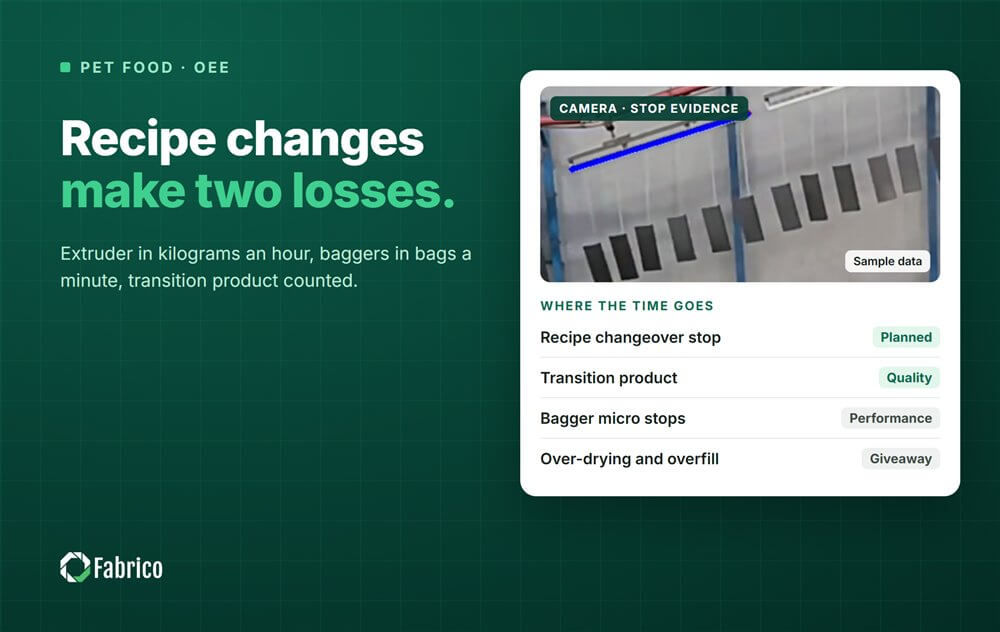
Where a bagger or pouch filler PLC says only 'stopped', a camera at the station keeps a clip of what happened: a bag caught, a pouch not opened, product on the seal. The software suggests a reason, the operator confirms it, and the clip stays with the stop as evidence.
A worked shift on a kibble line
Sample line (illustrative numbers, not a customer): an extruder line rated at 5,000 kg of dried kibble an hour for this recipe. Planned production time is 480 minutes.
- Recipe changeover: 45 minutes, against a standard of 30. Die blockage and feeder stops: 27 minutes. Total 72 minutes.
- Run time = 480 minus 72 = 408 minutes. Availability = 408 / 480 = 85.0%.
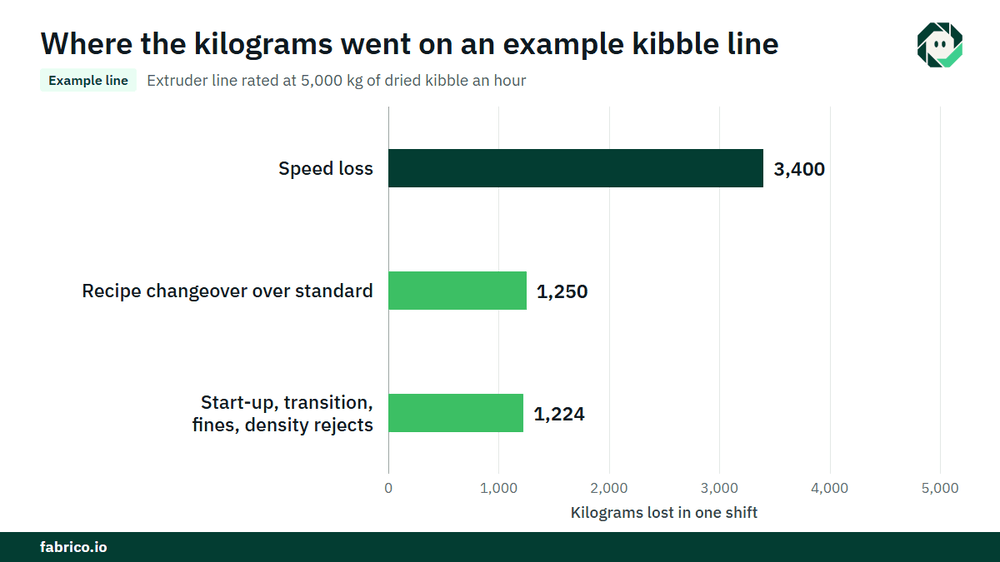
- Ideal output: 6.8 hours x 5,000 = 34,000 kg. Made: 30,600 kg, with the extruder turned down while the dryer was out of range. Performance = 30,600 / 34,000 = 90.0%.
- Start-up, transition, fines and density rejects: 1,224 kg. Good: 29,376 kg. Quality = 29,376 / 30,600 = 96.0%.
- OEE = 0.850 x 0.900 x 0.960 = 73.4%. Check: 29,376 / 5,000 = 5.875 hours, or 352.5 minutes, and 352.5 / 480 = 73.4%.
Now price it. The speed loss is 34,000 minus 30,600 = 3,400 kg. The changeover overrun is 15 minutes, or 1,250 kg at rated rate. If the line is sold out and a kg of kibble carries $0.50 of contribution (€0.50 in a euro plant), the speed loss costs $1,700 a shift and the overrun $625. Over 600 shifts a year that is $1,020,000 and $375,000, or €1,020,000 and €375,000. The 1,224 kg of rework come on top, as capacity used twice.
Mistakes plants make in pet food production
- Measuring the extruder only from its run signal, so start-up product counts as output.
- Starting the changeover clock at the die change instead of at the last good kg.
- Counting rework as good because it goes back into the recipe.
- Using one ideal rate for all recipes and kibble sizes.
- Booking a variety pack cartoner stop as a cartoner fault when one recipe ran short.
Where Fabrico fits
Fabrico is a computer vision enabled Manufacturing Performance Platform. In a pet food plant it starts with OEE and light MES: automatic downtime logging at the extruder, the coater, the baggers and the pouch filler, and OEE live by line and shift.
- The operator confirms the reason in one tap, so a start-up after a die blockage is logged with its cause.
- A camera clip as evidence for a stop where a camera watches the station, such as a bagger or a pouch filler.
- Losses priced in money and ranked by money, so speed loss, changeover overruns and rework compare in dollars or euros.
- One view across plants for groups with dry and wet pet food sites.
- For a breakdown, a work order to the right technician with its cost.
Recipes, ingredient records and the retort process stay with the plant's own systems and procedures. You start on one line, with a measured baseline and a decision date agreed in advance. Each plant gets a quote after a review of its lines.
Frequently asked questions
How do you calculate OEE for a pet food extruder?
Availability is run time over planned production time. Performance is kg of dried product made over what the rated rate for that recipe allows in the run time. Quality is good kg over kg made. Multiply the three, and count start-up product as a quality loss.
Is rework a quality loss in OEE?
Yes. Product that goes back into the recipe was not good the first time, and it uses capacity again. Count it as a reject and track how much is re-used.
Where do recipe changeover losses go in OEE?
The changeover time is an Availability loss, or planned time up to a standard if that is your rule. The transition product made while the extruder settles is a quality loss. Measure both from the last good kg to the first good kg.
How do you measure OEE on a wet pet food pouch line?
Use the pouch filler as the pacing machine, in pouches a minute, and give the batch retorts their own OEE. Seal rejects are quality losses, and a cartoner starved of one recipe needs its own reason code.
Does over-drying affect OEE?
Not directly: dry kibble still counts as good. But it sells less water, so it costs money. Track final moisture against target next to OEE.
See your pet food line's losses in a demo
Bring the stops and rates from one extruder line or pouch line, and we will show the losses priced in money, by shift.








Real Fabrico tiles, sample data.