


 Login
 Blog
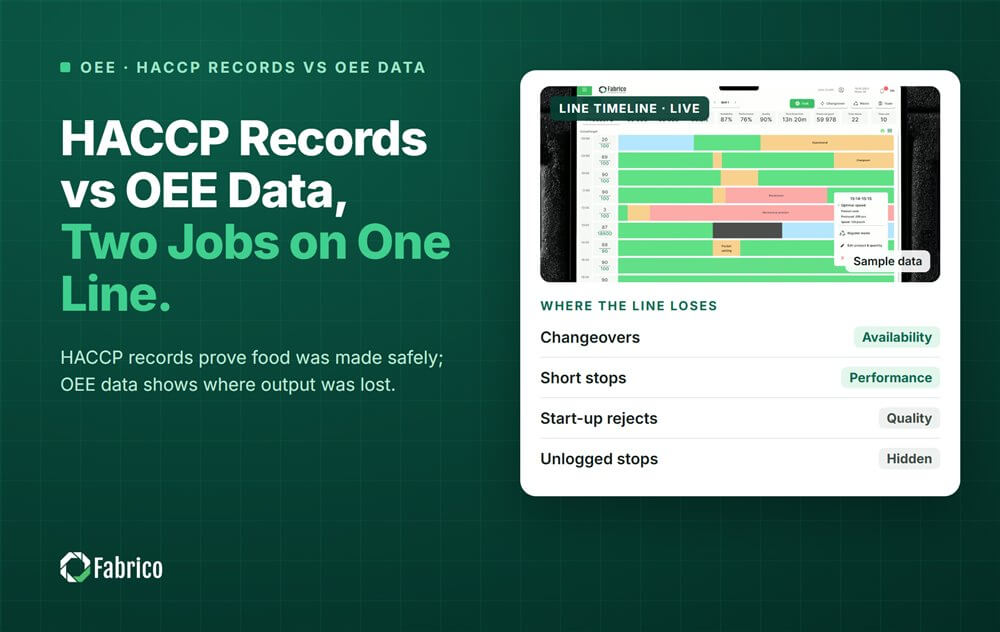
HACCP Records vs OEE Data: Two Jobs on One Line

Key takeaways
- HACCP records answer "was it safe?" OEE data answers "where did the output go?"
- Record keeping is principle 7 of HACCP, and it belongs to the food safety system.
- One event can live in both: a CCP deviation is a corrective action and also a stop.
- Link them by line and time, but keep each in its own system.
- OEE data supports the food safety record. It never replaces it.
Food plants keep two kinds of production data, and they are easy to mix up. HACCP records prove that each critical control point was kept in control. OEE data shows how much output the line lost, and why. You need both, and each has its own owner.
Fabrico, OEE and light MES software with AI cameras, logs stops and their reasons automatically. It makes no food safety claim of its own: its stop log can sit next to your food safety records, never in place of them.
What does each kind of record answer?
| HACCP records | OEE data | |
|---|---|---|
| Main question | Was each CCP kept within its limits? | Where did output go? |
| Typical content | Monitoring results, deviations, corrective actions, verification | Stops, counts, machine states, reasons |
| Who reads it | Food safety team, auditors, inspectors | Line leads, CI team, plant manager |
| Time grain | Per check and per lot | Per second, rolled up per shift |
| Where it lives | The food safety system | The OEE or MES layer |
The two answer different questions, so they are judged in different ways. A HACCP record must be complete and correct for every check. OEE data must be timed well enough to show where the minutes went.
What must HACCP records cover?
HACCP has seven principles: hazard analysis, critical control points, critical limits, monitoring, corrective actions, verification and record keeping. The records cover the last four: what was measured, what went wrong, what was done about it and how it was checked.
In the US, the FSMA preventive controls rule adds a written food safety plan with documented monitoring and corrective actions. The FSMA 204 rule adds records for certain foods, with a compliance date of July 20, 2028. In the EU, Regulation 178/2002 has asked food businesses to know "one step back, one step forward" since 1 January 2005.
None of that is OEE's job. Our HACCP guide for food manufacturing covers the plan and its records.
Where do HACCP records and OEE data overlap?
The same moment on the line often shows up in both, from two angles.
- A CCP deviation: in HACCP, a deviation and a corrective action. In OEE, a stop with a food safety reason.
- An allergen clean: in the food safety system, a verification record. In OEE, changeover minutes.
- Product put on hold: in HACCP, a disposition decision. In OEE, units that are not yet good count.
Worked example: one CCP deviation in both records
Sample line (illustrative numbers, not a customer). A cooked product line runs at 150 units a minute. The last good CCP check was at 10:00. At 10:12, a check finds the cook step below its critical limit.
The crew stops the line. The 12 minutes of product since the last good check go on hold: 12 x 150 = 1,800 units. The cook step is corrected, checked again, and the line restarts at 10:41.
| Field | HACCP record | OEE data |
|---|---|---|
| Event | Deviation at the cook step CCP, 10:12 | Stop 10:12 to 10:41, 29 minutes |
| Detail | Measured value, critical limit, who checked | Reason: CCP deviation, cook step |
| Action | Corrective action and recheck, signed off | Availability loss |
| Product | 1,800 units on hold, then a disposition decision | 1,800 units in total count, not good count |
The stop cost 29 x 150 = 4,350 units of output. At a margin of USD 0.12 a unit, that is USD 522 (about EUR 480). If the held units are destroyed, they add USD 216 of margin, plus their materials.
The HACCP record proves the deviation was handled. The OEE data shows what it cost. Neither one could do the other's job.
How should the two be linked?
- Use one clock. Put the line, the checks and the OEE system on the same time server, so 10:12 means 10:12 in both.
- Share the keys: plant, line, product and the lot code your plant already uses.
- Link, do not copy. Each record stays in its own system; a reviewer finds the other by line and time.
- Agree the owners. The food safety team owns the HACCP record. Production owns the OEE reason codes.
For product on hold, our guide to quality hold process design shows how to run the release. For record integrity in regulated plants, see GMP data integrity.
What should OEE data never be used for?
- As the food safety record. A stop log is not proof that a CCP was in control.
- To decide whether a check is needed. That is the HACCP team's decision.
- To rank people. Report by line and shift, never by named operator.
Where does Fabrico fit?
Fabrico is a computer vision enabled Manufacturing Performance Platform. OEE and light MES come first: it is the loss side of the line, not the food safety side.
- Automatic downtime logging, timed by the machine signal.
- The operator confirms the reason in one tap, including food safety reasons.
- A camera clip as evidence for a stop, where a camera watches.
- Every loss priced in money, so a deviation has a cost next to its record.
It is the OEE layer of a light MES. You start on one line, with a baseline and a decision date agreed in advance. There is no free plan and there are no tiers: each plant gets a quote.
Frequently asked questions
What are HACCP records?
They are the documents that prove a food safety plan works. They hold the monitoring results at each critical control point, any deviations, the corrective actions and the verification that followed. Record keeping is the seventh HACCP principle. The food safety team owns them.
Can OEE software replace HACCP records?
No. OEE software shows when a line stopped and why, which helps a reviewer find what happened. It does not prove that a critical control point stayed within its limits. Keep the HACCP record in your food safety system and link the two by line and time.
Does a CCP deviation count as downtime in OEE?
Yes. While the line is stopped for the corrective action, the minutes are an Availability loss under a food safety reason. Product put on hold counts in total count, and it only becomes good count if it is released without rework.
How do you link a deviation to the stop it caused?
Put both systems on the same clock and give both the same line and product keys. Then the deviation at 10:12 in the HACCP record and the stop at 10:12 in the OEE data match without any copying. The lot code your plant already uses joins the two.
Who should own HACCP records and OEE data?
The food safety team owns HACCP records, their format and how long they are kept. Production and CI own the OEE reason codes and the loss reports. Agree the shared keys and the clock together, then let each team run its own system.
See your food safety stops next to your losses
Bring one week of shift reports. We will show your stops by reason and what each one cost.
Latest from our blog


Real Fabrico tiles, sample data.