

Manufacturers who buy OEE software and CMMS separately pay three costs that never appear in vendor quotes: the licensing cost of two platforms, the integration cost connecting them, and the ongoing data management cost of keeping two systems aligned.
A typical mid-market manufacturer pays for a standalone OEE platform and a standalone CMMS side by side, and the combined licensing bill lands well ahead of a single integrated platform.
See our roundup of affordable CMMS software.
Integration between the two systems adds a one-time development cost and recurring annual maintenance as both APIs change with software updates. Ongoing data quality management, ensuring asset names, downtime reason codes, and production line identifiers match across both systems, adds 2 to 5 hours per week of maintenance manager or IT time.
Over three years, the two-tool approach carries a cost that varies by site in total for licensing, integration, and management overhead at mid-market scale.
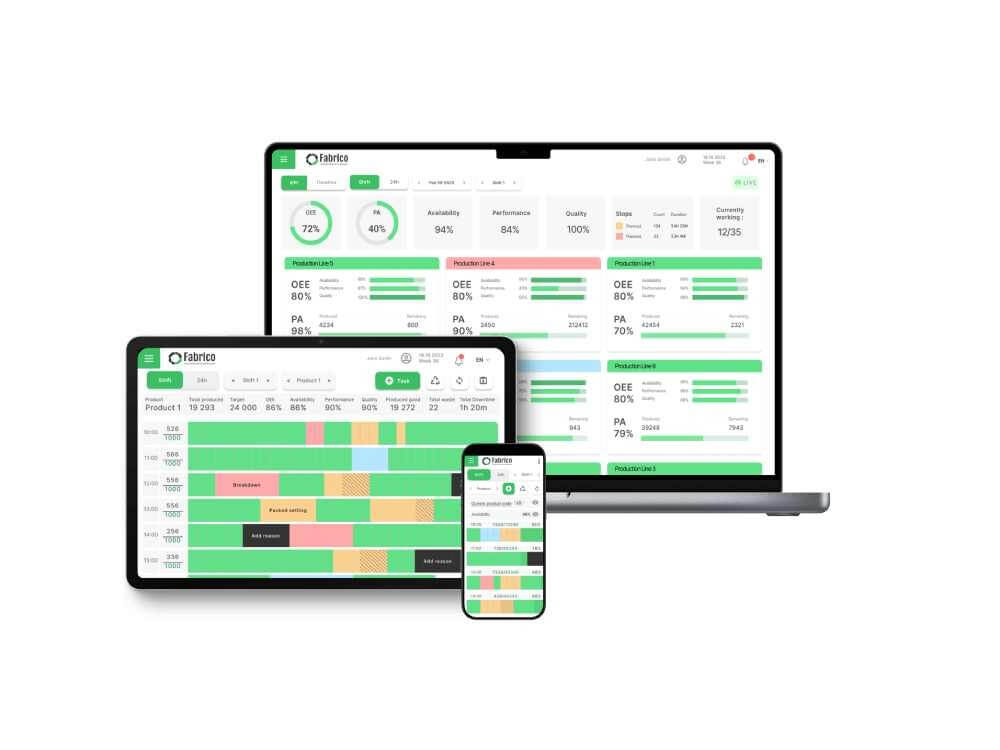
Fabrico is a cloud-based MES and OEE platform for manufacturers, with maintenance management (CMMS) built in. It prices on a combined basis rather than as two separate licenses. A mid-market manufacturer on a single Fabrico subscription gets both OEE monitoring across all production lines and full CMMS capability for the maintenance team, instead of paying two separate vendors for the same scope.
The pricing models vary by vendor: some integrated platforms charge per production line (aligning cost with the primary OEE use case), others charge per user (aligning with maintenance team size), and some use a hybrid model. Fabrico typically prices per site with production line and user counts informing the tier.
When evaluating the pricing of an MES and OEE platform with CMMS built in, require a three-year total cost of ownership comparison from any integrated vendor: year 1 licensing plus implementation versus the equivalent two-tool year 1 cost. Year 2 and 3 ongoing licensing cost comparison.
Integration cost (included in integrated platform, separate spend for two tools). The total three-year comparison almost always favors the integrated platform for a mid-market manufacturer.
The integrated OEE and CMMS platform wins the financial comparison in four scenarios. Greenfield deployment: new plants starting from zero get one implementation, one training program, and one vendor relationship instead of two.
The integrated path saves 3 to 6 months of implementation time and eliminates duplicate implementation costs. Both needs exist simultaneously: manufacturers who need OEE monitoring and CMMS in the same 12-month planning cycle should never buy them separately.
Existing single tool with planned addition: if you have OEE and are planning to add CMMS (or vice versa), migrating to an integrated platform is typically cheaper than adding the second standalone tool. PE-backed acquisition scenario: integrating a newly acquired manufacturer onto existing group tools in 90 days favors integrated platforms that deploy faster than the combined timeline of two separate implementations.
The two-tool path wins in one specific scenario: when the organization has significant existing investment in one system (e.g. IBM Maximo at enterprise scale) with proven adoption, and needs to add the other capability without disrupting a functioning program. In this case, integrating a best-of-breed OEE tool to an existing enterprise CMMS via API may be the pragmatic path.
Want OEE captured straight from your machines, no manual logs?
Request a demo













 Login
Login
 Blog
Blog