


 Login
 Blog
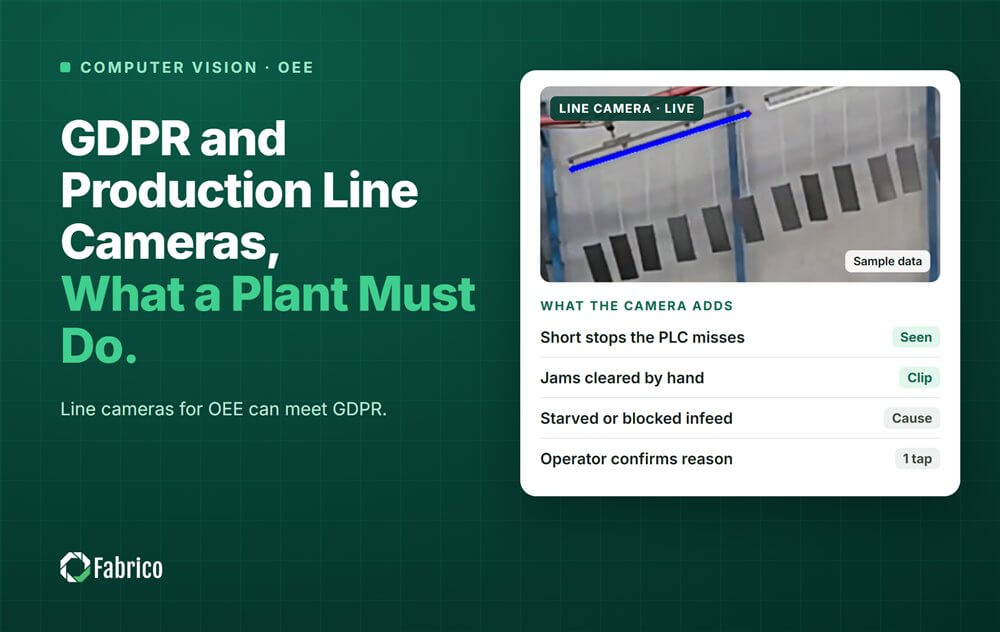
GDPR and Production Line Cameras: What a Plant Must Do

Key takeaways
- A line camera will catch people in the frame, so plan it as personal data from day one.
- Write one purpose down: machine stops and losses on named lines, never people.
- Do the data protection impact assessment (DPIA) under GDPR Article 35 before the first camera.
- Delete clips automatically. The European Data Protection Board (EDPB) says ideally after a few days; beyond 72 hours needs stronger justification.
- Add logged access by role, a sign at each camera, video processed at the line, and the works council where there is one.
A plant can put cameras on a production line for OEE (overall equipment effectiveness) under GDPR, if the design is right. That means one purpose: machine stops and losses, not people. It also means a DPIA, short retention, logged access, signs and the works council where one exists.
Fabrico is OEE and light manufacturing execution system (MES) software, with AI cameras as an add-on. The camera records a stop, the operator confirms the reason in one tap, and a short clip stays as evidence. This guide is general information, not legal advice: involve your data protection officer and worker representatives from the start.
Does GDPR apply to cameras on a production line?
In practice, yes. A camera over an infeed still catches the hand that clears a fallen bottle. If a person can be recognised in the picture, treat the footage as personal data.
The EDPB's Guidelines 3/2019 on video devices (version 2.0) set the tone. An employee is in most cases not expecting to be monitored by the employer (paragraph 37). And employers should not rely on consent for video (paragraph 47).
One point helps line cameras. The Article 9 rules on biometric data apply only when the system builds templates to uniquely identify a person (paragraphs 80 to 82). Detecting a hand or a body as a shape does not. So the rule is: no faces, no identities.
What purpose can a line camera have?
One purpose, in writing: find and fix machine stops and losses on named lines. GDPR's purpose limitation applies in every EU country.
The EDPB asks for safeguards against unexpected uses, and names employee performance monitoring as one (paragraph 2). In practice:
- Aim at the process: the infeed, the accumulation table, the jam point.
- Report OEE by line and shift, never by named operator.
- Keep clips out of performance reviews.
The EU AI Act agrees. Article 5(1)(f) has banned AI that infers emotions at work since 2 February 2025. Annex III point 4(b) makes AI that evaluates workers' performance high risk, with duties from 2 December 2027 under Regulation (EU) 2026/1744. Both rules are about people, so point the camera at the process, never the person.
Our guide to production line cameras without surveillance shows how to hold that boundary on the floor.
Do we need a DPIA before the first camera?
Plan on yes. GDPR Article 35 requires one where processing is likely to result in a high risk to people. The EDPB notes that many video systems need one: check your national authority's list (paragraphs 136 to 138).
For one line, the DPIA answers six questions:
- What is the purpose, in one sentence?
- Would a machine signal do the job instead?
- What is in the frame, and what is kept out?
- What is stored, for how long, and where?
- Who can watch clips, and is every view logged?
- What do workers see at the line, and who answers them?
Article 25 says data protection by design must be in place before any data is collected (EDPB paragraphs 126 to 127). So the DPIA comes before the install date. Our one-line camera pilot plan shows where it sits in a trial.
How long can we keep clips, and who can watch them?
Days, not months. The EDPB says footage should be erased ideally automatically, after a few days. Keeping it beyond 72 hours needs stronger justification (paragraph 121). In France, the authority CNIL says retention should in principle not exceed one month.
Split two kinds of data. The stop record holds the time, the minutes and the confirmed reason: that is what OEE needs. The clip only lives until the reason is confirmed and reviewed.
Access follows the same logic: named roles, for the stated purpose, every view logged. A German works agreement states the purpose, the reports, who sees them and when it is reviewed. Write that list into your plan even without a council.
Keep live views of workstations off office screens. CNIL's guidance says cameras should not film employees at their workstation. In 2019 it sanctioned a live workstation camera as manifestly excessive.
Where should the video be processed?
As close to the camera as possible. Video is heavy and time sensitive, so the edge, at the line, is the natural place to analyse it. Only events, OEE figures and the clips you keep go upstream.
The EDPB notes that processing in real time without recording can be less intrusive, depending on the purpose. A privacy friendly design processes frames in memory and discards them, and blurs faces before anything is stored. Raw video does not go to the cloud by default.
Ask every vendor, Fabrico included, where frames are processed and what leaves the plant. Our data protection guide for plant software lists the hosting questions to send.
When does the works council have to agree?
In Germany and Austria, before anything is switched on. Section 87(1) no. 6 of the Works Constitution Act (BetrVG) gives the works council a say over equipment that can monitor behaviour or performance.
The Federal Labour Court reads this broadly: suitability is enough, intent does not matter (BAG 1 ABR 43/12, see GÖRG's case law summary). So a camera that records nothing still needs a works agreement. The court also ruled open video surveillance unlawful where it puts staff under pressure to perform (BAG 8 AZR 421/17).
Austria's parallel rule is section 96 ArbVG. In France, the CSE staff committee is consulted before cameras go up. Bulgaria and Romania have no co-determination this strong, but purpose limitation still applies. The full consultation order is in our works council approval guide.
What does a sample retention and access plan look like?
Sample line (illustrative numbers, not a customer): a bottling line in a German plant with three cameras. They watch the labeller infeed, the accumulation table and the case packer outfeed. Together they flag about 60 stops a shift. Over three shifts that is 180 clips a day.
| Item | The plan for line 2 | Why |
|---|---|---|
| Purpose | Find and fix machine stops and losses on line 2. Nothing else. | EDPB paragraph 2 |
| In the frame | Infeed, table, outfeed. No faces, workstations or walkways. | CNIL, EDPB paragraphs 80 to 82 |
| Processing | Frames analysed at the line. Only events and clips leave it. | Article 25 |
| Stop record | Time, minutes, reason, by line and shift. No operator names in reports. | AI Act Annex III |
| Clips | One short clip per stop, deleted automatically after 72 hours. | EDPB paragraph 121 |
| Longer keeps | Only for an open repair or quality case, reason written down, with the data protection officer's OK. | EDPB paragraph 121 |
| Who can watch | Line leader, CI lead, maintenance lead. Every view logged. Nobody judges a person. | Works agreement |
| Signs | At each camera: what it films, why, who to ask. | Telling workers first |
| DPIA and council | DPIA and works agreement signed before install, reviewed when a camera moves. | Article 35, BetrVG |
Clips on file at any moment = clips a day x days kept.
- Deleted after 72 hours: 180 x 3 = 540 clips.
- Kept for 30 days: 180 x 30 = 5,400 clips.
That is ten times more footage to protect, and OEE gains nothing from it. Each reason was confirmed on its own shift, and the stop record keeps the minutes.
Where Fabrico fits
Fabrico is a computer vision enabled Manufacturing Performance Platform. OEE and light MES come first. The camera is the evidence, not the product. There is no free plan and there are no tiers: each plant gets a quote.
- Automatic downtime logging, with AI cameras only where the machine signal is blind.
- A camera clip as evidence for a stop, so the talk is about the machine, not the person.
- The operator confirms the reason in one tap. The camera suggests; it does not decide.
- OEE live by line and shift, never a ranking of named operators.
Where video is processed, how long clips are kept and the works agreement terms are confirmed for each plant by Fabrico's technical team. You start with a pilot on one line. See the computer vision OEE and MES page.
Frequently asked questions
Is video of a production line personal data under GDPR?
It is whenever a worker can be recognised in it, and on a busy line that is hard to rule out. So plan it as personal data: one written purpose, a DPIA, short retention and logged access. Keeping faces out of the frame lowers the risk, but it does not remove the duties.
Can workers consent to cameras on the line?
The EDPB says employers should not rely on consent for video at work, because of the power imbalance (paragraph 47). Choose the legal basis with your data protection officer instead. In many countries a works agreement sets the rules; GDPR Article 88 lets collective agreements do that for employee data.
Is a camera that detects people biometric processing?
Not by itself. The Article 9 rules on biometric data apply when the system creates templates to uniquely identify a person (EDPB paragraphs 80 to 82). Detecting a hand or a body as a shape, without knowing who it is, does not. A system that recognises a returning person would.
Do we need the works council if the camera records nothing?
In Germany, yes. Section 87(1) no. 6 BetrVG covers any equipment that can monitor behaviour or performance, and the courts say suitability is enough, whatever the employer intends. So even a camera that only analyses live video needs a works agreement first.
Bring your camera plan to a demo
Bring one line and your works council's questions. We will show what a stop clip contains, who sees it and how OEE is reported.
Latest from our blog


Real Fabrico tiles, sample data.