


 Login
 Blog
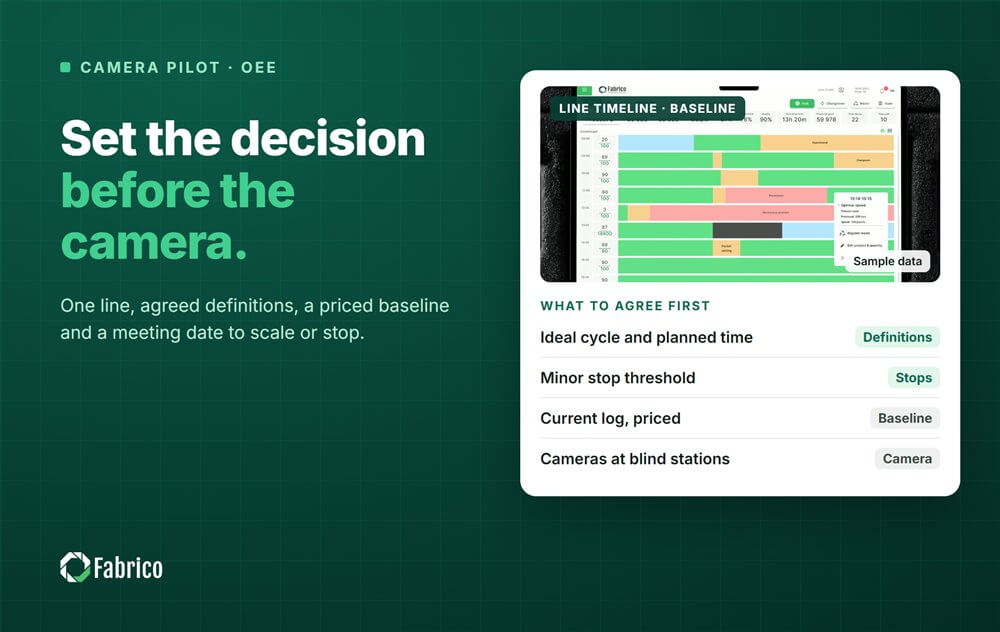
Computer Vision OEE Pilot: A One-Line Plan and Checklist

Key takeaways
- A camera pilot should end in a decision. Set the decision meeting, the people and the exit criteria before the first camera goes up.
- Scope it to one representative line, ideally the bottleneck, with a named sponsor and a named line owner.
- Agree the definitions first: ideal cycle time, planned time, the minor stop threshold and the reason code list. The plant's own definitions decide the OEE number.
- Keep your current downtime log as the baseline, and price its losses with the controller.
- Put cameras only at the stations where the machine signal is blind.
- Do the works council, the DPIA and the signs before the first camera.
- At the decision meeting, compare the pilot line with its baseline and choose: scale, change or stop.
Most camera pilots on a production line do not fail on the technology. They fail on questions nobody answered at the start: which line, measured against what, by whose definitions, and who decides when it is over. This page is a plan for one line that answers those questions first, and a checklist to take into the kickoff meeting.
It is written for plant managers, CI leads and OEE owners who are testing computer vision for OEE and downtime, with any vendor, Fabrico included. It promises no result and sets no length. The scope and the exit criteria do that job. If you are still deciding what cameras can do on a line, start with computer vision in manufacturing.
Why camera pilots stall
McKinsey found in 2018 that less than a third of manufacturers had moved their digital programmes from pilot to scale, while most rated themselves level with or ahead of their peers. The name for that gap is pilot purgatory.
Camera pilots stall for the same few reasons:
- No signed baseline and no decision date, so the pilot drifts and nobody can say whether it worked.
- The best line or the worst line was picked. The best one reassures and the worst one dramatises; neither tells you about the rest of the plant.
- Definitions are argued after the data arrives. Ideal cycle time and planned time are debated once the OEE looks uncomfortable.
- The model is trained once and frozen, then the process changes and the detections drift.
- A dashboard ranks operators, and the works council stops the project.
- Vendor accuracy is taken on trust instead of being measured on the pilot line.
Many offers in this market sell a pilot as a fixed length of time. Time is not the exit criterion. A decision is.

Step 1: Scope one line where a camera earns its place
Pick one representative line. Not the newest and not the worst: the line the rest of the plant will recognise. If you can, pick the bottleneck, because a minute lost at the constraint is a minute lost for the whole line.
Check that the camera has a job there. A camera earns its place where the machine signal is blind:
- stations with no PLC signal at all;
- manual and packing stations without counts;
- conveyors that can run while carrying nothing, so starved looks like running;
- stations with frequent short stops that nobody logs;
- stations whose stop causes are disputed in every morning meeting.
Name three people:
- a sponsor at plant manager level, who owns the decision;
- a line owner, who runs the review of the pilot data;
- a chair for the decision meeting, often the sponsor.
Write the scope in one paragraph: the line, the stations, the shifts and the products in the pilot, and what is out of scope. Part inspection, safety monitoring and anything about named people belong outside a line performance pilot.
Agree the IT basics: read-only access to the PLC, where cameras and video sit on the network, and one time source for the PLC, the cameras and the MES. Our guide to connecting line cameras to MES covers these in more detail.
Step 2: Agree the definitions before the first camera
The plant's definitions decide the OEE number, so agree them before any data arrives. Write each one down, sign it and keep its version.
- Ideal cycle time for each product, and where it comes from: the nameplate rate or a demonstrated best. Taking a good shift's speed as the ideal makes Performance look better than it is.
- Planned production time. What counts as planned: breaks, planned maintenance and the standard changeover. Changeover time above the standard is unplanned and gets a reason code.
- The minor stop threshold. No standard sets it. Your cutoff decides whether a short stop lands in Availability or in Performance. OEE stays the same; the diagnosis changes.
- The reason code list. A short list per line, each code mapped to Availability, Performance or Quality. Our guide to downtime reason code design shows how to keep it short enough to use.
- Count points. Where total count and good count are taken. For a camera station, someone who runs the line defines once what the start and end of a unit look like.
- What a stop is for the camera, per station: for example, product not moving at the infeed, agreed with the line owner.
OEE is still Availability x Performance x Quality. If you want a standard vocabulary for the elements, ISO 22400-2 names them; nobody is certified to it, but it settles arguments about terms.
Step 3: The baseline: your current log, priced
Keep the current downtime log running exactly as it is, on paper, in a spreadsheet or in the MES. Do not improve it before the baseline is taken, or you cannot tell what the camera changed.
Compute the baseline with the agreed definitions: OEE by line and shift, the downtime by reason, and the share that sits in "Other" or has no code.
Measure reason code coverage. Coverage = coded downtime minutes / total downtime minutes. Sample line (illustrative numbers): 1,860 of 2,100 downtime minutes carry a code, so coverage is 88.6%.
Price the loss with the controller. Use what the lost output is worth at contribution, at the constraint, not a machine hour rate with depreciation in it. Sample line (illustrative numbers): a line rated at 600 units an hour loses 52 minutes to stops in a shift. That is 520 units. At a contribution of $2.40 a unit, the shift lost $1,248; in a euro plant at €2.40 a unit, €1,248. Whether freed capacity becomes cash depends on whether the extra output sells, and the controller decides that rule, not the software. Our cost of downtime calculator prices your own losses.
Sign the baseline: the sponsor, the line owner and the controller.
Step 4: Cameras only at the blind stations
Go through the line station by station and ask one question: does the machine signal already tell you when this station stopped, and whether product was actually moving?
- If it does, the PLC is the clock for that station. A camera there adds a clip and a suggested reason, which helps where causes are disputed, but it is not needed for timing.
- If it does not, that is a blind station, and a candidate for a camera: no PLC, manual or packing work without counts, a conveyor that can run empty, frequent short stops.
Set up the scene:
- point the camera at the machine and the product, not at faces or workstations as such;
- use a stable mount and consistent light, because a model trained on a steady view stays accurate;
- cover the infeed and the outfeed of the station, where most stops show first;
- one camera per question: do not ask one view to count, watch a jam point and check a label;
- write down what it cannot see, such as the inside of a closed machine or product hidden by hands.
Mark each camera's field of view on the line drawing. The works council will ask for it, and it keeps the scope honest.
Plan how accuracy will be measured. Ask for two numbers on your own line, against your own log. Sample period (illustrative numbers): there are 100 real stops. The camera flags 95 of them and raises 15 false alarms. Recall = 95 / 100 = 0.95; precision = 95 / 110 = 0.86. Each detection should carry its clip, so a person can check it in seconds. Stops at stations without a camera still come from the PLC or the operator, without a clip.
Step 5: Works council, DPIA and signage
Cameras on a line film people, even when the purpose is the machine. Do this step before the first camera, not after. This is general information, not legal advice: check your plan with your data protection officer.
- Write the purpose down: the machine and the process, not the people. Reporting by line and shift, never by named operator.
- Germany. Under section 87(1) no. 6 BetrVG, the works council co-determines any technical device suited to monitor behaviour or performance. Suitability is enough, so a camera that records nothing still needs a works agreement.
- France. The CSE is consulted before cameras are installed at work, according to the CNIL.
- GDPR. Article 35 asks for a data protection impact assessment where processing is likely to be high risk. Article 88 lets collective agreements set rules for employee data.
- The EDPB video guidelines (3/2019, version 2.0) say employees are in most cases not expecting to be monitored by their employer (para 37), that employers should not rely on consent (para 47), and that footage should be erased, ideally automatically, with short retention (para 121). Detecting a body without creating templates that identify a person is not biometric processing under Article 9 (paras 80 to 82).
- The EU AI Act bans AI that infers emotions in the workplace, except for medical or safety reasons (Article 5(1)(f)). AI used to monitor and evaluate workers' performance and behaviour is high risk (Annex III, point 4(b)), with those obligations applying from 2 December 2027 under Regulation (EU) 2026/1744. Measure the process, never the person, and the pilot stays outside both.
- Signs at the line, the DPO's sign-off and the entry in the record of processing.
Questions to put to any vendor before the council meeting: where the footage is processed, what is kept (events, clips, footage), who can see the clips, how retention is set, and whether people are blurred or reduced to shapes. On Fabrico projects, these are answered by our technical team for each plant. Our guides to works council approval for OEE monitoring and production line cameras without surveillance go further.
Step 6: What to measure during the pilot
Agree three columns of exit criteria before the start, with a threshold for each line in each column. Write them into the scope paragraph.
1. Data: does the system agree with reality?
- Count error at a camera station, against a manual count.
- Precision and recall of stop detection, against the log.
- Stop start and length, against the PLC where one exists.
2. Adoption: do people use it?
- Reason code coverage, compared with the baseline.
- The share of suggested reasons the operator confirms or corrects.
- Whether the daily production meeting uses the pilot data.
3. Money: what do the losses cost?
- The loss in money by cause, ranked, using the pricing rule agreed with the controller.
- The top causes, each with a named owner and an action.
None of these is a target the camera "hits". They are the evidence the decision meeting needs.
Step 7: The decision meeting: scale, change or stop
Set the date before the first camera goes up, with the sponsor, the line owner, the controller and IT. Where there is a works council, agree how it is informed of the outcome.
The agenda:
- The pilot line against its baseline, on the agreed definitions.
- The data column: met or not, with the clips that settle disputed cases.
- The adoption column: coverage, confirmations, the daily meeting.
- The money column: the priced losses and the top causes with their owners.
- Open points from IT and the works council.
Three possible outcomes:
- Scale. Extend to the next lines in small waves, with the same definitions and the same baseline method.
- Change. Adjust the stations, the camera views, the definitions or the scope, and run the same plan again.
- Stop. Write down why. A clear stop is a result; a pilot that nobody ends is not.
The checklist
Copy it into your kickoff notes, or bring it to the demo.
Scope
- [ ] One representative line chosen, ideally the bottleneck
- [ ] Stations in scope listed, with the reason a camera is needed at each
- [ ] Inspection, safety monitoring and anything about named people written as out of scope
- [ ] Sponsor, line owner and decision meeting chair named
- [ ] IT agreed: read-only PLC access, network placement, one time source
Definitions
- [ ] Ideal cycle time for each product, with its source
- [ ] Planned time rules, including the standard changeover
- [ ] Minor stop threshold
- [ ] Reason code list, each code mapped to Availability, Performance or Quality
- [ ] Count points, and the start and end of a unit defined by someone who runs the line
- [ ] What counts as a stop for each camera station
- [ ] Definitions signed and versioned
Baseline
- [ ] Current downtime log kept exactly as it is
- [ ] Baseline OEE by line and shift on the agreed definitions
- [ ] Reason code coverage and the "Other" share recorded
- [ ] Pricing rule agreed with the controller: contribution at the constraint
- [ ] Baseline signed by the sponsor, the line owner and the controller
Cameras at blind stations
- [ ] Each station checked: does the machine signal show the stop and the product flow?
- [ ] Cameras only where it does not: no PLC, manual or packing work, conveyors that run empty, frequent short stops, disputed causes
- [ ] Each view on the machine and the product, marked on the line drawing
- [ ] Mount, light and hidden areas checked
- [ ] Method agreed for measuring precision and recall against the log
Works council and privacy
- [ ] Purpose written: the process, not people; reporting by line and shift
- [ ] Works agreement signed (Germany) or employee representatives consulted
- [ ] DPIA done where required, DPO signed off
- [ ] Retention, clip access and blurring agreed with the vendor's technical team
- [ ] Signs at the line
Decision meeting
- [ ] Date set before the first camera goes up
- [ ] Exit criteria written for data, adoption and money
- [ ] Attendees named
- [ ] Outcome recorded: scale, change or stop, with the reason
Running the pilot with Fabrico
Fabrico is a computer vision enabled Manufacturing Performance Platform: OEE and light MES first, with cameras where machine signals fall short. A pilot on one line is how a Fabrico project starts.
- A review first. Each project starts with a review of your process and machines. It shows which machines can be read through their PLC, which need a Fabrico IoT device and which manual stations suit a camera. One plant can mix all three.
- Cameras sized to the line. Fabrico installs one or more industrial-grade cameras per line, covering the key process areas; the number is agreed after the review.
- Stops from the machine. Downtime is logged from the machine signal, with its start time and length.
- Cameras at the blind stations. They detect when a line stands still, including a line that is switched on but not producing, and they count output at manual and packing stations.
- The operator confirms. AI models suggest a likely reason, such as no material, a jam or a broken part. The operator confirms it in one tap, and the clip stays as evidence for the stops at the stations a camera watches.
- Losses in money. OEE is live by line and shift, and losses are shown in money and ranked, which is the money column of your decision meeting.
- Maintenance as the last step. When a confirmed stop is a breakdown, the technician opens the work order from it, with its cost.
Network placement, retention and works agreement questions are answered by our technical team for each plant. Each plant gets a quote after the review. To compare other camera tools before you pick one, see Cerrion alternatives and our review of video analytics for manufacturing.
Frequently asked questions
What is a computer vision OEE pilot?
A test of camera-based OEE and downtime tracking on one production line, measured against the line's current downtime log and ended by a decision: scale, change or stop. It uses the plant's own definitions and puts cameras only where the machine signal is blind.
How long should a camera OEE pilot run?
Until the decision meeting you set at the start, and long enough for the pilot line to show its normal mix of products, shifts and stop causes against the baseline. We do not sell a pilot by its length: the scope and the exit criteria decide it.
Which line should we pilot?
A representative line, not the best and not the worst, ideally the bottleneck. It should have at least one blind station, where a camera has a real job: no PLC, manual or packing work, a conveyor that can run empty, or frequent short stops.
Do we need a PLC on the pilot line?
No. Where a PLC exists, it is the clock for stops, and a camera at that station adds a clip. Where there is none, as on many manual stations, a camera supplies the state and the count, and older machines can get an add-on sensor.
How many cameras does a pilot need?
As many as the blind stations need, and no more. One camera per question is the rule. With Fabrico, the number per line is agreed after a review of your process and machines.
What does the works council need to see?
The purpose in writing (the process, not people), each camera's field of view on the line drawing, what is stored and who can see it, and the reporting level: by line and shift, never by named operator. In Germany, a works agreement comes before the first camera.
What should the exit criteria be?
Three columns agreed before the start: data (does the system agree with reality), adoption (do people use it) and money (what the losses cost, by cause). Set a threshold in each, and write down who decides.
Is a pilot the same as a proof of concept?
Not quite. A proof of concept shows that the camera and the data work. A pilot also shows whether the line uses the data and what the losses cost, and it ends in a decision.
What does a pilot cost?
It depends on the number of stations and cameras. Each plant gets a quote after a review of its lines.
Plan a pilot on one of your lines
Bring the line you have in mind, its current downtime log and the people who will decide. In the demo we go through this plan for that line: where the PLC already covers you, which stations need a camera, and what the losses cost today. On the demo form, tick the box for camera based OEE.






