Login
 Blog
Cerrion Alternatives: 6 Camera Tools for OEE and Downtime Compared (2026)

Key takeaways
- Cerrion sells AI agents that watch production lines through cameras, detect issues such as jams, fallen products and damaged packs, and act on them: an alarm, a machine section stop, a product reject.
- It is a strong pick for glass, beverage, food and consumer goods lines that want the camera to act on the line, on cameras the plant may already have.
- Plants look for alternatives when their first question is a different one: what each stop costs, how OEE moves by line and shift, and who confirms the cause.
- The six alternatives below split by job: OEE and light MES with camera evidence (Fabrico), an AI analysis layer (Almetra), assembly time study (Invisible AI), footage behind downtime events (Factbird VIEW), site security and safety (Spot AI), and build your own (Roboflow).
- Each vendor fact on this page comes from that vendor's own website, read on 30 October 2026, with the link next to it.
A bottle falls at the labeller infeed. A camera sees it, an alarm sounds, and an operator clears it before the conveyor backs up into the filler. That is the job Cerrion is built for. Buyers who search for Cerrion alternatives usually want one of two things: another way to do that job, or a system that also answers the question the plant manager asks the next morning. How much did those stops cost, and what did they do to OEE on line 2?
This page covers both. First, what Cerrion does according to its own site, and when it is the right pick. Then six alternatives, compared on the points that decide a camera project on a production line. Fabrico wrote this page and is one of the six, so each entry also says where another tool fits better. If you are new to cameras on a line, start with computer vision in manufacturing.
What Cerrion does (per its site, checked 30 October 2026)
Cerrion is a Zurich company, Cerrion AG, backed by Creandum and Y Combinator according to its company page. It sells AI agents that monitor production lines through cameras.
- Detect and act. Its agents detect production issues before they cause downtime, safety incidents, quality escapes or waste, and trigger a response (cerrion.com).
- A library of detections. For downtime: fallen, stuck and misaligned products, jams, spillages and blockages. For quality: damaged or malformed products, foreign objects, damaged packaging, missing labels and wrong best-before dates. It also lists safety detections, such as fire, smoke and a person in a hazardous zone. Its detection list names micro stops and a machine running empty as well (AI agents).
- Cameras. The agents run on standard CCTV or industrial cameras already on the line. Where coverage is missing, Cerrion sources cameras through partners, including high-speed or thermal cameras (deployment). When a detection needs context, it can pull expected values from the MES or from machine state data (AI agents page).
- Actions on the line. Alerts go out as sound, screen, pager, email or chat messages. On beverage lines it integrates with common PLCs through OPC UA, MQTT and 24V relays (beverage and filling), and its platform page also lists Modbus TCP and Rockwell Logix controllers among its machine connections. That is how an agent can stop a machine section or reject a product (platform).
- Analysis. Detections and video are turned into root cause insights, with a view of the previous shift's issues and video evidence from several cameras (platform page).
- Data handling. The agents run on a dedicated server inside the factory. Only clips of detected issues are captured, people in them are anonymised on site, and the clips are encrypted on their way to an isolated cloud (deployment). Its security page states ISO 27001 certification and that data from European factories stays in the EU (security).
- Industries. Glass packaging, beverage and filling, food, consumer goods, tableware, and wood and sawmilling. Its beverage and filling page leads with closing OEE gaps and eliminating quality escapes (beverage and filling page).
- Buying. The main call to action is a discovery call. We found no public price (contact).
Its site also carries customer stories with results in downtime, scrap and yield. Those figures are vendor-reported, so we do not repeat them here.

When Cerrion is the right pick
Put Cerrion on your shortlist if most of these are true:
- The camera has to act, not only report. You want it to sound an alarm, stop a machine section or reject a product when a detection fires.
- Your lines match its industries. Glass, beverage, food, consumer goods, tableware or wood, where its pre-built detections are close to your failure modes.
- You want quality and safety detections from the same cameras. Labels, best-before dates and damaged packs, plus its safety detections.
- You already have cameras on the line and want to reuse them.
If the camera must act on the machine, Cerrion is built for that job. Fabrico's cameras are set up for line performance: stops, counts and the evidence behind a stop. The alternatives below make more sense when your first question is about OEE and the cost of downtime, or when you need a different camera or data model.
What to compare
Seven questions separate these tools faster than any feature list:
- What was it built for? Acting on detections, measuring losses for OEE and MES, site security, time study, or building your own.
- Whose cameras? Yours, theirs or both, and which view each job needs.
- Does it calculate OEE? By line and shift, with your own definitions of ideal cycle time, planned time and the minor stop threshold. Or does it send events to a system that does?
- Does a detection become a stop record? With a start, a length, a cause and the clip attached, on the same timeline as the PLC data.
- Who names the cause? The model alone, the operator alone, or the model suggesting and the operator confirming.
- Are losses priced? In money and ranked, so the costly cause gets fixed first.
- What is stored, and what does the works council see? Footage, clips or events; data about the process or about people.
The last question decides more camera projects than any feature does. Our guide to production line cameras without surveillance covers it.
Comparison table
| Tool | Built mainly for | Cameras | OEE and downtime | Who names the cause of a stop |
|---|---|---|---|---|
| Cerrion (for reference) | AI agents that detect and act on production issues | Existing CCTV or industrial cameras, or cameras it sources | Detections for jams, stuck products and micro stops; its beverage page speaks of closing OEE gaps | Detections trigger alerts and automated actions |
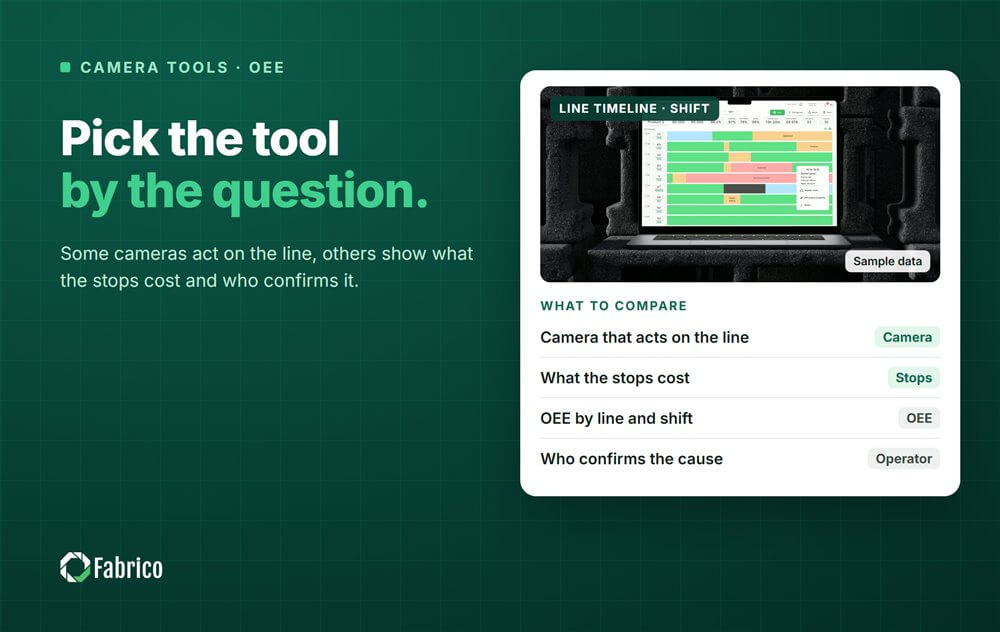
| 1. Fabrico | OEE and light MES, downtime with evidence | Industrial cameras per line, next to PLC and IoT data | OEE live by line and shift; stops from PLC, IoT device or camera; losses in money | AI suggests, operator confirms in one tap |
| 2. Almetra | An AI analysis layer over video, PLC, MES and ERP data | Cameras plus PLC, MES and ERP data | Real-time OEE tracking, PLC and video based downtimes | Agents correlate PLC states, fault codes, video and operator input |
| 3. Invisible AI | Cycle-level data on assembly lines | Its own edge devices with 3D cameras | Names OEE as an outcome; notifications of line stoppages | Video for root cause analysis |
| 4. Factbird VIEW | Footage behind Factbird downtime events | Off-the-shelf USB cameras | OEE and downtime in the Factbird platform | People review the footage at the data point |
| 5. Spot AI | Security, safety and operations on site cameras | Existing cameras or new ones | Names OEE on its Operations Assistant page | SOP deviations and coaching |
| 6. Roboflow | Building your own computer vision | The cameras you connect | Measures availability, performance and quality from video, or sends events to your OEE system | Your team defines the logic and the loss categories |
1. Fabrico: OEE and light MES with the camera clip as evidence
Fabrico is a computer vision enabled Manufacturing Performance Platform. OEE and light MES come first, and cameras cover the stations where machine signals fall short. Where Cerrion starts from the detection and the response, Fabrico starts from the stop record and what it cost.
What it does (fabrico.io, checked 30 October 2026):
- Every kind of machine. Machines connect through a PLC, a Fabrico IoT device or an AI camera, and one plant can mix all three. Which option fits each machine is agreed with the Fabrico team before installation.
- Stops log themselves. Fabrico reads the run and stop state from the machine signal, stamps the start time and counts the duration (downtime tracking).
- Cameras where the signal is blind. Cameras detect when a line stands still, including a line that is switched on but not producing, and the short stops nobody writes down. On manual and packing stations they count output, so those stations get counts and OEE too.
- The moment of the stop. Footage is synchronised with machine and timeline data, so you can go straight to the moment a line stopped.
- The operator confirms. AI models suggest a likely reason, such as no material, a jam or a broken part. The operator confirms it in one tap, and at the stations a camera watches, the clip stays with the stop as evidence.
- Losses in money. OEE is live by line and shift. Losses are shown in money and ranked, and one view covers several plants.
- Maintenance as the last step. When the confirmed cause is a breakdown, the technician opens a work order from the stop, with its cost.
Clips exist for the stops at the stations a camera watches. Elsewhere the PLC or the IoT device logs the stop and the operator adds the reason, without a clip.
Where Cerrion fits better: a camera that acts on the machine, part and label inspection, and safety detections. Use Cerrion or a specialist tool for those jobs.
Buying: each plant gets a quote. Each plant gets a quote after a review of its lines. Our guide to computer vision for OEE explains which losses a camera resolves, and how to connect line cameras to MES shows the setup step by step.
Best for: plants whose first question is what downtime costs by line and shift, on lines that mix PLC machines, older machines and manual stations.
2. Almetra: an AI analysis layer over video, PLC and MES data
Almetra, formerly known as Deltia, is a Berlin-based manufacturing intelligence company (Series A post).
What its site says (checked 30 October 2026):
- The platform combines cameras, sensors, PLC signals, MES, ERP and machine data into one operational record (platform).
- For automated lines it lists real-time OEE tracking, PLC and video based downtimes, video snippets for root cause analysis and AI-based root-causing. For manual lines it lists bottleneck detection and waste identification (same page).
- Its OEE Recovery Agent breaks availability, performance and quality losses into ranked improvement opportunities with evidence from the line. A Downtime Root Cause Agent correlates PLC states, fault codes, video and operator input to classify stoppages. A Micro-Stop Detection Agent targets short recurring stops, and a Morning Briefing Agent summarises the previous shift and ranks the largest losses (OEE Recovery Agent).
- On privacy, the homepage says raw video is deleted immediately and processes are tracked, not people, and lists GDPR compliance, works council co-decision, no performance ranking and openness to audit. It offers to meet the works council directly (almetra.ai).
- The calls to action are a demo request or a factory assessment (contact).
Compared with Cerrion: Almetra's pages are about explaining and ranking losses for engineers and managers. Cerrion's are about acting on the line as an issue happens.
Ask in the demo: how its OEE figures reconcile with the OEE your MES already reports, and which video snippets are kept for root cause review when raw video is deleted.
Best for: plants that already have MES and OEE data and want an AI analysis layer with agents on top, including on manual lines, with the works council involved from the start.
3. Invisible AI: cycle-level data on assembly lines
Invisible AI sells a Vision Execution System for assembly lines.
What its site says (checked 30 October 2026):
- The system captures cycle-level data across stations for industrial engineers and team leads (invisible.ai).
- It uses its own edge devices with 3D cameras and a built-in AI chip. Its FAQ says customers cannot use their own cameras (FAQ).
- It deploys entirely on premise, and its FAQ says data is stored on the edge, inside the factory firewall (homepage and FAQ).
- It integrates with MES systems and PLC controllers, among other plant systems (FAQ).
- Its production page links cycle times, throughput and wait time to video, sends notifications of line stoppages with footage for root cause analysis, and describes tracking human movement for workforce performance data (production).
- The industries on its site are automotive and aerospace.
Compared with Cerrion: Invisible AI brings its own cameras and focuses on manual assembly cycles. Cerrion reuses plant cameras and focuses on issues on process and packaging lines.
Ask in the demo, if you buy in the EU: how the workforce data fits the AI Act's rules on monitoring workers (Annex III, point 4(b)) and your works agreement.
Best for: automotive and aerospace plants whose industrial engineers need cycle-level data on manual assembly. Fabrico does not time manual work steps, so for that job Invisible AI or a time study tool is the better fit.
4. Factbird VIEW: footage behind each downtime event
Factbird VIEW is the vision add-on to Factbird's manufacturing intelligence platform, whose homepage lists OEE and downtime management (factbird.com).
What its site says (checked 30 October 2026):
- VIEW collects video footage and syncs it with production data to help find the root causes of downtime events (Factbird VIEW).
- Downtime events recorded in Factbird sync with the footage automatically. You click the data point in the Factbird cloud app and watch the video (same page).
- It works with off-the-shelf USB cameras; the page lists 480p resolution at 30 fps and says it retrofits to existing machines (same page).
- Footage is captured for analysis in the cloud (same page).
- Factbird's homepage also mentions AI vision for counting what sensors miss, and the VIEW page offers a free trial.
Compared with Cerrion: VIEW shows you the footage behind a downtime event that Factbird already recorded. Cerrion detects the event itself and can act on it.
Ask in the demo: whether the footage is analysed by a model or only reviewed by people, and how long it is kept.
Best for: plants already running Factbird that want footage behind their downtime events.
5. Spot AI: security and safety on existing cameras
Spot AI sells AI agents for site cameras across many industries, with manufacturing as one of them.
What its site says (checked 30 October 2026):
- Its manufacturing page leads with protecting property, people and production, and turns existing cameras into a system that detects and responds to threats, unsafe behaviour and operational disruptions (Spot AI manufacturing).
- Security use cases include unauthorised access and tailgating. Safety use cases include missing protective equipment and restricted-area entry. Operations use cases include process drift and bottlenecks (same page).
- When conditions are met, it can trigger lights or sirens, play an automated talk-down or notify the right team, and each incident is timestamped (same page).
- It works with existing cameras or new deployments (same page).
- Its AI Operations Assistant checks work against SOPs, flags deviations, coaches operators and produces scorecards and training plans for each shift. For manufacturing it names faster changeovers, higher OEE and less yield loss (AI Operations Assistant).
Compared with Cerrion: both reuse existing cameras and respond as things happen. Spot AI starts from site security and safety, Cerrion from production line issues.
Ask in the demo: how a stop on a specific machine becomes a downtime record with a duration and a cause, and how operator scorecards fit your works agreement.
Best for: plants that want one camera system for site security and safety, with an operations module on top.
6. Roboflow: build your own
Roboflow is a general computer vision platform for building, training and deploying your own models.
What its site says (checked 30 October 2026):
- Its OEE Monitoring page describes measuring availability, performance and quality from camera feeds on machines and manual stations, including older equipment with no PLC data (OEE Monitoring).
- It runs on the edge, on premise, air-gapped, in your own cloud or through an API, and sends machine states, counts and events over MQTT, OPC UA or REST to MES, historians and OEE platforms (same page).
- The page says Roboflow is the measurement engine, while your operations and continuous improvement teams own the ideal cycle times, planned downtime rules and loss categories (same page).
- The page invites you to try it for free.
Compared with Cerrion: Cerrion ships pre-built agents for named industries. Roboflow gives you the parts to build your own.
Ask yourself first: who on your team will label the data, build the workflow and keep it running when the line changes.
Best for: plants with an in-house vision or data team, and an OEE system ready to receive the events.
Which one fits your plant
- The camera must act on the line, on glass, beverage, food or consumer goods lines: Cerrion.
- You want OEE and downtime in one system, with losses in money and a clip behind the stops a camera watches: Fabrico.
- You want an AI analysis layer over the MES you already have, including manual lines: Almetra.
- You want cycle-level time study on manual assembly: Invisible AI.
- You already run Factbird and want footage behind downtime events: Factbird VIEW.
- You want security and safety first: Spot AI.
- You have a vision team and want to build: Roboflow.
Some plants will want two of these: one camera system that acts on the line and one OEE system that records what each stop cost. That works when each tool is bought for its own job and both agree on what counts as a stop. For a wider field of eight tools, see our comparison of video analytics for manufacturing, and for OEE alone, our shorter list of computer vision OEE software.
Decide with a pilot on one line
Whichever two or three tools you shortlist, test them the same way:
- One representative line, ideally the bottleneck, with a sponsor and a line owner named.
- Your definitions first: ideal cycle time, planned time, the minor stop threshold and the reason code list.
- Your current downtime log as the baseline, priced with the controller.
- Cameras only where the machine signal is blind, such as manual stations, machines with no PLC and conveyors that can run empty.
- The works council and the DPIA before the first camera.
- A decision meeting set in advance, with written exit criteria: scale, change or stop.
Ask each vendor for precision and recall measured on that line, against your own log. Sample period (illustrative numbers): 100 real stops; the camera flags 95 of them and raises 15 false alarms. Recall is 95 / 100 = 0.95 and precision is 95 / 110 = 0.86. Both numbers matter, and each detection should carry its clip so a person can check it.
Our computer vision OEE pilot plan and checklist walks through each step.
Frequently asked questions
What is Cerrion?
Cerrion is a Zurich company that sells AI agents for production lines. The agents watch camera feeds, detect issues such as jams, fallen products, damaged packaging and wrong best-before dates, and trigger a response, from an alarm to a machine section stop or a product reject. Its industries are glass, beverage, food, consumer goods, tableware and wood.
Is Cerrion OEE software?
Cerrion describes itself as AI agents that detect and act on production issues, and its beverage and filling page talks about closing OEE gaps. If you need OEE calculated by line and shift, with stop records, confirmed causes and losses in money, ask whether Cerrion does that itself or sends its detections to your MES or OEE system.
Can Cerrion use my existing cameras?
Yes, according to its deployment page: it runs on standard CCTV or industrial cameras already on the line, and sources cameras through partners where coverage is missing. Spot AI and Roboflow also work with existing cameras. Invisible AI uses its own devices, and Factbird VIEW uses off-the-shelf USB cameras. Fabrico installs industrial-grade cameras per line, with the number agreed after a review of your process and machines.
Does Cerrion store video of workers?
Per its deployment and security pages, footage is processed on a server inside the factory, only clips of detected issues are captured, and people in those clips are anonymised on site before the clips go to an isolated cloud. Ask any vendor, us included, the same questions: what is stored, where, for how long, and who can see it.
How is Fabrico different from Cerrion?
Cerrion starts from the detection and the response on the line. Fabrico starts from the OEE and downtime record: stops logged from the machine signal or a camera, the reason confirmed by the operator in one tap, the clip as evidence for the stops a camera watches, OEE by line and shift and losses ranked in money. If the camera must stop a machine or reject a product, Cerrion is the more direct fit.
What is the difference between Cerrion and Almetra?
Both use cameras on production lines. Cerrion's agents detect issues and act on the line in real time, on process and packaging lines. Almetra is an analysis layer that combines video with PLC, MES and ERP data, ranks losses and explains root causes, on automated and manual lines.
What does Cerrion cost?
Cerrion does not publish a price; its main call to action is a discovery call. Each plant gets a quote after a review of its lines.
See Fabrico on one of your lines
Bring one line and its current downtime log. We will show you where the machine signal already covers you, where a camera would add evidence and what the losses cost. On the demo form, tick the box for camera based OEE.
Latest from our blog