


 Login
 Blog
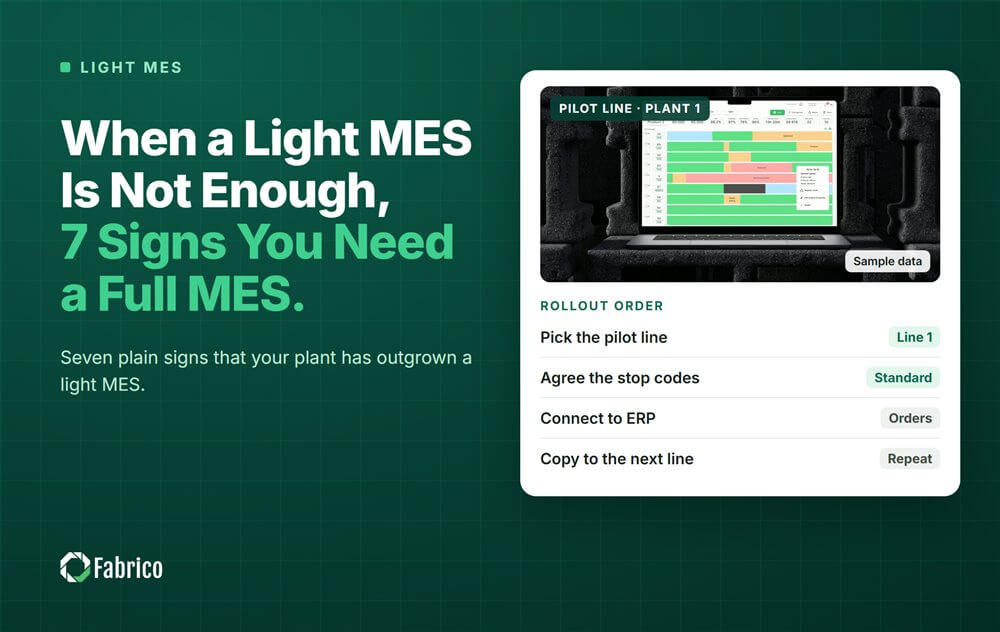
When a Light MES Is Not Enough: 7 Signs You Need a Full MES

Key takeaways
- A light MES is enough when your main problem is lost time on the line: stops, slow running and rejects.
- You need a full MES when the law or your customer demands an electronic batch record, full genealogy or enforced work steps.
- Most plants need both in time, but the light layer comes first because it goes after the minutes you lose today.
- A full MES that starts before the downtime data is clean tends to stall.
A light MES is not enough when a regulator, an auditor or a customer needs records that prove how each batch was made, step by step. If your problem is that lines stop and nobody knows why, a light MES is the right size, and a full MES is a much bigger project than you need.
This guide is for plant managers and operations leads who are choosing between the two. Fabrico, a light MES built around OEE and downtime, sees this question in almost every first call, so we wrote down the seven signs we use to answer it honestly. For the basics of each type, start with our guide to light MES vs full MES.
What does a light MES cover, and what does a full MES add?
A light MES covers the production performance part of MES: machine states, downtime reasons, counts, speed, rejects, OEE by line and shift, and the reports people read every morning. A full MES adds the parts that control and document the process itself.
| Function | Light MES | Full MES |
|---|---|---|
| Machine states and downtime reasons | Yes, the core | Yes |
| OEE by line, shift and product | Yes, the core | Yes |
| Shift reports and loss ranking | Yes | Yes |
| Electronic batch record | No | Yes |
| Enforced work steps and sign offs | No | Yes |
| Full material genealogy | No | Yes |
| Detailed scheduling and dispatching | Usually not | Often |
The MESA model, now with ISA, lists 11 MES functions, among them data collection and performance analysis. A light MES does a few of those very well. A full MES tries to do all of them.
What are the 7 signs you need a full MES?
- A rule requires an electronic batch record. Some regulated products must be made against a recipe, with every step and signature recorded. That is a full MES job.
- You must trace each lot of material to each lot of product. Food law in the EU already asks for one step back and one step forward. When a customer wants full genealogy inside the plant, you need material tracking a light MES does not do.
- Operators must not be able to skip a step. If a wrong step is a safety or recall risk, the system has to block it, not just record it.
- The plant runs complex make to order work. Hundreds of routings and constant resequencing call for dispatching tools.
- Quality checks must stop the line. When an out of limit result must hold the order in the system, you need quality control built into execution.
- Your downtime data is already clean. If stops are logged, coded and trusted, you are ready for the next layer.
- The business case is about compliance, not minutes. If the money is in audits passed and recalls avoided, a full MES is the tool.
If none of the first five apply, you probably do not need a full MES yet. Signs six and seven tell you when you are ready, not whether you need it.
Why should the light layer come first?
A full MES rollout touches every process, every master data record and every user. One industry survey asked 1,560 decision makers: 93% have an MES, but only 28% run it enterprise wide and 23% have it fully integrated. Big systems are easy to buy and hard to finish. Our guide on why MES implementations fail covers the usual causes.
The light layer is smaller. It needs machine signals, a short list of reason codes and a screen for the operator. It goes after the minutes you lose today as soon as the first big loss is visible, and it builds the habit of trusted data that a full MES needs later.
A worked example: does this plant need a full MES?
Sample plant (illustrative numbers, not a customer): a snack plant with 4 packaging lines, 2 shifts, 450 minutes of planned time a shift, a contribution of $40 a minute of line output.
- Logged downtime on paper: 45 minutes a line a shift.
- Downtime seen once machine states were logged automatically: 85 minutes a line a shift. The gap is short stops nobody wrote down.
- Recovering 10 of those minutes a line a shift: 10 x 4 lines x 2 shifts = 80 minutes a day.
- 80 minutes x $40 = $3,200 a day.
The plant has no rule that requires an electronic batch record, and its traceability needs are met by lot codes printed on the pack and recorded in the ERP. Signs one to five do not apply. A light MES is the right tool, and the full MES question can wait until the downtime data is trusted.
Can a light MES grow into a full MES?
Sometimes, but plan for a handover rather than a growth path. Many plants keep the light MES for OEE and downtime and add a separate full MES or quality system for batch records. Each tool does its own job, and they share a clean line and product master. Read how the layers fit in our ISA 95 guide.
Mistakes plants make with this choice
- Buying a full MES because a peer plant has one, without a rule or a customer that needs it.
- Starting a full MES before stops are logged automatically, so the new system inherits bad data.
- Treating OEE as a report the full MES will add at the end, when it is the first thing that goes after the minutes you lose today.
- Comparing licence prices instead of the minutes each option recovers.
Where Fabrico fits
Fabrico is a computer vision enabled Manufacturing Performance Platform. OEE and light MES come first. A machine connects through its PLC, a Fabrico IoT device or an AI camera, so the machine itself needs no PLC. Fabrico works in the ISA 95 Level 2 to Level 3 space; it is not an ERP and does not replace Level 4.
- Automatic downtime logging, with OEE live by line and shift.
- The operator confirms the stop reason in one tap, and where a camera watches the machine, the clip stays as evidence.
- Losses priced in money and ranked, so the costliest stop rises to the top.
- One view across plants for groups with several sites.
- A work order with its cost to the right technician when a stop is a breakdown, as a side benefit.
Named results: at Ficosota, factory wide OEE went from 53.1% to 59.6% and good output rose 23.2% a month; ABB reports 20% less downtime. You start on one line, with a baseline and a decision date agreed in advance. There is no free plan and there are no tiers: each plant gets a quote.
See how light MES works on a real line on our light MES page.
Frequently asked questions
What is the difference between light MES and full MES?
A light MES covers production performance: downtime, speed, rejects and OEE. A full MES also controls and documents how each order is made, with batch records, enforced steps and material genealogy.
Do food plants need a full MES?
Not always. Food law requires traceability one step back and one step forward, which many plants meet with lot codes and their ERP. A full MES makes sense when customers or rules ask for detailed in plant genealogy or recipe control.
Can I run a light MES and a full MES together?
Yes. Many plants keep a light MES for OEE and downtime and use a separate system for batch records. Agree which system owns each piece of data so they do not disagree.
Is a light MES cheaper than a full MES?
The scope is smaller, so the project is smaller. Compare total cost against the minutes each option recovers, not licence prices alone.
When should I move from light MES to full MES?
When a rule, an auditor or a customer requires records a light MES does not keep, and your downtime data is already trusted.
Check your own plant in a demo
Bring one line and its current downtime log. We will show what a light MES sees on it and whether you need more.
Latest from our blog



Real Fabrico tiles, sample data.