


 Login
 Blog
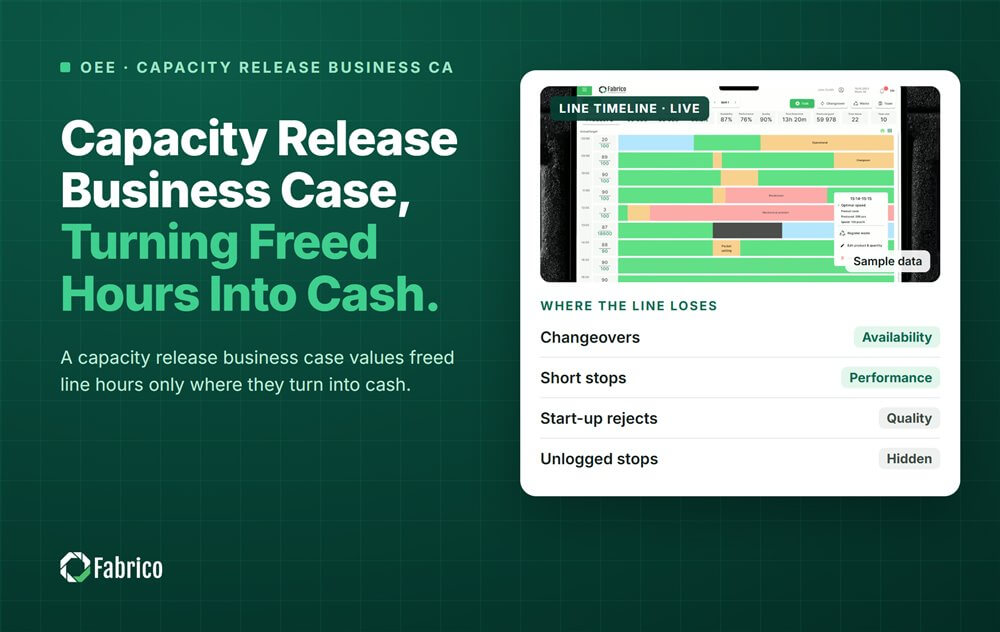
Capacity Release Business Case: Turning Freed Hours Into Cash

Key takeaways
- Freed hours are worth money only if something changes: more sales, less overtime, or an investment you push out.
- Measure the baseline from the machine before you promise anything.
- Value bottleneck hours at throughput, not at a machine-hour rate.
- Robert C. Hansen called the capacity inside your current lines the hidden factory (2001).
- Write the case as conditions and a decision date, not one big headline number.
In the sample below, the same 4 freed hours a week are worth USD 144,000 or USD 691,200 a year. It depends on which condition is true.
Fabrico, OEE and light MES software with AI cameras, logs stops automatically from the machine signal, which gives a business case its baseline. This guide is for CI leads and plant controllers who need to defend an OEE project in front of finance.
What is a capacity release business case?
It is the business case for getting more good output from the lines you already have. Robert C. Hansen's book Overall Equipment Effectiveness, from 2001, calls this spare capacity the "hidden factory". The book also links OEE to net profit for exactly this kind of case.
The case answers three questions. How many hours will we free? What will we do with them? What is that worth? Our guide to the hidden factory covers where those hours usually hide.
When are freed hours actually worth cash?
Freed hours are not money by themselves. They become money through one of three routes:
- Sell more. Only if there are orders for the extra output, and only on the bottleneck.
- Spend less. Drop an overtime or weekend shift, because the plan now fits in normal hours.
- Invest later. Push out a new line or machine, because the old one now makes enough.
If none of the three is true, the freed hours are spare capacity. That is still useful, but it is not a saving yet. Our article on a new line vs recovering capacity looks at the third route in detail.
How do you measure the baseline first?
A business case built on a guessed baseline falls apart in the first review. Measure before you promise.
- Use machine data, not end of shift notes. Manual logs miss short stops, so the baseline looks better than it is.
- Collect at least four weeks, so one bad week does not set the number.
- Lock the definitions: planned time, ideal rate, minor stop cutoff, good count.
- Record the product mix, because the mix will change during the project.
Our guide to OEE baseline measurement has a checklist.
How do you value a freed bottleneck hour?
Use throughput: the selling price minus the truly variable costs, mostly materials, for what the bottleneck makes in one hour. Do not use the machine-hour rate from the cost sheet; our guide to throughput accounting explains why.
For context only: Siemens' True Cost of Downtime 2024 puts one lost hour in a large FMCG plant at USD 36,000. Your own line will have its own number. Use yours, and show how you got it. Our guide to capacity vs throughput explains the difference.
Worked example: what does a capacity release case look like?
Sample line (illustrative numbers, not a customer): a bottling line with the filler as the bottleneck.
- Ideal rate 150 bottles a minute. Throughput USD 0.40 a bottle, so one filler hour is worth USD 3,600.
- Baseline from 4 weeks of machine data: changeovers run long and short stops take about 6 hours a week on the filler.
- The project aims to free 4 hours a week on the filler. The plant works 48 weeks a year.
| Route | Condition that must be true | Sample value per year |
|---|---|---|
| Sell more | Orders exist for 36,000 more bottles a week | 4 h x USD 3,600 x 48 = USD 691,200 |
| Spend less | Demand stays flat, so a 4 hour Saturday overtime run at USD 3,200 can go | USD 3,200 x 48 = USD 153,600 |
| Invest later | A planned second filler costing USD 1.8 million moves out by one year | Cost of capital at 8% = USD 144,000 |
Look at the spread. The same 4 hours are worth USD 144,000 or USD 691,200, depending on which condition is true. A good case shows all three, says which one the plant expects, and names the person who confirms it. Sales confirms orders. Planning confirms the overtime run. Finance confirms the investment plan.
Why should the case avoid promising one big number?
Because a promised number becomes the only thing anyone remembers. If the result lands lower for a reason outside the project, the whole programme loses trust.
McKinsey's 2018 survey found that less than a third of manufacturers had moved digital programmes from pilot to scale. It called this "pilot purgatory". Cases that promise a big number, with no decision date, are one way to end up there.
Write it this way instead:
- The baseline, measured from the machine, with the dates.
- The loss the project targets, in hours on the bottleneck.
- The value under each route, with its condition and its owner.
- A decision date: continue, change course, or stop.
What does finance want to see in the case?
- A method they agreed before the project, not after.
- Throughput per bottleneck hour, with the inputs shown.
- Only one route counted in the total, the one the plant expects.
- How the saving will be checked after the project, on the same definitions.
The OEE business case guide has a template you can adapt.
Where does Fabrico fit?
Fabrico is a computer vision enabled Manufacturing Performance Platform. It logs stops automatically from the machine signal, prices each loss in money and ranks the losses by what they cost. That gives the case a baseline from the machine, not from memory.
Devices are connected in about one month, and a full rollout takes 3 to 4 months. Most plants start with a pilot on one line, often the line the case is about.
There is no free plan and there are no tiers: each plant gets a quote.
Frequently asked questions
Is freed capacity a saving?
Not by itself. A capacity release business case values the line hours an improvement frees up. It counts money only where those hours become cash. That means more sales on the bottleneck, an overtime shift that can go, or an investment that moves out. If none of these is true, the hours are spare capacity, not a saving.
How do you put a value on freed capacity?
Value a freed bottleneck hour at throughput: selling price minus truly variable costs, for what the bottleneck makes in an hour. Then apply it only to the route that will really happen. Freed hours on machines that are not the bottleneck rarely add output.
Why not use the machine-hour rate?
A machine-hour rate spreads depreciation and overhead over running hours. You pay those costs whether the line runs or not, so they do not change when hours are freed. Using that rate makes most cases look wrong, either too small on the bottleneck or too large elsewhere.
How long should the baseline be?
At least four weeks of machine data on the same definitions you will use after the project. Shorter baselines swing with one bad week. Record the product mix too. A mix change during the project can look like a gain or a loss that has nothing to do with the work.
Should the business case include one headline figure?
Show the value under each route with its condition, and count only the route the plant expects. Avoid one headline number with no conditions. Add a decision date, so the project ends in a clear choice to continue, change course or stop.
Build your case on machine data
Bring one line and the project you want to fund. We will show the baseline the machine data gives and where the freed hours would come from.
Latest from our blog


Real Fabrico tiles, sample data.