







 Login
 Blog
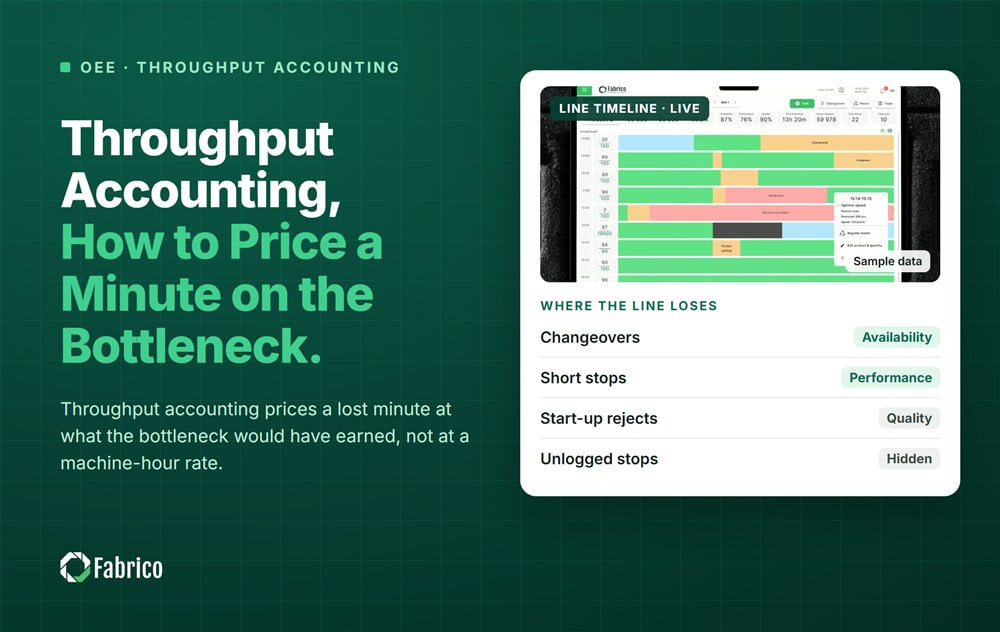
Throughput Accounting: How to Price a Minute on the Bottleneck

Key takeaways
- In throughput accounting, net profit = throughput minus operating expense. It does not spread all costs over products.
- A minute lost on the bottleneck is a minute lost for the whole plant.
- Price a stop at the throughput the bottleneck would have earned, not at a machine-hour rate with depreciation.
- A minute saved on a machine that waits anyway is worth almost nothing.
- Goldratt's steps: identify the constraint, exploit it, subordinate the rest, raise its capacity, then start again.
In the sample below, the same 45 minutes of filler jams cost USD 135 at the machine-hour rate and USD 4,500 at throughput.
Fabrico is OEE and light MES software with AI cameras that prices every loss in money and ranks the losses by what they cost. This guide shows how to price a bottleneck minute and why the usual cost rate gets it wrong. It also shows how to use that price to rank OEE losses.
What is throughput accounting?
Throughput accounting comes from Eliyahu Goldratt's Theory of Constraints, made famous by his book The Goal in 1984. It uses three measures:
- Throughput: sales revenue minus the truly variable costs, mostly materials.
- Operating expense: everything else it costs to run the plant, including wages and overhead.
- Investment: the money tied up in the plant, stock and equipment.
Then net profit = throughput minus operating expense. The key difference from cost accounting: it does not allocate all costs to products. Wages and overhead are paid whether the line runs or not.
Why does a bottleneck minute cost more than other minutes?
Because the bottleneck sets the output of the whole line. In drum-buffer-rope terms, the constraint is the drum that sets the beat. Every other machine has spare capacity.
- A minute lost on the bottleneck is product that is never made. It cannot be won back later in the shift.
- A minute lost on a machine with spare capacity, protected by a buffer, often costs nothing. The bottleneck kept running.
So the first question about any stop is simple. Did it reach the bottleneck? Our guide to finding the real constraint on linked packaging lines shows how to tell.
Why is a machine-hour rate the wrong price for a stop?
A machine-hour rate spreads depreciation, overhead and labour over the hours a machine runs. It is useful for quoting a product. It is wrong for pricing a stop, for two reasons:
- It understates the bottleneck. The lost sales from a stopped bottleneck are far larger than its share of overhead.
- It overstates the other machines. A stop on a machine with spare capacity gets a cost, even when no sale was lost.
The rule from throughput accounting is simple: price a stop at contribution margin per constraint hour, never at a machine-hour rate with depreciation.
Worked example: how do you price one bottleneck minute?
Sample line (illustrative numbers, not a customer): a bottling line where the filler is the bottleneck.
- Selling price USD 1.20 a bottle. Truly variable cost (bottle, cap, label, liquid) USD 0.70. Throughput USD 0.50 a bottle.
- The filler's ideal rate is 200 bottles a minute, so one filler minute is worth USD 100 of throughput.
- The finance team's machine-hour rate for the filler is USD 180 an hour, or USD 3 a minute.
- The plant is sold out, so every bottle not made is a lost sale.
| Stop | Minutes | Reached the filler? | Priced at machine-hour rate | Priced at throughput |
|---|---|---|---|---|
| Filler jams, one shift | 45 | Yes, it is the filler | USD 135 | USD 4,500 |
| Labeller stop, buffer absorbed it | 3 | No | USD 9 | USD 0 |
| Labeller stop longer than the buffer | 12 | Yes, 8 minutes of it | USD 36 | USD 800 |
The machine-hour rate says the filler jams cost USD 135. Throughput accounting says USD 4,500, more than 30 times as much. It also says the short labeller stop cost nothing, because the buffer kept the filler running.
Now the ranking of losses changes. The filler jams go to the top, and the CI team stops chasing labeller stops that never reached the filler.
When is a non-bottleneck stop still expensive?
- When it outlasts the buffer. If the stop lasts longer than the buffer can cover, the bottleneck starves or gets blocked. Little's law tells you how long a buffer lasts. Say the table between filler and labeller has room for 800 bottles, and the filler makes 200 a minute. Then it absorbs 4 minutes of a labeller stop. That is why the 12 minute stop cost the filler 8 minutes. See our guide to Little's law.
- When scrap happens after the bottleneck. A bottle rejected at the end used bottleneck time that is now lost.
- When the non-bottleneck becomes the bottleneck. Product mix changes can move the constraint. Check it again when the mix shifts.
How do you use throughput accounting in OEE work?
- Find the constraint machine on each line.
- Work out throughput per minute on the constraint, per product.
- Price each stop that reached the constraint at that rate.
- Rank the losses by money, and fix the top one first.
- When the constraint moves, start again.
OEE on the constraint is the number that matters most. Our article on OEE vs throughput explains why a higher OEE on another machine may not add a single unit of output.
What does throughput accounting not tell you?
It assumes you can sell what the bottleneck makes. If demand is the limit, a saved minute is spare capacity, not cash. In that case the value comes later: fewer overtime shifts, a capacity investment you do not need, or room for a new product. Our guide on capacity vs throughput covers the difference.
Where does Fabrico fit?
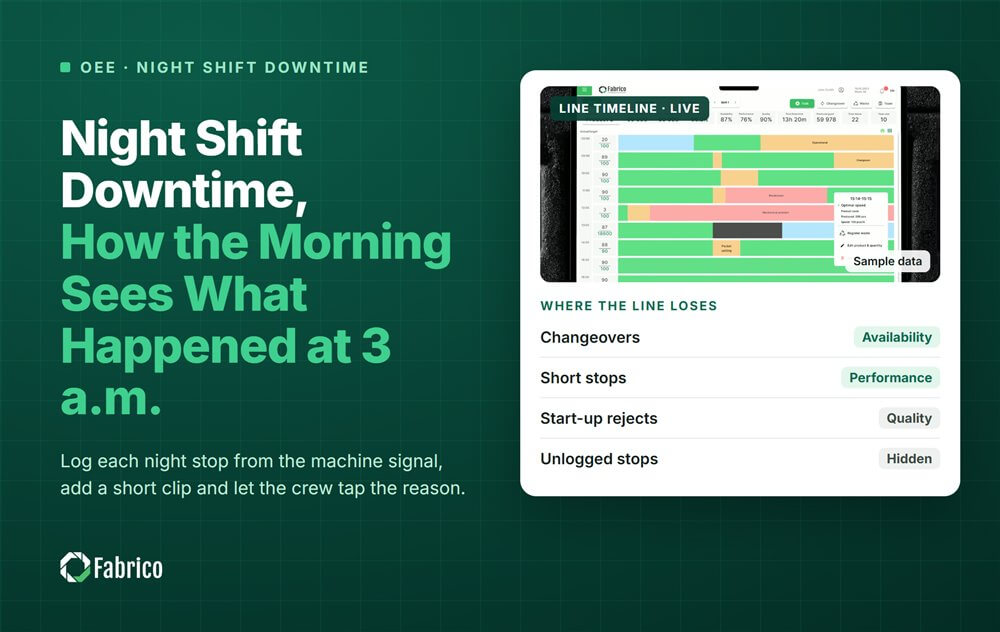
Fabrico is a computer vision enabled Manufacturing Performance Platform. It logs stops automatically from the machine signal, prices each loss in money and ranks the losses by what they cost, by line and shift.
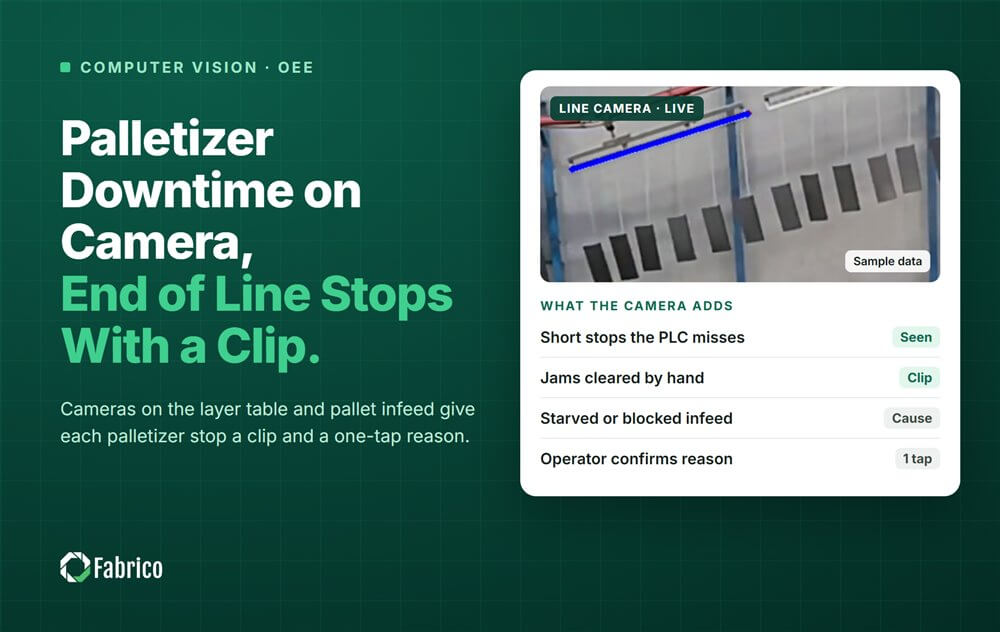
The operator confirms the reason in one tap, and where a camera is fitted, a clip is kept as evidence for the stop. Start with a pilot on the line with the most valuable bottleneck.
There is no free plan and there are no tiers: each plant gets a quote.
Frequently asked questions
What is throughput accounting in simple words?
Throughput accounting measures a plant by the money it makes from sales minus the truly variable costs, mostly materials. Wages and overhead are treated as fixed. It comes from Goldratt's Theory of Constraints and focuses improvement on the bottleneck, because the bottleneck sets the output of the whole plant.
How do you calculate throughput per bottleneck minute?
Take the selling price per unit and subtract the truly variable cost per unit. Multiply by the units the bottleneck makes in one minute at its ideal rate. If throughput is USD 0.50 a unit and the bottleneck makes 200 units a minute, one minute is worth USD 100.
Why not use the standard machine-hour rate for downtime cost?
A machine-hour rate spreads depreciation and overhead over running hours. It understates a stopped bottleneck, which loses sales. It overstates stops on machines with spare capacity, which often lose nothing. Price stops at throughput per constraint minute instead. Keep the machine-hour rate for quoting products, not for ranking stops.
Does a stop on a non-bottleneck machine cost anything?
Only if it reaches the bottleneck. A stop that the buffer absorbs costs no output. A stop that lasts longer than the buffer starves or blocks the bottleneck, and those minutes cost the full throughput rate. Scrap made after the bottleneck also costs bottleneck time.
What is the difference between throughput accounting and cost accounting?
Cost accounting allocates all costs to products to find a product cost. Throughput accounting does not allocate fixed costs. It asks how a decision changes throughput, operating expense and investment. For pricing stops, it gives a far more realistic answer, especially on the bottleneck.
Price your bottleneck minute
Bring one line, its product prices and last week's stops. We will show which losses reached the bottleneck and what they cost.
Related articles




Real Fabrico tiles, sample data.