


 Login
 Blog
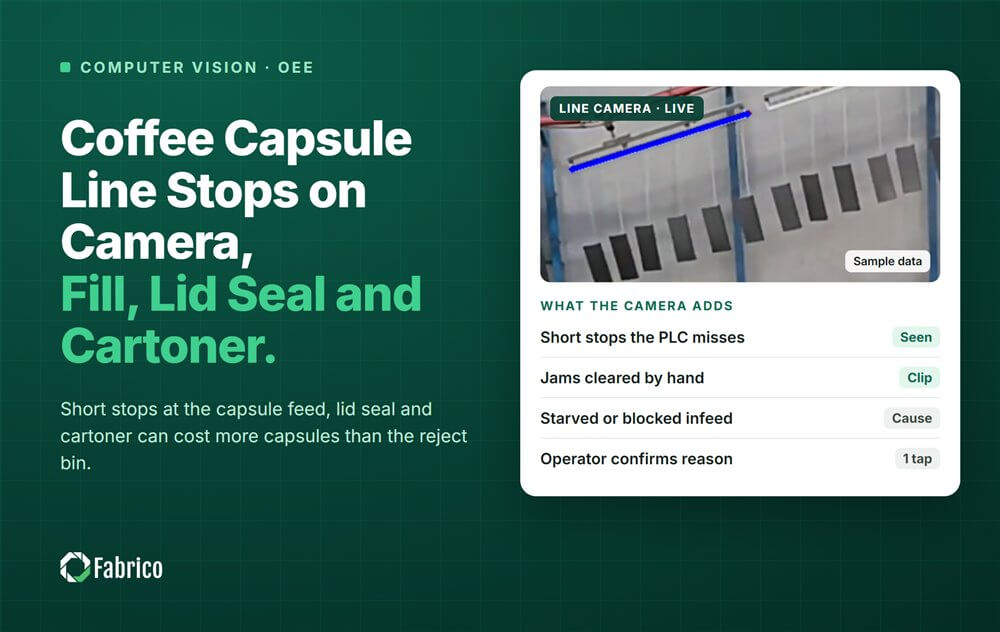
Coffee Capsule Line Stops on Camera: Fill, Lid Seal and Cartoner

Key takeaways
- At capsule line speed, a few seconds of stop costs dozens of capsules. Most stops start at the capsule feed, the lid seal and the cartoner infeed.
- A reject costs one capsule. A stop costs the capsules the line did not make, and it is rarely on screen.
- Cameras on the capsule feed and the cartoner infeed mark each stop and keep a short clip. The operator confirms the reason in one tap.
- On a sample shift, short stops lost 8,640 capsules, 3.6 times the reject bin.
On a coffee capsule line, the stops that cost the most are the short ones. Each lasts seconds and rarely reaches a log, but at hundreds of capsules a minute the seconds add up. A camera on the capsule feed and on the cartoner infeed gives each one a clip.
Fabrico is OEE (overall equipment effectiveness) and light MES (manufacturing execution system) software, and in Fabrico, cameras are an add-on. Each camera event joins the filler's timeline with a clip and a reason the operator confirms in one tap. The OEE method itself is in our guide to OEE for coffee capsule lines.
Why do short stops cost so much on a capsule line?
Speed and size. The filler on the sample line below makes 360 capsules a minute, or 6 a second, so an 8 second jam costs 48 capsules. And an empty capsule weighs a few grams: static, a dented rim or cups that nest too tightly can stop the feed.
The operator clears it in seconds and restarts. Nobody writes it down, and the plant's logging cutoff, often two to five minutes, books it as slow running. Our guide to a weekly micro stop video review shows how to work through them.
What is the difference between a reject and a stop?
A reject is a capsule the line made and threw out. A stop is time when the line made nothing. Both cost money, in different parts of OEE.
| Loss | Reject | Stop |
|---|---|---|
| What happens | The inspection ejects a light or badly sealed capsule | The filler or cartoner stands still |
| What it costs | One capsule and its contents | The capsules not made |
| OEE factor | Quality | Availability, or Performance if short |
| What a camera adds | Little: inspection counts it | A clip of the moment before |
The two are linked. A run of rejects on one lane often comes before a stop, and some fillers stop after several rejects in a row.
Where do the short stops start on a capsule line?
| Station | Typical short stop | What the clip shows |
|---|---|---|
| Capsule feed | Double capsule, capsule not seated, cups stuck in the stack | Two cups in one pocket, a cup sitting high, a stack that did not drop |
| Dosing and tamping | Lane fault, coffee build-up, low hopper | Little from outside: the PLC alarm and the weights tell more |
| Lid seal | Lid missed, lid off centre, seal fault | On the feed clip: whether the capsule arrived seated |
| Cartoner infeed | Wrong count, tipped capsule, magazine empty, carton not opened | A tipped capsule in a lane, a short stack, an empty magazine |
Lid seal faults
The sealing station raises its own alarms, but a lid seal fault does not always start at the sealing head. A capsule sitting high in its pocket, or coffee on the rim, can cause it. The feed clip from the same moment shows whether the capsule arrived seated.
The cartoner and its many small cartons
Capsules go into small cartons, often ten or more to a box, so the carton magazine empties often. The lanes in front of the cartoner absorb its short stops. Long ones block the filler. Our cartoner OEE guide covers carton feed jams.
Where should the cameras point on a capsule line?
- Over the capsule feed: the stack and the carrier pockets. This view shows double cups, cups sitting high and stacks that did not drop.
- Over the cartoner infeed: the lanes, the stacking point and the magazine. This view shows tipped capsules, short stacks and an empty magazine.
Capsules are small and shiny. Light the view evenly, keep one capsule clearly visible, and watch for glare off foil lids.
How does a capsule line stop get a clip and a reason?
- The stop is marked. The filler or cartoner signal, or the camera, marks its start and end.
- The clip is attached to the stop as evidence.
- The screen suggests a reason, such as double capsule or magazine empty.
- The operator confirms in one tap, or picks another reason.
- The stop joins the OEE timeline with its seconds, its capsules and its cost.
Keep the reason list short. At this speed the operator has seconds to tap, not minutes to type.
Worked example: what do short stops cost a sample capsule line?
Sample line (illustrative numbers, not a customer): a 10-lane capsule filler at 36 cycles a minute makes 360 capsules a minute, or 6 a second. It feeds a cartoner that packs 10 capsules a carton, through lanes that hold 30 seconds of capsules. The line runs 450 planned minutes a shift and 750 shifts a year.
The filler PLC logged one long stop, a 20 minute dosing fault, and the inspection counted 2,400 rejects. The clips, confirmed by the operator, added the short stops:
| What the clip showed | Stops | Seconds each | Filler minutes lost | Capsules lost |
|---|---|---|---|---|
| Feed: double capsule or capsule not seated | 60 | 8 | 8 | 2,880 |
| Feed: cups stuck in the stack | 24 | 15 | 6 | 2,160 |
| Lid seal stop | 30 | 12 | 6 | 2,160 |
| Cartoner: wrong count or tipped capsule | 40 | 10 | 0 | 0 |
| Cartoner: magazine empty or carton not opened | 12 | 50 | 4 | 1,440 |
| Total | 166 | 24 | 8,640 |
- Capsules lost = filler seconds lost x 6 capsules a second.
- The 40 short cartoner stops ended inside the 30 second buffer. Each 50 second magazine stop outlasted it by 20 seconds: 12 x 20 seconds = 4 filler minutes.
- The capsule feed alone lost 2,880 + 2,160 = 5,040 capsules, and 18 of the 30 lid seal stops began with a capsule sitting high.
- Short stops took 24 filler minutes, more than the 20 minute dosing fault, and lost 8,640 capsules: 3.6 times the 2,400 rejects.
- At a contribution of $0.04 a capsule (or €0.04 in a euro plant): short stops $345.60 a shift, rejects $96.00.
- Over 750 shifts a year: short stops $259,200 (€259,200), rejects $72,000.
The "lid seal fault" code would have sent a technician to the sealing head. The clips sent most of the problem back to the feed, where one batch of cups nested too tightly.
That money counts only if the line is sold out or the lost capsules cost overtime to make up. Agree that rule with your controller first.
What can a camera on a capsule line not see?
- Inside the dosing unit. Build-up and dose weight come from the PLC and the weights.
- Seal quality. It does not test a seal or measure residual oxygen.
- Each capsule. It is not an inspection camera. It marks stops and keeps clips.
- Outside its view. Two cameras cover two stations, not the whole line.
- The cause on its own. It suggests, and the operator confirms.
How do you keep the cameras on the capsules, not the crew?
Point the views at the pockets, the lanes and the magazine, not at people. Report OEE by line and shift, never by named operator. The clip defends the crew: it shows a bad batch of cups, not a slow person.
In Germany, the works council co-determines any camera that could monitor performance. Our works council approval guide covers the steps.
Where Fabrico fits
Fabrico is a computer vision enabled Manufacturing Performance Platform. OEE and light MES come first, and cameras are an add-on.
- Automatic downtime logging at the filler and the cartoner, down to the short stops.
- A camera clip as evidence for a stop, from the capsule feed or the cartoner infeed.
- The operator confirms the reason in one tap, so a double capsule and an empty magazine get different codes.
- Losses priced in money and ranked, so short stops and rejects compare in one currency.
- OEE live by line and shift, one view across plants, and a work order with its cost when a stop is a breakdown.
ABB, a Fabrico customer, reports 20% less downtime.
You start with a pilot on one line, with a baseline and a decision date agreed in advance. Devices are connected in about a month, and the full rollout takes 3 to 4 months. There is no free plan and there are no tiers: each plant gets a quote.
See the computer vision OEE and MES page, or our guide to starvation and blocking.
Frequently asked questions
Why does a coffee capsule machine stop so often?
It handles small, light parts at high speed. Nested cups, static, a capsule that does not seat, a missed lid and an empty carton magazine each stop the line for seconds. Code each one apart, so the Pareto shows which one costs the most capsules.
Is a rejected capsule a stop?
No. A reject is a capsule made and thrown out, a Quality loss. A stop is time when the line made nothing, an Availability or Performance loss. Track both side by side. A run of rejects on one lane is often the warning that a stop is coming.
Where should the first camera go on a capsule line?
Over the capsule feed, where the cups drop into the carrier, because that is where most short stops start. Add the cartoner infeed next if the cartoner's stops block the filler. Check the view for glare off the lids before you trust the clips.
Does the camera inspect each capsule?
No. That is the inspection system's job: weight, lid position and seal checks. The OEE camera marks stops and keeps a short clip of each one. The two jobs work side by side, and the reject counts feed the Quality part of OEE.
See your capsule line's short stops in a demo
Bring one capsule line and a week of its stop and reject data. We will show where the short stops start and what each one costs.
Latest from our blog


Real Fabrico tiles, sample data.