


 Login
 Blog
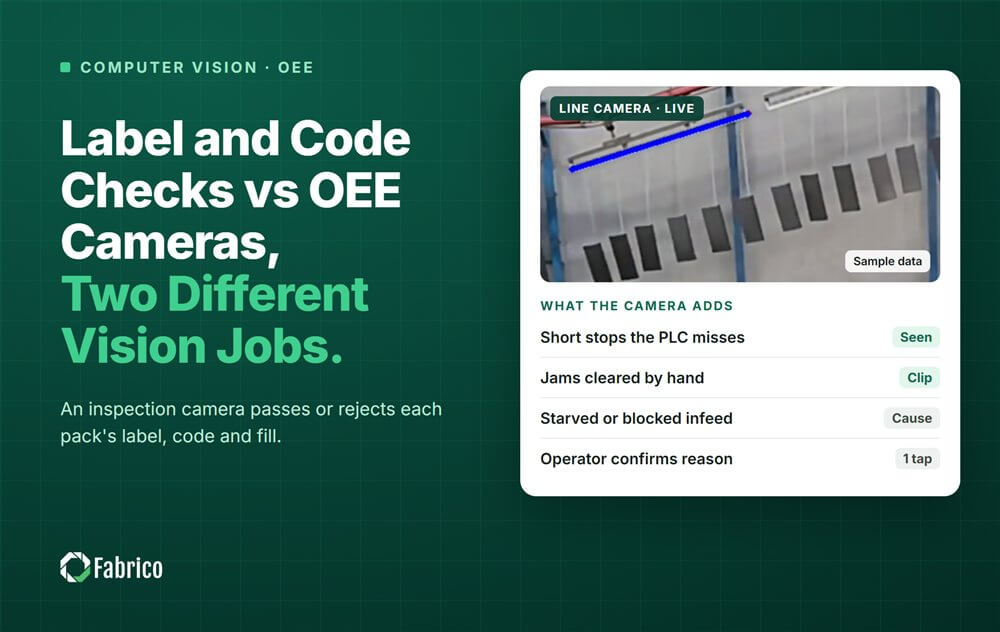
Label and Code Checks vs OEE Cameras: Two Different Vision Jobs

Key takeaways
- An inspection camera checks each pack at one point: label, date code, barcode, cap and fill. A reject gate pushes bad packs off the line.
- An OEE camera counts output, records stops and keeps a clip of each stop.
- The jobs need a different view, light and timing, so one camera rarely does both well.
- Inspection rejects belong in the OEE Quality rate. A line stop caused by rejects belongs in Availability.
- On the sample labelling line below, label stops cost $720 a shift and label rejects $180.
A label and code inspection camera and an OEE (overall equipment effectiveness) camera do two different jobs. The inspection camera decides, pack by pack, whether each one is fit to ship. The OEE camera marks each stop and how long it lasted, keeps a short clip and counts what the line made; the operator confirms the reason in one tap.
Fabrico is OEE and light MES (manufacturing execution system) software, with AI cameras as an add-on. Its cameras count output, record stops and keep a short clip of each stop. The operator confirms the reason in one tap. Checking each label and code stays the job of the inspection system on your line.
What does a label and code inspection camera do?
An inline inspection camera sits at one fixed point, usually right after the labeller or the coder. A sensor tells it when each pack arrives. It takes one sharp picture under its own light and gives a pass or a fail.
Typical checks:
- Label: present, straight and the right one.
- Date and lot code: printed, readable, the right date.
- Barcode: readable, and on some lines graded for print quality.
- Cap and fill: cap present and seated, fill level inside the limits.
A fail fires a reject gate: a pusher or an air jet moves the pack into a bin. Many lines also stop after a few rejects in a row. Then a bad label reel cannot fill the bin.
This is a quality job, usually owned by the quality team. A miss means a bad pack reaches a customer. For when to check every pack and when to sample, see inline vs offline inspection.
What does an OEE camera do?
An OEE camera watches a wider scene over time: an infeed, an accumulation table or an outfeed. It does not judge single packs. It asks whether product is moving and how many units passed.
- It counts output at the point it watches.
- It records stops with a start and an end, even short ones.
- It keeps a short clip of each stop: a web break, a fallen bottle, an empty infeed.
The camera suggests what happened, the operator confirms it in one tap, and the clip stays as evidence. Where the PLC (programmable logic controller) signal is good, it stays the clock. See our comparison of computer vision and PLC data for OEE.
How do the two vision jobs compare?
| Point | Label and code inspection | OEE camera |
|---|---|---|
| Question it answers | Is this pack fit to ship? | When and why did the line stop? |
| Where it looks | One pack, close up, at one fixed point | A stretch of conveyor or a machine zone |
| Light | Its own lamp, shielded and steady | The plant's own light, in a stable range |
| Timing | A decision on every pack | Events over minutes and hours |
| Output | Pass or fail, a reject signal, a reject count | Stops, counts, a clip of each stop |
| Cost of a miss | A bad pack reaches a customer | A stop is missing from the loss data |
| Usual owner | Quality | Production and continuous improvement |
| Where it lands in OEE | Quality, through the reject count | Availability and Performance, through stops and counts |
Why can one camera rarely do both jobs well?
Because the two jobs pull the camera in opposite directions.
- View. Reading a small date code at line speed needs a tight view of one pack. Seeing a jam needs a view of several meters.
- Light. Inspection brings its own shielded light. An OEE camera works in the plant's light.
- Timing. Inspection judges every pack and fires the gate on time. Stop recording works over minutes.
- What a mistake costs. An inspection miss can mean a recall, so it rejects when in doubt. An OEE camera can live with a false alarm: the clip shows it in seconds.
Each has a blind spot. The inspection camera cannot see the web break two meters back. The OEE camera sees the stop, but cannot read a code.
So run two systems with two owners, and join their numbers in one place.
How do inspection rejects feed the OEE Quality rate?
Quality in OEE is good count divided by total count, and good = total minus rejects. The inspection system gives you the rejects, from its own counter, a PLC tag or the reject bin.
- Count at one point. Total and good at the same place, ideally the inspection camera.
- Relabelled packs are not good. They were not right the first time.
- Book the stop and the rejects apart. When rejects stop the line, the minutes are Availability loss. The packs are Quality loss.
- Give each reject type its own reason. A missing label and an unreadable code have different owners.
Then read both side by side. When label rejects and stops rise in the same hour, they often share a cause: a bad reel, glue or a coder low on ink. See our OEE calculation guide and our labeller OEE guide.
Worked example: what do label stops and label rejects cost on a sample line?
Sample line (illustrative numbers, not a customer): a sauce bottling line at 240 bottles a minute. The labeller, coder and inspection camera sit right after the filler with almost no buffer. So every labeller stop stops the line. The line is sold out.
Each bottle carries a contribution of $0.10 (or €0.10 in a euro plant). A rejected bottle costs $0.25: $0.10 of lost contribution plus $0.15 of sauce and pack. In one shift, 96,000 bottles pass the inspection camera.
| Label loss | Recorded by | Size | OEE factor | Cost a shift |
|---|---|---|---|---|
| Web breaks and reel splices, 9 stops | OEE camera and PLC | 18 minutes | Availability | $432 |
| Glue and label pick faults, 12 stops of 30 seconds | OEE camera | 6 minutes | Performance (short stops) | $144 |
| Line stopped after 3 unreadable codes in a row, 4 stops | Inspection alarm, timed as a stop | 6 minutes | Availability | $144 |
| Missing or skewed labels rejected | Inspection camera | 480 bottles | Quality | $120 |
| Unreadable date codes rejected | Inspection camera | 240 bottles | Quality | $60 |
| Total | 30 minutes, 720 bottles | $900 |
- Stops: 30 minutes x 240 bottles = 7,200 bottles not made. At $0.10 each: $720 a shift.
- Rejects: 720 bottles x $0.25 = $180 a shift.
- Quality = (96,000 minus 720) / 96,000 = 95,280 / 96,000 = 99.25%. On its own, that looks fine.
- Over 500 shifts a year (2 shifts, 250 days): $900 x 500 = $450,000 a year, or €450,000.
Two lessons. The stops cost four times as much as the rejects, and only the stop log shows them. And the coder shows up in both systems: 240 code rejects ($60) and 4 stops ($144), $204 a shift from one machine.
That $450,000 is cash only if the line is sold out or the lost bottles cost overtime. Agree that rule with your controller first.
What mistakes do plants make with the two cameras?
- Expecting the inspection camera to explain line stops.
- Pointing an OEE camera at labels and hoping it reads codes.
- Leaving the reject count out of OEE, so Quality reads close to perfect.
- Booking a stop caused by rejects with no minutes, so the Availability loss disappears.
- Ranking label losses by count instead of by money.
Where Fabrico fits
Fabrico is a computer vision enabled Manufacturing Performance Platform. It runs with OEE and light MES first. On a labelling line it covers the loss side: stops, counts and cost.
- Automatic downtime logging, down to short stops.
- A camera clip as evidence for a stop, where a camera watches the line.
- The operator confirms the reason in one tap.
- Every loss priced in money and losses ranked by money.
- OEE live by line and shift.
Keep your inspection system for labels and codes. Point cameras at the process, not at people: see line cameras without surveillance.
You start with a pilot on one line, with a baseline and a decision date agreed in advance. There is no free plan and there are no tiers: each plant gets a quote. See the computer vision OEE and MES page.
Frequently asked questions
Can an OEE camera check labels?
Not well. Checking a label or a date code needs a close view of each pack, its own light and a fast decision. An OEE camera watches a wider area to record stops and counts. Use an inspection system for labels and codes, and feed its rejects into OEE.
Can an inspection camera give me OEE?
Only part of it. Its reject count gives you the Quality rate, and some systems also count every pack. It cannot see why the line stopped upstream or downstream. Availability and Performance need the PLC, sensors or an OEE camera.
Where do inspection rejects go in OEE?
Into Quality. Good count is total count minus rejects, at one counting point. If a run of rejects stops the line, the stopped minutes go into Availability. Give each reject type its own reason, so the fix goes to the right team.
Do I need both cameras on a labelling line?
If you ship labelled or coded packs, you need inspection on each pack. You also need loss data, and that can come from the PLC, sensors or an OEE camera. Many lines start with the PLC and add a camera where the stop log only says "stopped".
See your label losses in a demo
Bring one labelling line, its stop log and its reject counts. We will show which label losses cost the most.
Latest from our blog
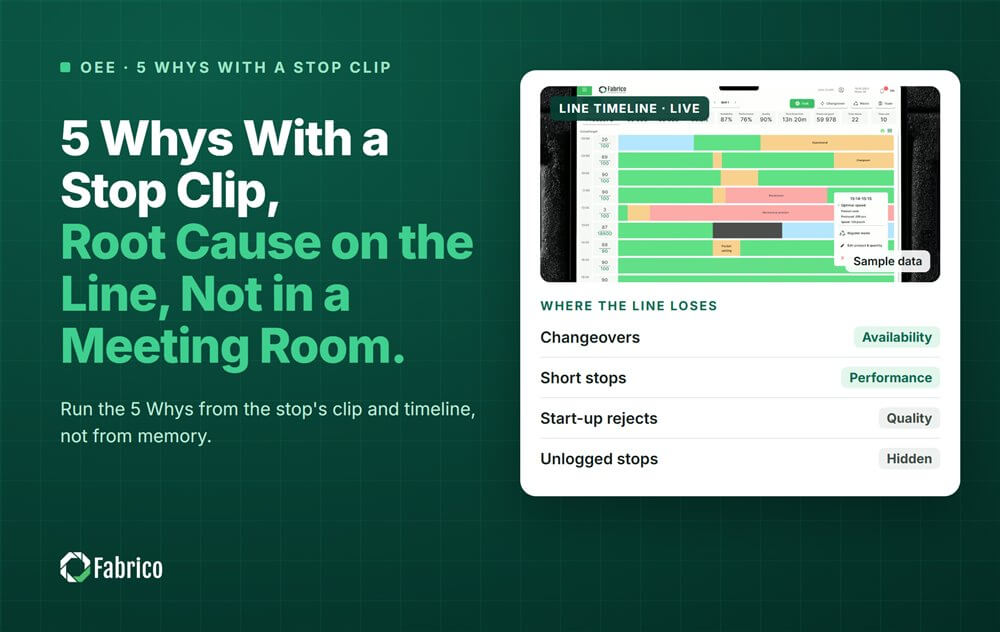


Real Fabrico tiles, sample data.